8,430  PAGES BROWSED TODAY PAGES TODAY 36  ANTIQUES UPLOADED TODAY NEW ARRIVALS
ID #SA534620
FOR SALE
£2,750
Email
Save
Benjamin Marshall, 1768 - 1835 A Sportsman Walking Up Grouse, with His Double Barreled, Flint Lock Shot Gun
Artware Fineart
for sale €3,218     $3,493
£2,750

Artware Fineart

Sellingantiques Verified Since Sep 2008
View Dealers Stock Page
Relevant Links
Id #SA534620
PDF SHARE
SAVE

Benjamin Marshall, 1768 - 1835 A Sportsman Walking Up Grouse, with His Double Barreled, Flint Lock Shot Gun

19th century
For Sale by Artware Fineart
Description

Benjamin Marshall, 1768 - 1835

A Sportsman Walking up Grouse, with his Double Barreled, Percussion Shot Gun

oil on canvas

21 x 16 in. (54 x 41 cm.)

Thomas Page’s The Art of Shooting Flying Explained of 1767 (a longer and more technical work than those of Blome and Markland) recommended 32in for early season work and, for “after Michaelmas, the birds by that time… grown so shy, that your shoots must be at longer distances”, 39in, adding, “if you intend one gun to serve for all purposes… a three feet barrel or thereabouts” would be ad-visable. Such guns anticipated the range and killing power of a modern shotgun, Markland recommending Full forty Yards permit the Bird to go/The spreading Gun will surer Mischief show.

While the flintlock and trigger-to-bang time continually improved, the next major innovation was the addition of a second barrel. The earliest examples of guns with barrels held together by soldering rather than the stock were French side-by-sides of the 1730s. However, these were slow to catch on in England, the Shooting Directory of 1804 dep-recating their usefulness and equating their French origin with “a great many other foolish things”. Nevertheless, the great English gunmakers Ezekiel Baker, Henry Nock and the Mantons were already producing superb examples, which, with the formerly full-length stock (as long as the barrels) reduced to a “half-stock” (resembling a fore-end), looked much like modern guns.

Rapidity of fire increased with the application of percussion ignition early in the 19th century, especially with the perfected percussion cap of about 1830. However, it was the introduction of a fully functional hinged breech in the 1830s and then of cartridges containing primer, propellant and projectile – and reliable firing pins – that saw the birth of the modern shotgun.

A top hat, beaver hat, high hat, silk hat, cylinder hat, chimney pot hat or stove pipe hat,sometimes also known by the nickname "topper", is a tall, flat-crowned, broad-brimmed hat, worn by men from the latter part of the 18th to the middle of the 20th century. The first silk top hat in England is credited to George Dunnage, a hatter from Middlesex, in 1793. The invention of the top hat is often erroneously credited to a haberdasher named John Hetherington. Within 30 years top hats had become popular with all social classes, with even workmen wearing them. At that time those worn by members of the upper classes were usually made of felted beaver fur; the generic name "stuff hat" was applied to hats made from various non-fur felts. The hats became part of the uniforms worn by policemen and postmen (to give them the appearance of authority); since these people spent most of their time outdoors, their hats were topped with black oilcloth. The Top hat was usually black but the sporting varities were grey, brown and white.

Artist Biography

Benjamin Marshall, (1768–1835), painter and racing journalist, was born on 8 November 1768 at Seagrave, Leicestershire, the only surviving son of eight children born to Charles Marshall and his wife, Elizabeth (d. 1772). Benjamin Marshall married Mary Saunders (d. 1827) of Ratby on 12 November 1789 and is recorded as being a schoolmaster in the will of his brother-in-law, dated 1791. However, he must have already shown a talent for portraiture for in the same year, on the recommendation of William Pochin of Barkby Hall, MP for the county, he was apprenticed to the portrait painter Lemuel Francis Abbott.

It is said that Ben Marshall (as he was known) was so impressed by Sawrey Gilpin'slife-size painting Death of a Fox, exhibited at the Royal Academy in 1793, that he decided to change from portraiture to sporting subjects (Sporting Magazine, Aug 1835, 298). By 1795 the Marshalls were living in London at Beaumont Street, Marylebone, their elder son, Charles, having been born the previous year. Soon after their arrival Marshall met William Taplin, the author of The Gentleman's Stable Directo

Physical Dimensions
Height
54cm (21.26")
Width
42cm (16.54")
Depth
3cm (1.18")
Declaration

Artware Fineart has dated this Georgian Sporting Oil Painting to the 19th Century.

Reference Numbers
Sellingantiques Reference
SA534620
Dealers Internal Reference
3980
Description
Benjamin Marshall, 1768 - 1835

A Sportsman Walking up Grouse, with his Double Barreled, Percussion Shot Gun

oil on canvas

21 x 16 in. (54 x 41 cm.)

Thomas Page’s The Art of Shooting Flying Explained of 1767 (a longer and more technical work than those of Blome and Markland) recommended 32in for early season work and, for “after Michaelmas, the birds by that time… grown so shy, that your shoots must be at longer distances”, 39in, adding, “if you intend one gun to serve for all purposes… a three feet barrel or thereabouts” would be ad-visable.
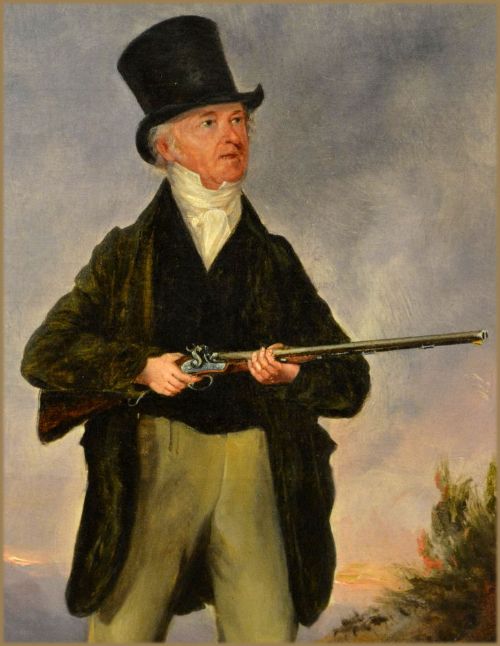
Such guns anticipated the range and killing power of a modern shotgun, Markland recommending Full forty Yards permit the Bird to go/The spreading Gun will surer Mischief show.
Artware Fineart
fig 1. An antique oil painting depicting a gentleman standing in a highland landscape, wearing a top hat and frock coat while holding a flintlock shotgun.
fig 1. Benjamin Marshall, 1768 - 1835 A Sportsman Walking Up Grouse, with His Double Barreled, Flint Lock Shot Gun

While the flintlock and trigger-to-bang time continually improved, the next major innovation was the addition of a second barrel. The earliest examples of guns with barrels held together by soldering rather than the stock were French side-by-sides of the 1730s. However, these were slow to catch on in England, the Shooting Directory of 1804 dep-recating their usefulness and equating their French origin with “a great many other foolish things”. Nevertheless, the great English gunmakers Ezekiel Baker, Henry Nock and the Mantons were already producing superb examples, which, with the formerly full-length stock (as long as the barrels) reduced to a “half-stock” (resembling a fore-end), looked much like modern guns.
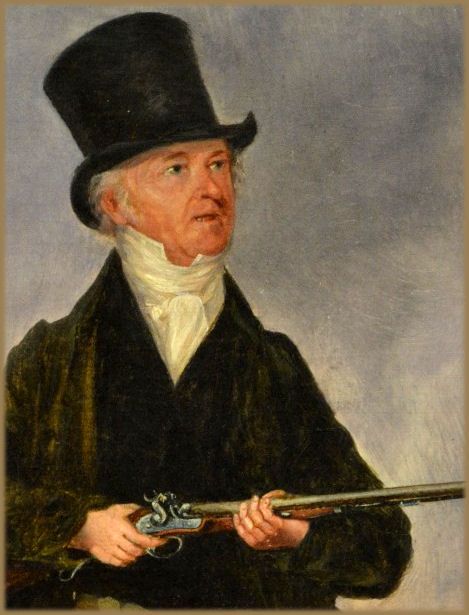
fig 2. An antique oil painting depicting a gentleman standing in a highland landscape, wearing a top hat and frock coat while holding a flintlock shotgun.
fig 2. Benjamin Marshall, 1768 - 1835 A Sportsman Walking Up Grouse, with His Double Barreled, Flint Lock Shot Gun

Rapidity of fire increased with the application of percussion ignition early in the 19th century, especially with the perfected percussion cap of about 1830. However, it was the introduction of a fully functional hinged breech in the 1830s and then of cartridges containing primer, propellant and projectile – and reliable firing pins – that saw the birth of the modern shotgun.
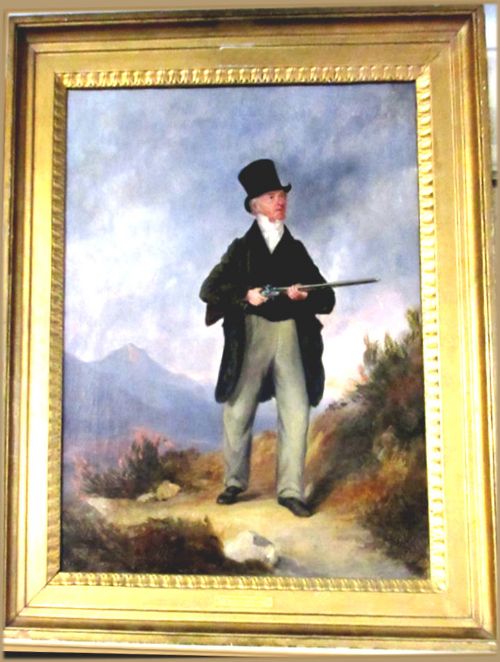
fig 3. An antique oil painting depicting a gentleman standing in a highland landscape, wearing a top hat and frock coat while holding a flintlock shotgun.
fig 3. Benjamin Marshall, 1768 - 1835 A Sportsman Walking Up Grouse, with His Double Barreled, Flint Lock Shot Gun

A top hat, beaver hat, high hat, silk hat, cylinder hat, chimney pot hat or stove pipe hat,sometimes also known by the nickname "topper", is a tall, flat-crowned, broad-brimmed hat, worn by men from the latter part of the 18th to the middle of the 20th century. The first silk top hat in England is credited to George Dunnage, a hatter from Middlesex, in 1793. The invention of the top hat is often erroneously credited to a haberdasher named John Hetherington. Within 30 years top hats had become popular with all social classes, with even workmen wearing them. At that time those worn by members of the upper classes were usually made of felted beaver fur; the generic name "stuff hat" was applied to hats made from various non-fur felts. The hats became part of the uniforms worn by policemen and postmen (to give them the appearance of authority); since these people spent most of their time outdoors, their hats were topped with black oilcloth. The Top hat was usually black but the sporting varities were grey, brown and white.

Artist Biography

Benjamin Marshall, (1768–1835), painter and racing journalist, was born on 8 November 1768 at Seagrave, Leicestershire, the only surviving son of eight children born to Charles Marshall and his wife, Elizabeth (d. 1772). Benjamin Marshall married Mary Saunders (d. 1827) of Ratby on 12 November 1789 and is recorded as being a schoolmaster in the will of his brother-in-law, dated 1791. However, he must have already shown a talent for portraiture for in the same year, on the recommendation of William Pochin of Barkby Hall, MP for the county, he was apprenticed to the portrait painter Lemuel Francis Abbott.

It is said that Ben Marshall (as he was known) was so impressed by Sawrey Gilpin'slife-size painting Death of a Fox, exhibited at the Royal Academy in 1793, that he decided to change from portraiture to sporting subjects (Sporting Magazine, Aug 1835, 298). By 1795 the Marshalls were living in London at Beaumont Street, Marylebone, their elder son, Charles, having been born the previous year. Soon after their arrival Marshall met William Taplin, the author of The Gentleman's Stable Directo

Height
54cm (21.26")
Width
42cm (16.54")
Depth
3cm (1.18")
Date of Manufacture

Artware Fineart has dated this Georgian Sporting Oil Painting to the 19th Century.

Reference Numbers
Sellingantiques Ref
SA534620
Dealers Internal Ref
3980
Artware Fineart
Sellingantiques verified Since Sep 2008
Dealer Profile

You can view the stock and full dealer information on the Artware Fineart Profile Page

Relevant Links
PDF SHARE
SAVE
An antique oil painting depicting a gentleman standing in a highland landscape, wearing a top hat and frock coat while holding a flintlock shotgun.
1 / 4
Archive I An antique oil painting depicting a gentleman standing in a highland landscape, wearing a top hat and frock coat while holding a flintlock shotgun.

Benjamin Marshall, 1768 - 1835 A Sportsman Walking up Grouse, with his Double Barreled, Flint Lock Shot Gun

Archive II An antique oil painting depicting a gentleman standing in a highland landscape, wearing a top hat and frock coat while holding a flintlock shotgun. View II
Archive III An antique oil painting depicting a gentleman standing in a highland landscape, wearing a top hat and frock coat while holding a flintlock shotgun. View III
Archive IV An antique oil painting depicting a gentleman standing in a highland landscape, wearing a top hat and frock coat while holding a flintlock shotgun. View IV
Enlarged Archival View
Telephone 07958 699 645
Location
18 La Gare
51 Surrey Row
London
SE1 0BZ
United Kingdom
Verified Since Sep 2008
Items For Sale 243
Items Sold 223
Artware Fineart
Verified Since Sep 2008
View Dealer Info
Location: 18 La Gare , 51 Surrey Row , London , SE1 0BZ , United Kingdom
Verified
Sep 2008
For Sale
243
Sold
223
An antique oil painting depicting a gentleman standing in a highland landscape, wearing a top hat and frock coat while holding a flintlock shotgun.
Benjamin Marshall, 1768 - 1835 A Sportsman Walking up Grouse, with his Double Barreled, Flint Lock Shot Gun
Ref: SA534620
An antique oil painting depicting a gentleman standing in a highland landscape, wearing a top hat and frock coat while holding a flintlock shotgun.
Detail View 1
Detail View 2
Detail View 3
Archival Detail
Every single antique dealer on our platform is individually approved by our internal team. We verify their professional trade history, ethical standards, and photographic quality to ensure a secure, high-standard buying environment. Upon joining, every dealer agrees to a strict 9-point code of conduct. While issues can occasionally arise, our dealers typically resolve them swiftly and directly with the buyer. In fact, since our founding in 2002, Sellingantiques has only had to step in to help resolve an issue on roughly five occasions—a true testament to the quality of our dealers and their dedication to your happiness.
Our dealers are highly experienced in packing and shipping fragile, high-value antiques. Because you are in direct contact with the dealer, you will be able to easily go through all available shipping and insurance options together to ensure your item arrives safely.
Antiques are the ultimate green purchase. By choosing historical pieces over newly manufactured goods, you completely eliminate the carbon footprint of modern mass production while preserving exceptional, timeless craftsmanship.

British sporting art from the Georgian era typically depicts equestrian scenes, hunting, and portraits of gentlemen, reflecting the field sports and country pursuits popular among the landed gentry during the late 18th and early 19th centuries.

Artists during this period predominantly used hand-stretched linen or cotton canvas primed with gesso, painted with pigments bound in linseed oil, and protected with a natural resin varnish.

Authentic period oil paintings often exhibit age-appropriate craquelure across the surface, natural oxidisation on the reverse of the canvas or wooden stretcher, and period-correct brushwork and pigment application.

A sporting oil painting can be styled as a focal piece above a fireplace mantel or sideboard, framed against contemporary dark backdrop tones like navy or olive green to highlight the historical subject matter.

Keep the canvas away from direct sunlight, high humidity, and direct heat sources to prevent warping and fading, and clean the surface gently using only a dry, soft-bristled brush.
items
Add keywords to the filter
Price
£100
£250000
Era
Movements
Material
Origin
Stock Location
Freshness
Online Payments
Categories