22,411  PAGES BROWSED TODAY PAGES TODAY 71  ANTIQUES UPLOADED TODAY NEW ARRIVALS
ID #SA524914
FOR SALE
£2,500
Email
Save
Attributed to Henry Edridge, Ara, 1768 – 1821 A Mother and Child Dancing (A Pair , 2)
Artware Fineart
for sale €2,925     $3,175
£2,500

Artware Fineart

Sellingantiques Verified Since Sep 2008
View Dealers Stock Page
Relevant Links
Id #SA524914
PDF SHARE
SAVE

Attributed to Henry Edridge, Ara, 1768 – 1821 A Mother and Child Dancing (A Pair , 2)

19th century
For Sale by Artware Fineart
Description

Attributed to Henry Edridge, ARA, 1768 – 1821

A Mother and Child Dancing (a pair , 2)

a pair of watercolours ( x 2)

28 x 19 cm each

It’s a truth universally acknowledged that after a bride and groom consummate the marriage the pitter patter of little feet will surely follow (and follow and follow and follow). Such was the case during Jane Austen’s day. Her mother bore eight children and luckily survived her ordeals. The wives of Jane’s brothers Edward and Frank did not, both dying in childbirth with their eleventh child. That these two women were able to survive so many pregnancies was a miracle in itself, given that the chance of a woman dying in childbirth at the time was 20%.

Deborah Kaplan writes in Jane Austen Among Women:

“On the birth of his fourteenth child in 1817, Thomas Papillon received this advice within a letter of congratulations from his wife’s uncle, Sir Richard Hardinge: It is now recommended to you to deprive Yourself of the Power of Further Propagation. You have both done Well and Sufficiently.”

Abstinence was one method of birth control, as Sir Richard recommended. Breast feeding was another. If a mother breasfed her child for 3-4 years, the pregnancies would be naturally spaced inbetween periods of amenorrhea (the absence of menstruation). While breastfeeding regained some popularity during the Georgian and Regency eras, women did not feed their babies long enough to supress menstruation for very long and often handed them over to a wet nurse. Cassandra Austen farmed her children to a nurse in a nearby village after six to eight months, guaranteeing that her lactation would soon cease and that she would soon be fertile again. The common belief that having intercourse during lactation would in some way harm the mother and child did offer some added protection from pregnancy, but large families were still common.

Once children were born and the family was large, it was not unusual to farm out a few children, some to work in their childhood, as Charles Dickens did, and other to live with relatives, as was the case with Fanny Price, who lived with her aunt’s family in Mansfield Park and Edward Austen Knight, who was adopted by a rich, childless couple.

It has been said that families had many children during the 18th and 19th centuries because of the high rate of infant mortality and the need for many helping hands on the farm. But as society became industrialized, large families became a hindrance. With many mouths to feed and limited resources (except in the case of the rich), it is no wonder that couples since time immemorial have searched for ways to limit the number of their offspring. Update: As Nancy Mayer rightly pointed out in her comment, most women during the Georgian and Regency eras thought it their duty to bear their husbands children and oversee the family household. The matter of family planning might well have been influenced by women of a certain class who could not allow pregnancies to interfere with the rhythm of the work cycle, single women who were desperate to seek ways to end their pregnancies before their condition became obvious, and in houses of ill repute, where condoms would offer some protection against disease. Mistresses and prostitutes would find pregnancies to be more of a hindrance than help in their work. I have often wondered, for example, how Emma Hamilton managed to have so few children and yet enjoy the charms of so many men.

In the eighteenth century, the prevailing belief about children was that they should be treated (and be expected to behave) as miniature adults. The advice we hear today, to let kids be kids? Not something you would have heard in the early Georgian-era of powdered wigs and telling French peasants to eat cake. But round and about the turn of the nineteenth century, there was a tremendous change in not only how children we

Physical Dimensions
Height
28cm (11.02")
Width
19cm (7.48")
Depth
1cm (0.39")
Declaration

Artware Fineart has dated this Regency Portrait Watercolour Pair to the Regency era.

Reference Numbers
Sellingantiques Reference
SA524914
Dealers Internal Reference
3970
Description
Attributed to Henry Edridge, ARA, 1768 – 1821

A Mother and Child Dancing (a pair , 2)

a pair of watercolours ( x 2)

28 x 19 cm each

It’s a truth universally acknowledged that after a bride and groom consummate the marriage the pitter patter of little feet will surely follow (and follow and follow and follow).
Artware Fineart

Such was the case during Jane Austen’s day. Her mother bore eight children and luckily survived her ordeals. The wives of Jane’s brothers Edward and Frank did not, both dying in childbirth with their eleventh child. That these two women were able to survive so many pregnancies was a miracle in itself, given that the chance of a woman dying in childbirth at the time was 20%.

Deborah Kaplan writes in Jane Austen Among Women:

“On the birth of his fourteenth child in 1817, Thomas Papillon received this advice within a letter of congratulations from his wife’s uncle, Sir Richard Hardinge: It is now recommended to you to deprive Yourself of the Power of Further Propagation. You have both done Well and Sufficiently.”

Abstinence was one method of birth control, as Sir Richard recommended. Breast feeding was another. If a mother breasfed her child for 3-4 years, the pregnancies would be naturally spaced inbetween periods of amenorrhea (the absence of menstruation). While breastfeeding regained some popularity during the Georgian and Regency eras, women did not feed their babies long enough to supress menstruation for very long and often handed them over to a wet nurse. Cassandra Austen farmed her children to a nurse in a nearby village after six to eight months, guaranteeing that her lactation would soon cease and that she would soon be fertile again. The common belief that having intercourse during lactation would in some way harm the mother and child did offer some added protection from pregnancy, but large families were still common.

Once children were born and the family was large, it was not unusual to farm out a few children, some to work in their childhood, as Charles Dickens did, and other to live with relatives, as was the case with Fanny Price, who lived with her aunt’s family in Mansfield Park and Edward Austen Knight, who was adopted by a rich, childless couple.

It has been said that families had many children during the 18th and 19th centuries because of the high rate of infant mortality and the need for many helping hands on the farm. But as society became industrialized, large families became a hindrance. With many mouths to feed and limited resources (except in the case of the rich), it is no wonder that couples since time immemorial have searched for ways to limit the number of their offspring. Update: As Nancy Mayer rightly pointed out in her comment, most women during the Georgian and Regency eras thought it their duty to bear their husbands children and oversee the family household. The matter of family planning might well have been influenced by women of a certain class who could not allow pregnancies to interfere with the rhythm of the work cycle, single women who were desperate to seek ways to end their pregnancies before their condition became obvious, and in houses of ill repute, where condoms would offer some protection against disease. Mistresses and prostitutes would find pregnancies to be more of a hindrance than help in their work. I have often wondered, for example, how Emma Hamilton managed to have so few children and yet enjoy the charms of so many men.

In the eighteenth century, the prevailing belief about children was that they should be treated (and be expected to behave) as miniature adults. The advice we hear today, to let kids be kids? Not something you would have heard in the early Georgian-era of powdered wigs and telling French peasants to eat cake. But round and about the turn of the nineteenth century, there was a tremendous change in not only how children we

Height
28cm (11.02")
Width
19cm (7.48")
Depth
1cm (0.39")
Date of Manufacture

Artware Fineart has dated this Regency Portrait Watercolour Pair to the Regency era.

Reference Numbers
Sellingantiques Ref
SA524914
Dealers Internal Ref
3970
Artware Fineart
Sellingantiques verified Since Sep 2008
Dealer Profile

You can view the stock and full dealer information on the Artware Fineart Profile Page

Relevant Links
PDF SHARE
SAVE
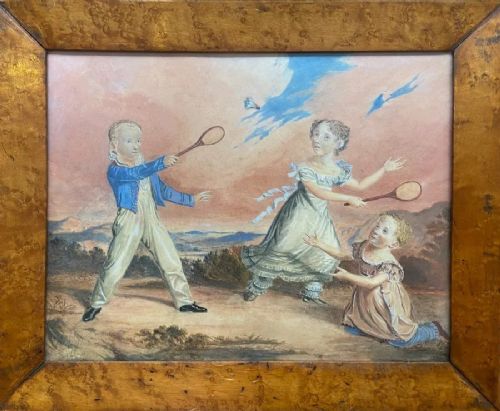
A pair of Regency watercolour portraits depicting a mother and child dancing outdoors in white empire-waist dresses.
1 / 1
Archive I A pair of Regency watercolour portraits depicting a mother and child dancing outdoors in white empire-waist dresses.

Attributed to Henry Edridge, ARA, 1768 – 1821 A Mother and Child Dancing (a pair , 2)

FURTHER BROWSING

Visitors also looked at these ⇣

Enlarged Archival View
Telephone 07958 699 645
Location
18 La Gare
51 Surrey Row
London
SE1 0BZ
United Kingdom
Verified Since Sep 2008
Items For Sale 243
Items Sold 223
Artware Fineart
Verified Since Sep 2008
View Dealer Info
Location: 18 La Gare , 51 Surrey Row , London , SE1 0BZ , United Kingdom
Verified
Sep 2008
For Sale
243
Sold
223
A pair of Regency watercolour portraits depicting a mother and child dancing outdoors in white empire-waist dresses.
Attributed to Henry Edridge, ARA, 1768 – 1821 A Mother and Child Dancing (a pair , 2)
Ref: SA524914
A pair of Regency watercolour portraits depicting a mother and child dancing outdoors in white empire-waist dresses.
Archival Detail
Every single antique dealer on our platform is individually approved by our internal team. We verify their professional trade history, ethical standards, and photographic quality to ensure a secure, high-standard buying environment. Upon joining, every dealer agrees to a strict 9-point code of conduct. While issues can occasionally arise, our dealers typically resolve them swiftly and directly with the buyer. In fact, since our founding in 2002, Sellingantiques has only had to step in to help resolve an issue on roughly five occasions—a true testament to the quality of our dealers and their dedication to your happiness.
Our dealers are highly experienced in packing and shipping fragile, high-value antiques. Because you are in direct contact with the dealer, you will be able to easily go through all available shipping and insurance options together to ensure your item arrives safely.
Antiques are the ultimate green purchase. By choosing historical pieces over newly manufactured goods, you completely eliminate the carbon footprint of modern mass production while preserving exceptional, timeless craftsmanship.

Regency portraiture from the late eighteenth and early nineteenth centuries is known for its delicate handling of light, naturalistic landscape backdrops, and focus on informal domestic subjects wearing empire-waist fashions.

Artists of this era primarily used watercolour, gouache, or graphite on wove paper, vellum, or thin sheets of ivory, using natural pigment binders and fine sable brushes.

Authentication involves evaluating historical costume details, examining paper age and watermarks under magnification, analysing pigment composition, and tracing provenance or artist signatures.

These small-scale artworks perform well when styled as a pair or grouped within a framed gallery wall, positioned in intimate spaces such as reading nooks, staircases, or above a hallway console table.

Watercolours must be kept out of direct sunlight and displayed behind UV-filtering conservation glass in a climate-controlled space with stable humidity to prevent fading and foxing.
items
Add keywords to the filter
Price
£100
£250000
Era
Movements
Material
Origin
Stock Location
Freshness
Online Payments
Categories