Roy Precious - Antiques & Fine Art has dated this piece to the 18th Century.
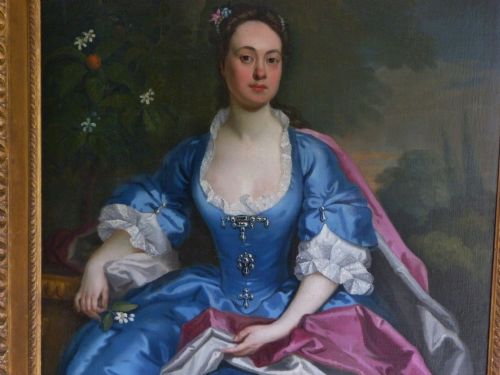
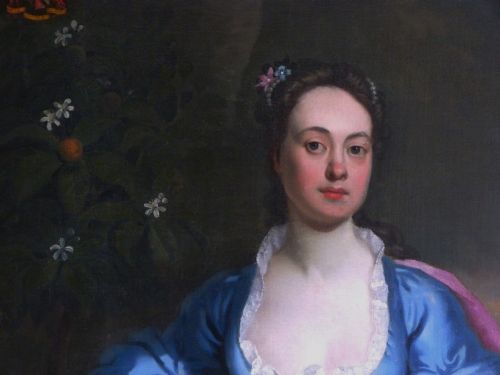
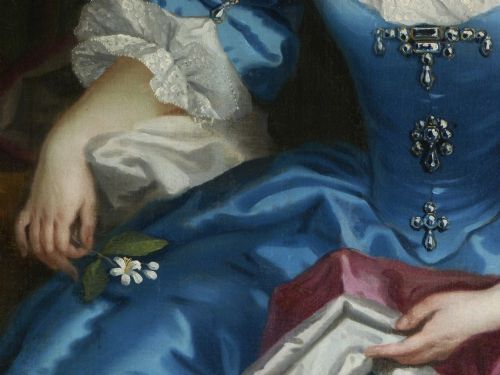
The Duchess sits beside an orange tree and holds one of its flowers.
Oranges were an expensive luxury in Northern Europe, coming as they did from the warm South. They also has considerable symbolic significance.
The orange tree bears leaves, flowers and fruit all at the same time.
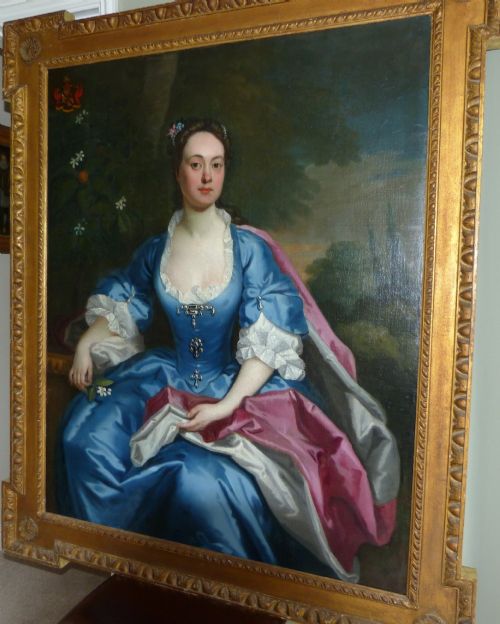
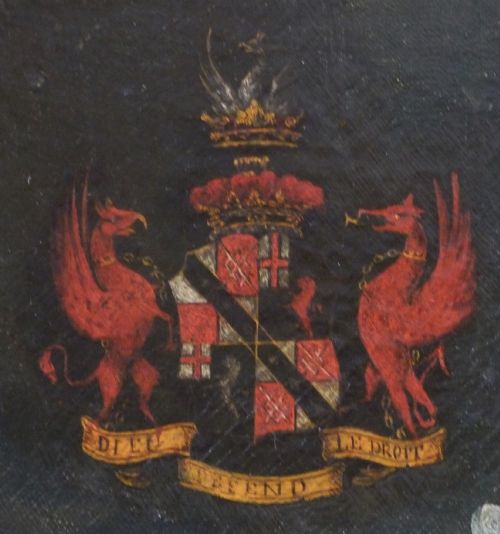
In the upper left of the portrait is depicted the coat of arms for the Spencer-Churchill family.
The Hon. ELIZABETH TREVOR, DUCHESS OF MARLBOROUGH, was the daughter of the Thomas Trevor, second Baron Trevor of Bromham and wife of Charles Spencer, fifth Earl of Sunderland and third Duke of Marlborough.
Charles Spencer, 3rd Duke of Marlborough KG, PC (1706 – 1758), known as The Earl of Sunderland between 1729 and 1733.
He was a British soldier and politician. He briefly served as Lord Privy Seal in 1755. He led British forces during the Raid on St Malo in 1758.
He was the second son of Charles Spencer, 3rd Earl of Sunderland and Lady Anne Churchill, the second daughter of John Churchill, 1st Duke of Marlborough and his wife Sarah Churchill, Duchess of Marlborough.
Charles inherited the Sunderland title from his older brother in 1729, becoming 5th Earl of Sunderland, and then the Marlborough title from his aunt, Henrietta, 2nd Duchess of Marlborough in 1733.
He was one of the original governors of London's Foundling Hospital, the foundation of which in 1739 marked a watershed in British child care advocacy and attitudes.
The Duke and Duchess had five children:
Lady Diana Spencer (1734–1808). Married first Frederick St John, 2nd Viscount Bolingbroke and secondly Topham Beauclerk.
Elizabeth Herbert, Countess of Pembroke and Montgomery (January/March 1737 – 30 April 1831). Married Henry Herbert, 10th Earl of Pembroke.
George Spencer, 4th Duke of Marlborough (26 January 1739 – 29 January 1817).
Lord Charles Spencer (31 March 1740 – 16 June 1820).
Lord Robert Spencer (3 May 1747 – 23 June 1831)
MARIA VERELST (1680-1744)was arguably the greatest female immigrant artist of the late Stuart/early Georgian era, she was the daughter of Dutch painter Herman Verelst (1641-1690) and niece of the more well-known Stuart court painter Simon Verelst (1644-1710). Maria moved to England at the age of three with her father following the siege of Vienna by the Ottoman Empire and, following her father’s success, later became his student. Well-connected and highly skilled, Maria established herself quickly and her earliest recorded painting dates to c. 1695, painted when Maria was fourteen, and depicts William Wentworth, 2nd Earl of Strafford (1626-1695) [Welbeck Abbey]. Maria painted several works for Welbeck as well as thirteen portraits for James Brydges, 1st Duke of Chandos.
In addition to being a talented painter, Maria was also well educated and spoke a number of different languages which no doubt helped her secure patronage.
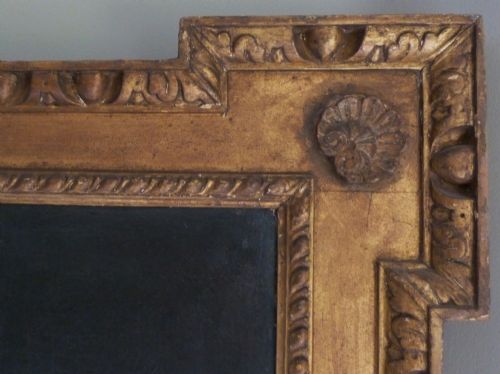
SIZE: 60 x 50.75 inches inc. frame.
PROVENANCE: Cheshire Family Private Collection for many years.
With Roy Precious Fine Art.
Collection of a Fellow of a Cambridge College.
Roy Precious - Antiques & Fine Art has dated this piece to the 18th Century.
Roy and nadine precious: specialists in portraiture from the 16th to the 20th century. Established in 1972.
You can view the stock and full dealer information on the Roy Precious - Antiques & Fine Art Profile Page

Portrait of Elizabeth, Duchess of Marlborough C.1730: Attributed to Maria Verelst.