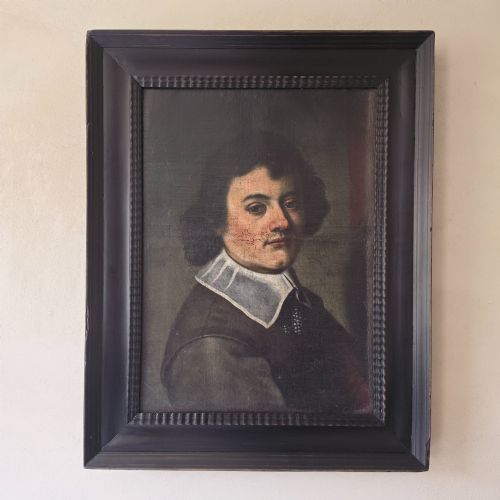
Artware Fineart has dated this Georgian Oil Portrait Painting to the 17th Century.
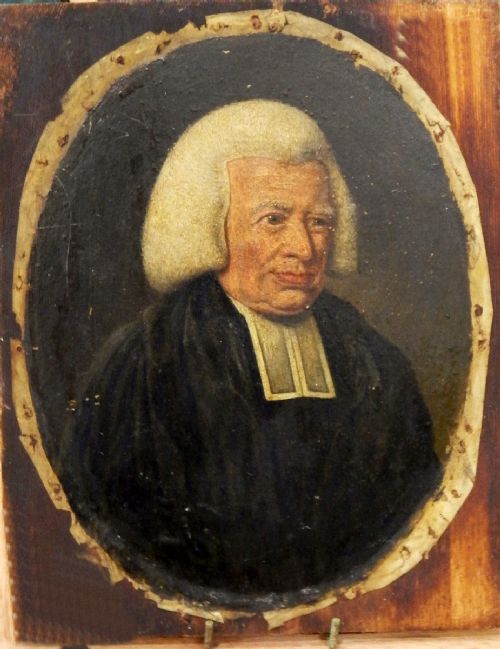
Portrait of Josiah Tucker, Dean Tucker, 1713-1799
oil on canvas
21 x 16 cm. (8.1/2 x 6.1/2in.)
His reluctance to discuss his antecedents left few details regarding his family and later gave rise to many apocryphal stories regarding his Welsh peasant stock, long life, and physical strength. His father, however, was probably Josiah Tucker, a member of the salt office at Nevern, Pembrokeshire, who, after his marriage to Eliza Bradshaw at Laugharne in October 1711, inherited a small estate in Aberystwyth. A certain amount of mystery also surrounds Tucker's two marriages. His first wife was Elizabeth Woodward (1696–1771), a widow seventeen years his senior. Although the couple lived apart Tucker educated her sons, one of whom, Richard Woodward, later became bishop of Cloyne, Ireland. In 1781 Tucker married his housekeeper, a Miss Crow, the daughter of a local schoolmaster. This second marriage, which seems to have been one of genuine affection, produced no children. Tucker's later correspondence indicates that he had a sister whose eight children he helped to provide for.
Early career
Whatever his background, Tucker received an excellent education. Following his attendance at the endowed Elizabethan grammar school at Ruthin, Denbighshire, he went up as an exhibitioner to St John's College, Oxford, in January 1733. Having graduated BA in 1736 he took holy orders; he graduated MA in 1739, and DD in 1755. He was appointed curate of St Stephen's, Bristol, in 1737 and made rector of All Saints', in the same city, two years later. In 1750 he was appointed vicar of St Stephen's, a large and wealthy parish, and his long residence in Bristol, England's second city and an important commercial centre, was crucial to the development of his religious, political, and economic viewpoints. It also brought him into contact with the bishop, Joseph Butler (1692–1752).
One of the most celebrated theologians of his day, Butler greatly influenced Tucker's outlook regarding human motivation, as well as the role that private virtue and enlightened self-interest could play in public life. Tucker considered Butler's Analogy of Religion (1736) a masterpiece. Their close friendship led to Tucker's advancement: Butler appointed Tucker his private chaplain in 1738 and a minor canon in Bristol Cathedral in 1742. A decade later Tucker acted as one of the executors of Butler's will. Butler's scepticism regarding religious freethinkers, deists, and the growing movement of religious enthusiasm also influenced Tucker's views and involved him in local controversy regarding Methodist beliefs then taking root under George Whitefield and John Wesley in Bristol.
In 1739 Tucker's first published work, attacking Methodism, led to a heated newspaper exchange, a lengthy rebuttal of his attacks in An Answer to Mr. Tucker's Defence of his Queries, possibly written by Wesley, and to Tucker being physically assaulted in the streets of Bristol. Ignoring his local unpopularity, Tucker went on to publish, at the request of the archbishop of Armagh, A Brief History of the Principles of Methodism (1742). One of his twelve published works on religious topics, all of which displayed great learning, this work attacked Methodism as little more than a medley of older, conflicting religious ideas artificially thrown together by the personal whim of Whitefield himself. Wesley, who admired Tucker as a preacher, published a sincere reply, Principles of Methodism (1746), which brought an end to this particular controversy but not to Tucker's development as something of a born controversialist. In a long career he published over forty-four works, many of which considered the pressing problems of the day. His published wor
Artware Fineart has dated this Georgian Oil Portrait Painting to the 17th Century.
You can view the stock and full dealer information on the Artware Fineart Profile Page

English School 18th, Century portrait of Josiah Tucker, Dean Tucker, 1713-1799