20,068  PAGES BROWSED TODAY PAGES TODAY 36  ANTIQUES UPLOADED TODAY NEW ARRIVALS
ID #SA485924
FOR SALE
£2,500
Email
Save
Alfred Egerton Cooper, Rca, Rsba,, 1883 - 1974 Chit Rocks at Low Tide, Jacobs Ladder Sidmouth, East Devon
Artware Fineart
for sale €2,925     $3,175
£2,500

Artware Fineart

Sellingantiques Verified Since Sep 2008
View Dealers Stock Page
Id #SA485924
PDF SHARE
SAVE

Alfred Egerton Cooper, Rca, Rsba,, 1883 - 1974 Chit Rocks at Low Tide, Jacobs Ladder Sidmouth, East Devon

1920 - 1940
For Sale by Artware Fineart
Description

Alfred Egerton Cooper, RCA, RSBA,, 1883 - 1974

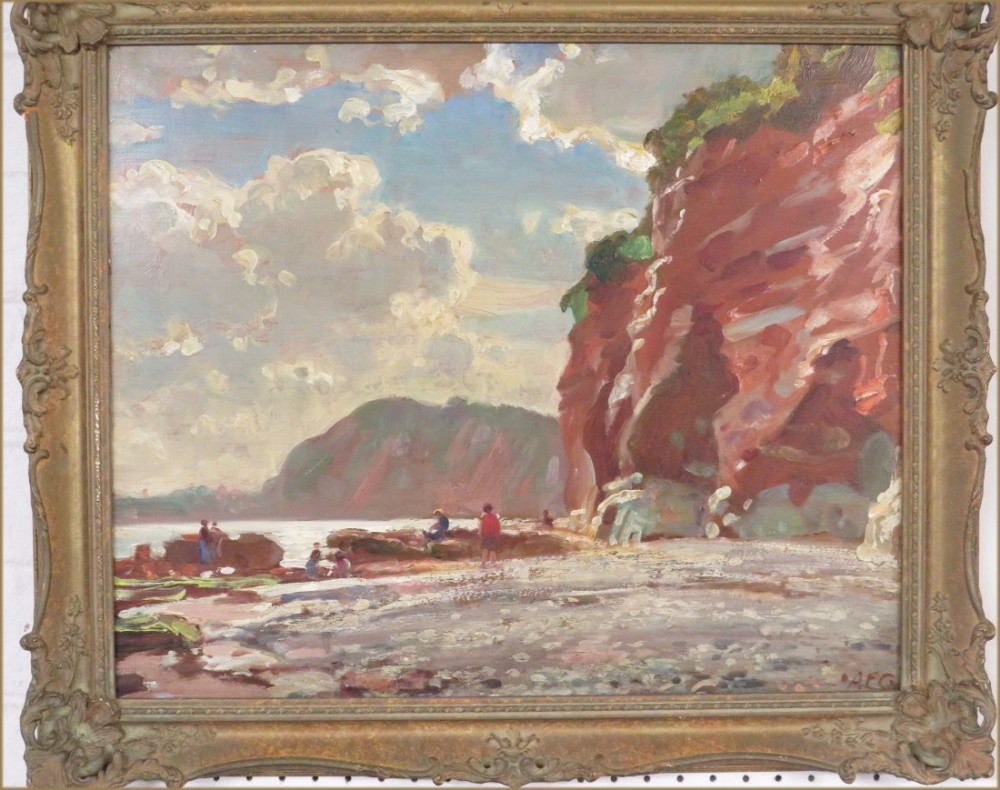
Chit Rocks at Low Tide, Jacobs Ladder Sidmouth, East Devon

Signed/Inscribed:

with initials "AEC" lower left

oil on board

36.50 x 44.50 cm. (14.3/4 x 18in.)

The painting shows beach goers walking and rock pooling at low tide on the Chit Rocks which are the remenants of a Cliff-Height Sea Stack destroyed in the severe 1824 storms, (a one in about 250 year event). The Jacob's Ladder promonontory might develop into a similar stack although it is currently well protected.

Provenance

Private Collection, Sidmouth

Notes

“Farewell, seductive Sidmouth by the sea older and more exclusive than Torquay : you’re the town for me!” so says Sir John Betjeman in "Bejtemans England".

Sidmouth is a town situated on the English Channel coast in Devon, South West England, 14 miles (23 km) east of Exeter. In 2004, it had a population of about 15,000, of whom 40% were aged 65 or over. By the time of the 2011 census the population was 12,569. It is a tourist resort and a gateway to the Jurassic Coast World Heritage Site. A large part of the town has been designated a conservation area. Sidmouth appeared in the Domesday Book as Sedemuda. Like many such settlements, it was originally a fishing village. Although attempts have been made to construct a harbour, none has succeeded. A lack of shelter in the bay prevented growth as a port.

Emmanuel Lousada, who founded the resort. The Jewish businessman recognised the physical beauty and potential of what was then a small port nestling on the mouth of the River Sid. He bought up as much land as he could in the late 1700s and set about developing a genteel, yet exotic holiday venue. He built the first cottage orné - a large house dressed up as a cottage and often thatched with pretty bargeboards, which appealed to the holidaying aristocracy of the day. Lousada was a brilliant publicist and attracted an ever- widening circle of grandees to build their own holiday houses a little above and away from the sea. They now form the best collection of cottages ornés in the country.

When the Duke and Duchess of Kent, with their baby daughter Victoria, the future Queen, took Woolbrook Cottage for their holiday, it sealed Sidmouth's status in social and architectural terms.Sidmouth remained a village until the fashion for coastal resorts grew in the Georgian and Victorian periods of the 18th and 19th centuries. The numerous fine Georgian and Regency villas and mansions are now mostly hotels. In 1819, George III's son Edward, Duke of Kent, his wife, and baby daughter (the future Queen Victoria) came to stay at Woolbrook Glen for a few weeks. In less than a month he had died from an illness. The house later became the Royal Glen Hotel; a plaque on an exterior wall records the visit. In 1874, Sidmouth was connected to the railway network by a branch line from Sidmouth Junction, which called at Ottery St Mary and Tipton St John. This was dismantled in 1967 as a result of the Beeching Axe. Most of the route can still be traced and the Sidmouth railway station can still be found now although this is now a private property.

In 2008, Canadian millionaire, Keith Owen, who had vacationed in the town and planned to retire there, bequeathed the community's civic society, the Sid Vale Association, about £2.3 million upon learning that he had only weeks to live due to lung cancer. The bequest is to be used as a capital fund to generate an annual interest dividend of around £120,000 for community projects. Sidmouth lies at the mouth of the River Sid in a valley between Peak Hill to the west and Salcombe Hill to the east. It is surrounded by the East Devon Area of Outstanding Natural Beauty and is on the Jurassic Coast, a World Heritage Site, and the South West Coast Path. The red-coloured rock indicates the arid conditions of the Triassic geological perio

Physical Dimensions
Height
36cm (14.17")
Width
44cm (17.32")
Depth
2cm (0.79")
Declaration

Artware Fineart has dated this British Coastal Oil Painting to the 1930s.

Reference Numbers
Sellingantiques Reference
SA485924
Dealers Internal Reference
3926
Description
Alfred Egerton Cooper, RCA, RSBA,, 1883 - 1974

Chit Rocks at Low Tide, Jacobs Ladder Sidmouth, East Devon

Signed/Inscribed:

with initials "AEC" lower left

oil on board

36.50 x 44.50 cm. (14.3/4 x 18in.)

The painting shows beach goers walking and rock pooling at low tide on the Chit Rocks which are the remenants of a Cliff-Height Sea Stack destroyed in the severe 1824 storms, (a one in about 250 year event).
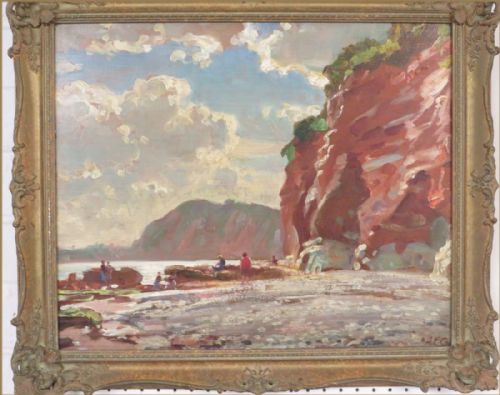
The Jacob's Ladder promonontory might develop into a similar stack although it is currently well protected.
Artware Fineart
fig 1. An impressionist oil painting depicting red sandstone cliffs on a pebble beach at low tide with figures and clouds.
fig 1. Alfred Egerton Cooper, Rca, Rsba,, 1883 - 1974 Chit Rocks at Low Tide, Jacobs Ladder Sidmouth, East Devon

Provenance

Private Collection, Sidmouth

Notes

“Farewell, seductive Sidmouth by the sea older and more exclusive than Torquay : you’re the town for me!” so says Sir John Betjeman in "Bejtemans England".

Sidmouth is a town situated on the English Channel coast in Devon, South West England, 14 miles (23 km) east of Exeter. In 2004, it had a population of about 15,000, of whom 40% were aged 65 or over. By the time of the 2011 census the population was 12,569. It is a tourist resort and a gateway to the Jurassic Coast World Heritage Site. A large part of the town has been designated a conservation area. Sidmouth appeared in the Domesday Book as Sedemuda. Like many such settlements, it was originally a fishing village. Although attempts have been made to construct a harbour, none has succeeded. A lack of shelter in the bay prevented growth as a port.
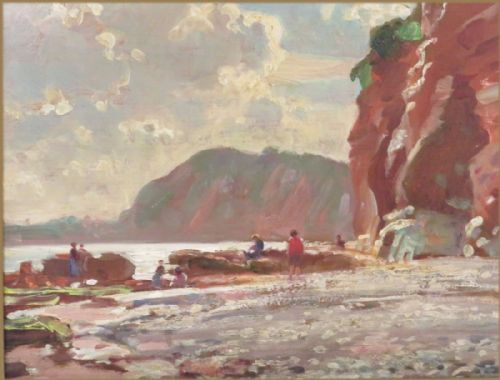
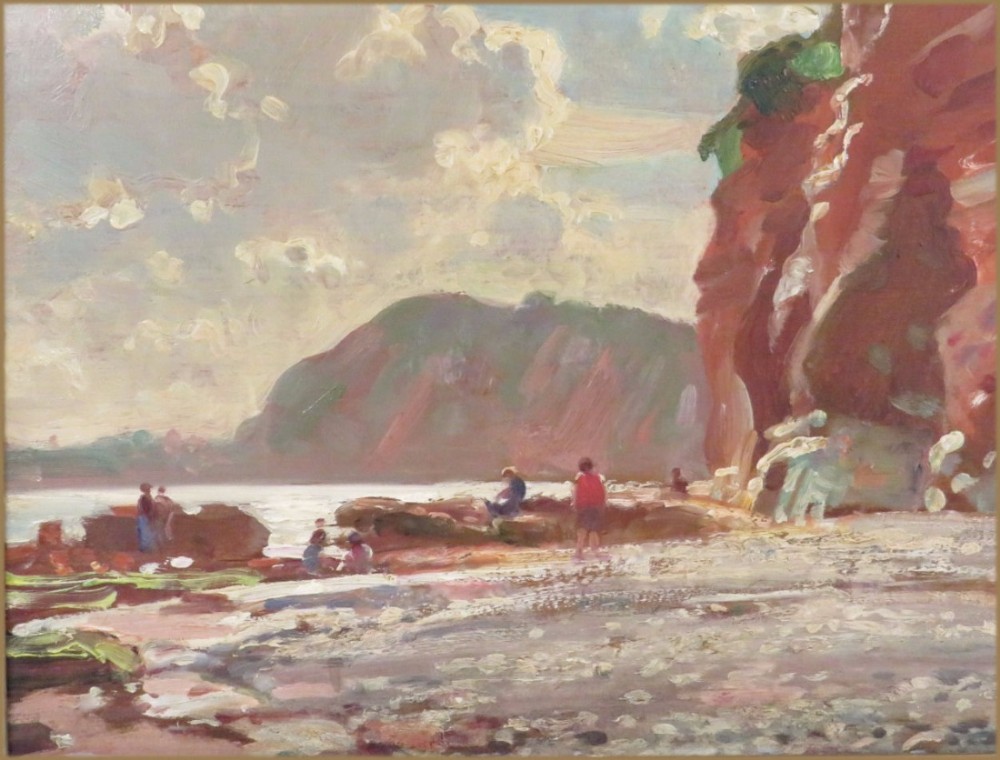
fig 2. An impressionist oil painting depicting red sandstone cliffs on a pebble beach at low tide with figures and clouds.
fig 2. Alfred Egerton Cooper, Rca, Rsba,, 1883 - 1974 Chit Rocks at Low Tide, Jacobs Ladder Sidmouth, East Devon

Emmanuel Lousada, who founded the resort. The Jewish businessman recognised the physical beauty and potential of what was then a small port nestling on the mouth of the River Sid. He bought up as much land as he could in the late 1700s and set about developing a genteel, yet exotic holiday venue. He built the first cottage orné - a large house dressed up as a cottage and often thatched with pretty bargeboards, which appealed to the holidaying aristocracy of the day. Lousada was a brilliant publicist and attracted an ever- widening circle of grandees to build their own holiday houses a little above and away from the sea. They now form the best collection of cottages ornés in the country.
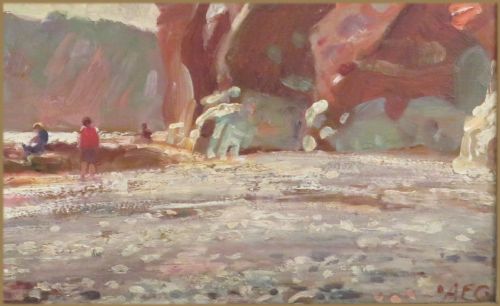
fig 3. An impressionist oil painting depicting red sandstone cliffs on a pebble beach at low tide with figures and clouds.
fig 3. Alfred Egerton Cooper, Rca, Rsba,, 1883 - 1974 Chit Rocks at Low Tide, Jacobs Ladder Sidmouth, East Devon

When the Duke and Duchess of Kent, with their baby daughter Victoria, the future Queen, took Woolbrook Cottage for their holiday, it sealed Sidmouth's status in social and architectural terms.Sidmouth remained a village until the fashion for coastal resorts grew in the Georgian and Victorian periods of the 18th and 19th centuries. The numerous fine Georgian and Regency villas and mansions are now mostly hotels. In 1819, George III's son Edward, Duke of Kent, his wife, and baby daughter (the future Queen Victoria) came to stay at Woolbrook Glen for a few weeks. In less than a month he had died from an illness. The house later became the Royal Glen Hotel; a plaque on an exterior wall records the visit. In 1874, Sidmouth was connected to the railway network by a branch line from Sidmouth Junction, which called at Ottery St Mary and Tipton St John. This was dismantled in 1967 as a result of the Beeching Axe. Most of the route can still be traced and the Sidmouth railway station can still be found now although this is now a private property.

In 2008, Canadian millionaire, Keith Owen, who had vacationed in the town and planned to retire there, bequeathed the community's civic society, the Sid Vale Association, about £2.3 million upon learning that he had only weeks to live due to lung cancer. The bequest is to be used as a capital fund to generate an annual interest dividend of around £120,000 for community projects. Sidmouth lies at the mouth of the River Sid in a valley between Peak Hill to the west and Salcombe Hill to the east. It is surrounded by the East Devon Area of Outstanding Natural Beauty and is on the Jurassic Coast, a World Heritage Site, and the South West Coast Path. The red-coloured rock indicates the arid conditions of the Triassic geological perio

Height
36cm (14.17")
Width
44cm (17.32")
Depth
2cm (0.79")
Date of Manufacture

Artware Fineart has dated this British Coastal Oil Painting to the 1930s.

Reference Numbers
Sellingantiques Ref
SA485924
Dealers Internal Ref
3926
Artware Fineart
Sellingantiques verified Since Sep 2008
Dealer Profile

You can view the stock and full dealer information on the Artware Fineart Profile Page

PDF SHARE
SAVE
An impressionist oil painting depicting red sandstone cliffs on a pebble beach at low tide with figures and clouds.
1 / 4
Archive I An impressionist oil painting depicting red sandstone cliffs on a pebble beach at low tide with figures and clouds.

Alfred Egerton Cooper, Rca, Rsba,, 1883 - 1974 Chit Rocks at Low Tide, Jacobs Ladder Sidmouth, East Devon
Archive II An impressionist oil painting depicting red sandstone cliffs on a pebble beach at low tide with figures and clouds. View II
Archive III An impressionist oil painting depicting red sandstone cliffs on a pebble beach at low tide with figures and clouds. View III
Archive IV An impressionist oil painting depicting red sandstone cliffs on a pebble beach at low tide with figures and clouds. View IV
FURTHER BROWSING

Visitors also looked at these ⇣

Enlarged Archival View
Telephone 07958 699 645
Location
18 La Gare
51 Surrey Row
London
SE1 0BZ
United Kingdom
Verified Since Sep 2008
Items For Sale 243
Items Sold 223
Artware Fineart
Verified Since Sep 2008
View Dealer Info
Location: 18 La Gare , 51 Surrey Row , London , SE1 0BZ , United Kingdom
Verified
Sep 2008
For Sale
243
Sold
223
An impressionist oil painting depicting red sandstone cliffs on a pebble beach at low tide with figures and clouds.
Alfred Egerton Cooper, RCA, RSBA,, 1883 - 1974 Chit Rocks at Low Tide, Jacobs Ladder Sidmouth, East Devon
Ref: SA485924
An impressionist oil painting depicting red sandstone cliffs on a pebble beach at low tide with figures and clouds.
Detail View 1
Detail View 2
Detail View 3
Archival Detail
Every single antique dealer on our platform is individually approved by our internal team. We verify their professional trade history, ethical standards, and photographic quality to ensure a secure, high-standard buying environment. Upon joining, every dealer agrees to a strict 9-point code of conduct. While issues can occasionally arise, our dealers typically resolve them swiftly and directly with the buyer. In fact, since our founding in 2002, Sellingantiques has only had to step in to help resolve an issue on roughly five occasions—a true testament to the quality of our dealers and their dedication to your happiness.
Our dealers are highly experienced in packing and shipping fragile, high-value antiques. Because you are in direct contact with the dealer, you will be able to easily go through all available shipping and insurance options together to ensure your item arrives safely.
Antiques are the ultimate green purchase. By choosing historical pieces over newly manufactured goods, you completely eliminate the carbon footprint of modern mass production while preserving exceptional, timeless craftsmanship.

British Impressionist coastal painting emerged in the late 19th and early 20th centuries, heavily influenced by French plein air techniques. Artists focused on capturing natural light, atmospheric conditions, and fluid tidal movements across British shorelines using energetic brushstrokes and harmonious colour palettes.

Painters during this period typically utilized oil paints composed of natural pigments bound with linseed oil, applied to stretched cotton or linen canvas, or wooden/pulp boards. Frames were often handcrafted from wood, carved, and gilded or hand-painted to complement the artwork.

Authenticity is verified through artist signatures or monograms, contemporary exhibit labels or stamps on the reverse of the canvas or board, consistent age-related craquelure, and archival gallery records or auction catalogue references.

Position the painting as a focal point above a timber sideboard, mantelpiece, or console table. Pair it with neutral linen textiles, natural oak furniture, and minimalist decor to allow the warm tones and expressive texture of the artwork to stand out.

Keep oil paintings out of direct sunlight and away from high humidity or heat sources to prevent cracking and discolouration. Dust gently with a clean, dry, soft-feather brush, and consult a professional fine art conservator for varnish cleaning or repair work.
items
Add keywords to the filter
Price
£100
£250000
Era
Movements
Material
Origin
Stock Location
Freshness
Online Payments
Categories