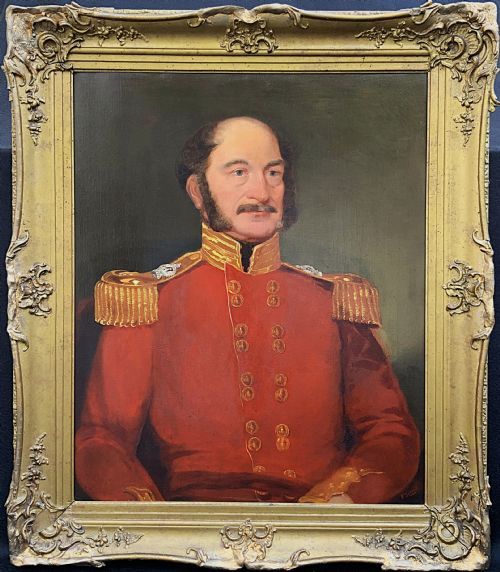
Artware Fineart has dated this Antique Military Portrait Painting to the 1800s.
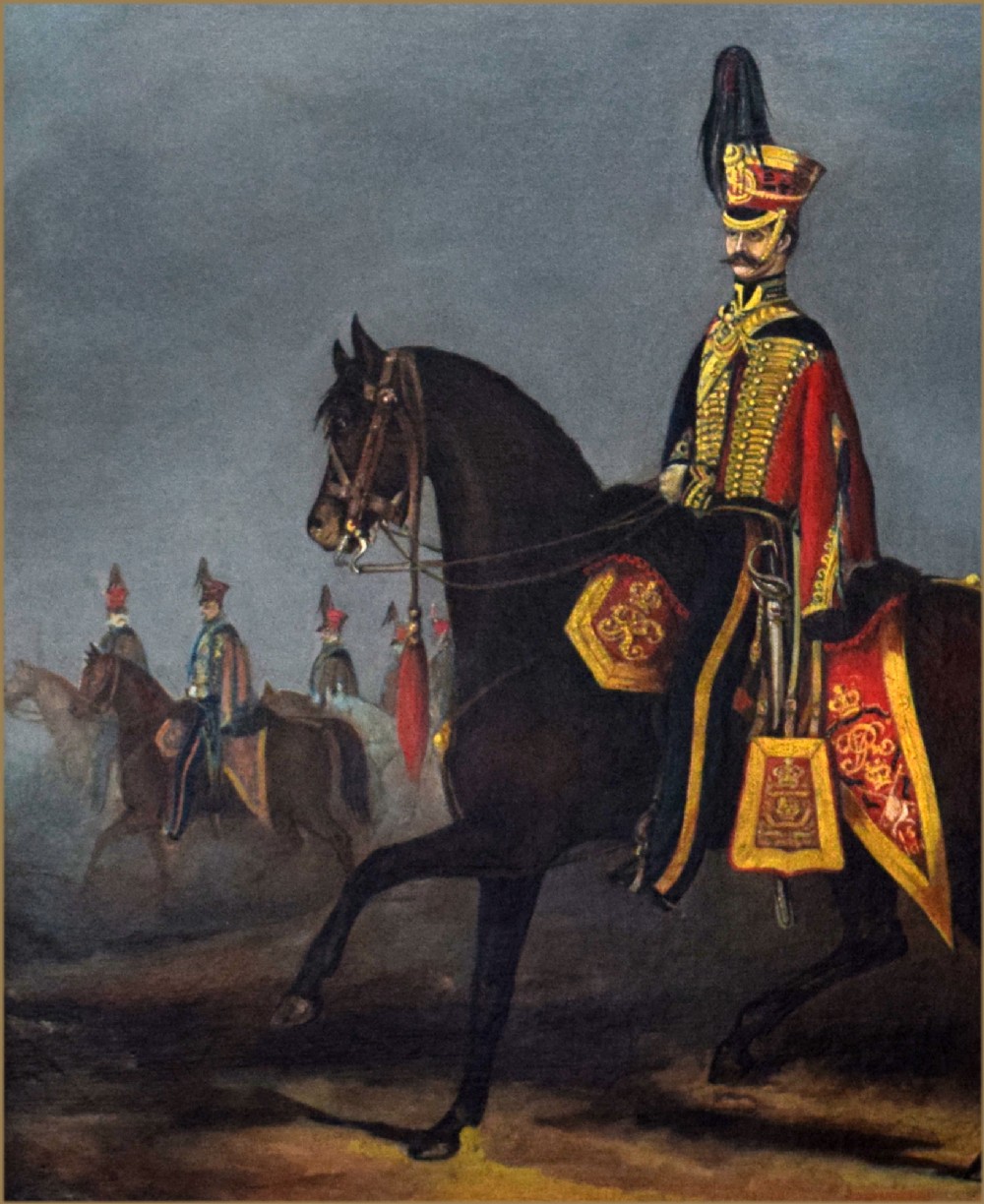
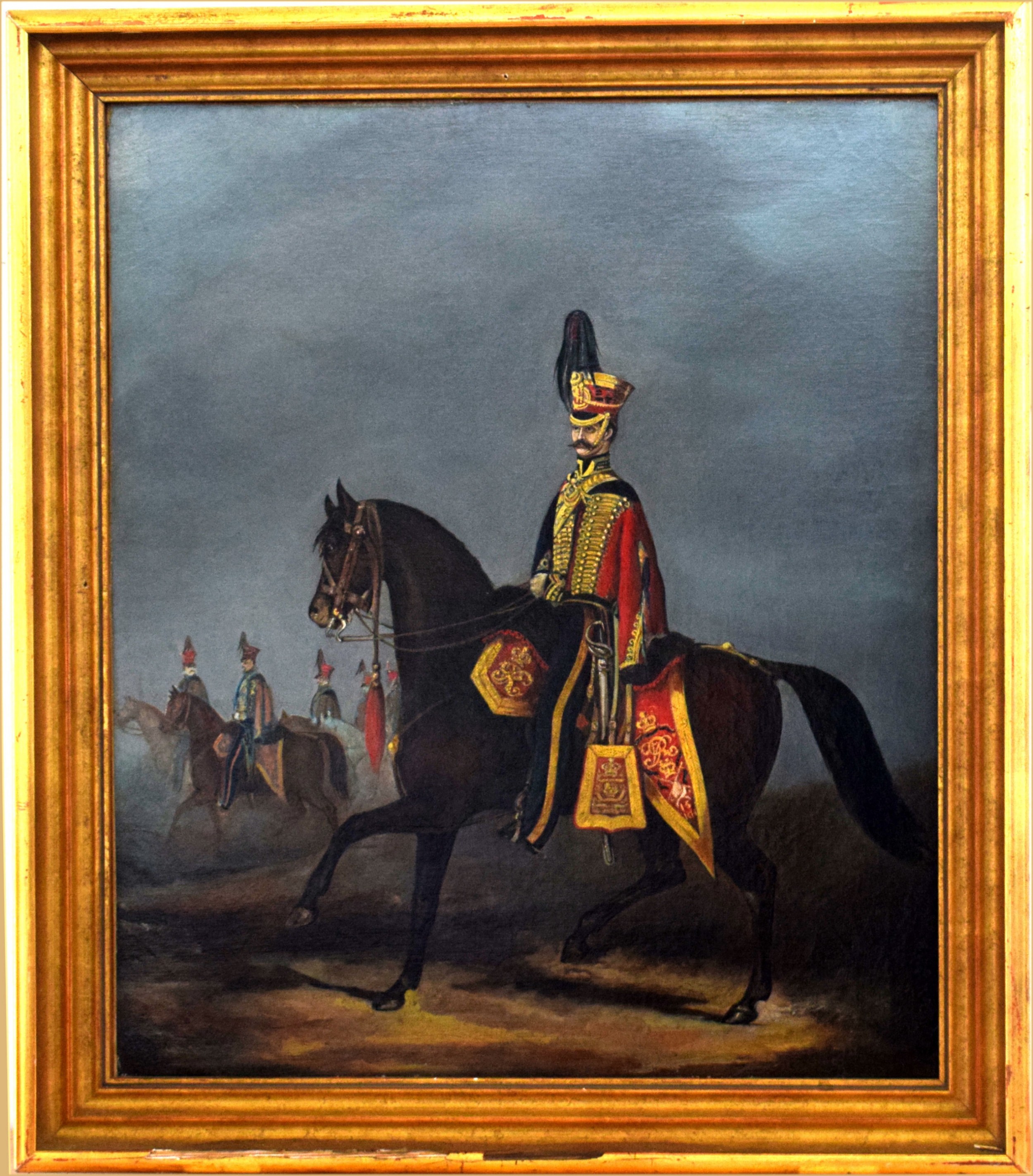
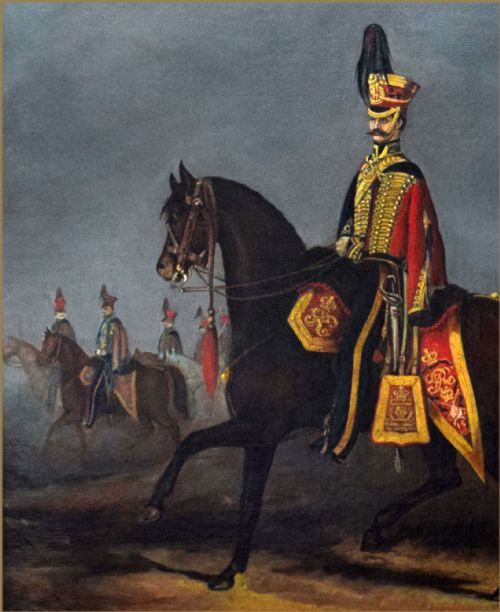
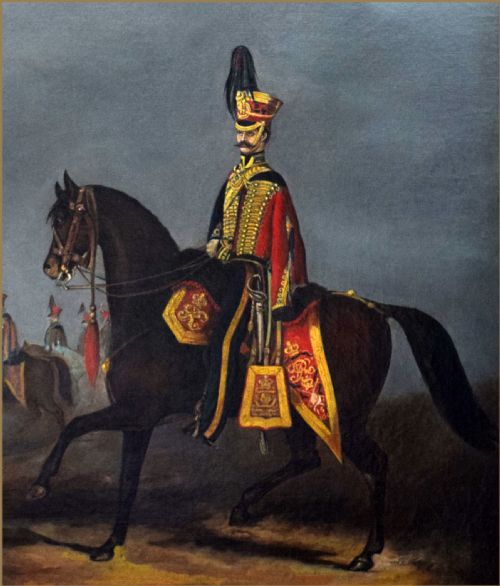
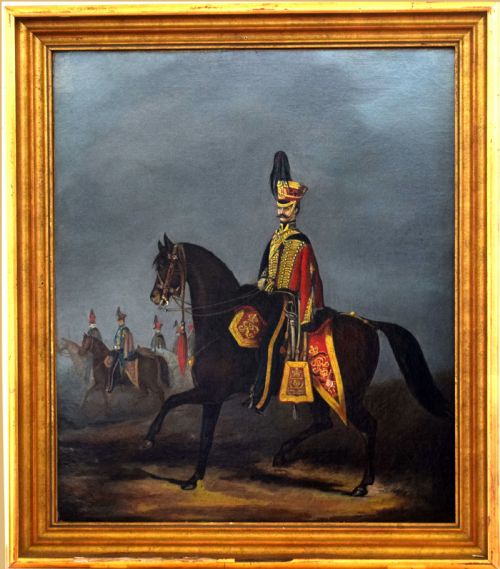
Portrait of an Officer of the 15th King's Hussars mounted on his Charger
oil on canvas
20 x 17in. (51 x 43 cm.)
The Portrait shows an Officer of the 15th (King's) Hussars and dates from before 1830 as he has GR on his shabraque (William IV succeeded on 26th June 1830) though it would have taken some time before GR was removed from appointments and WR was put on.
The monogram is a little difficult to make out; it might be GR but could be WR. With thanks to Andrew Cormack in identifying the regiment.
The 15th The King's Hussars was a cavalry regiment in the British Army. First raised in 1759, it saw service over two centuries, before being amalgamated with the 19th Royal Hussars into the 15th/19th The King's Royal Hussars in 1922. The regiment was raised as the first of the new regiments of light dragoons in 1759, and named Elliots Light Horse, after George Augustus Eliott, 1st Baron Heathfield who had raised the regiment, he was previously lieutenant colonel of the 2nd Troop of Horse, Grenadier Guards. The unit Eliott raised was immediately numbered the 15th (or Light) Regiment of Dragoons and deployed to join the Allied army in Germany during June the following year.Its first engagement was at Emsdorf in July that year, where it suffered two-thirds of the total allied casualties, including six dead by heatstroke, and won the first ever battle-honour awarded to a British regiment.
It was then renamed the 15th Regiment of (Light) Dragoons. In 1760 the 15th was the first unit in the British Army to be awarded a battle honour "Emsdorf" for the Battle of Emsdorf in the Seven Years' War. Other more senior units then applied to be awarded battle honours for previous campaigns and battles.
In 1766 they were renamed for George III as the 1st (or The King's Royal) Regiment of Light Dragoons, the number being an attempt to create a new numbering system for the light dragoon regiments. However, the old system was quickly reestablished, with the regiment returning as the 15th (The King's) Regiment of (Light) Dragoons in 1769. They became hussars in 1807, as the 15th (The King's) Regiment of (Light) Dragoons (Hussars).They fought in the Netherlands during the early stages of the French Revolutionary Wars and were converted into a hussar regiment in 1807 before being sent to Spain a year later. There it joined up with Sir John Moore’s force before charging uphill through snow against French chasseurs and dragoons at Sahagun on 21 December 1808.
In 1819, the 15th played a pivotal role in the notorious Peterloo Massacre, where a 60,000 strong crowd calling for democratic reform were charged by the Yeomanry. Panic from the crowd was interpreted as an attack on the Yeomanry and the Hussars (led by Lieutenant Colonel Guy L'Estrange) were ordered in. The charge resulted in 15 fatalities and as many as 600 injured.
The title was simplified in 1861 to the 15th (The King's) Hussars.
At the start of the First World War in August 1914, the 15th The King's Hussars was stationed at Longmoor. They moved to France on 18 August 1914, landing at Rouen. The squadrons were attached to different infantry divisions to form the divisional reconnaissance element: The regiment spent the whole of the First World War on reconnaissance and dismounted duties on the Western Front, before being merged with the 19th Royal Hussars (Queen Alexandra’s Own) in 1922 to form the 15th/19th The King’s Royal Hussars.
A Squadron was attached to 3rd Division
B Squadron was attached to 2nd Division
C Squadron was attached to 1st Division
On 14 April 1915, the squadrons returned to regimental control and the regiment was placed under the command of the 9th Cavalry Brigade in the
Artware Fineart has dated this Antique Military Portrait Painting to the 1800s.
You can view the stock and full dealer information on the Artware Fineart Profile Page

English School 19th Century. Portrait of an Officer of the 15th King's Hussars Mounted on His Charger