
Artware Fineart has dated this Victorian Naval Officer Portrait to the 19th Century.
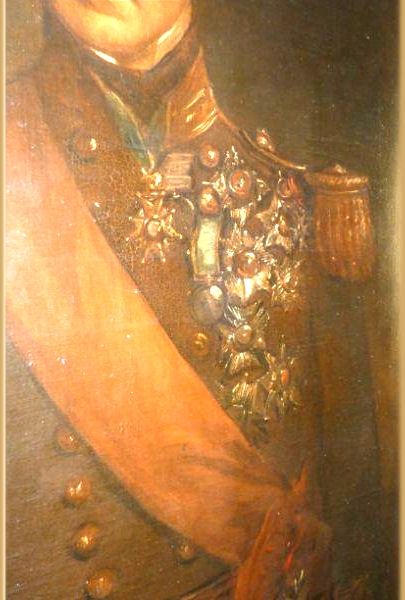
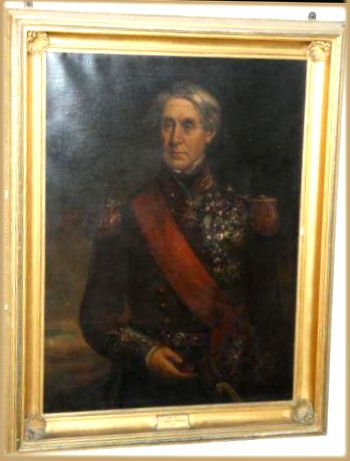
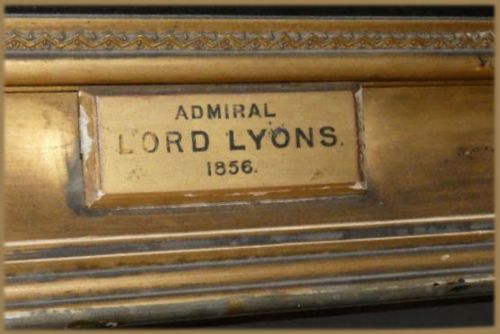
Portrait of Admiral Edmund Lyons, 1st Baron Lyons, GCB, GCMG, KCH, 1790–1858
Portrait of Admiral Edmund Lyons
oil on canvas
101.60 x 76.20 cm ( 40 x 30 in.)
Provenance
Newbold Pacey Hall, Warwickshire
Notes
Admiral Edmund Lyons, 1st Baron Lyons, GCB, GCMG, KCH (21 November 1790 – 23 November 1858) was an eminent British Admiral of the Royal Navy, and an eminent British diplomat, who was responsible for encouraging the Crimean War, during which he was Commander-in-Chief of the Mediterranean Fleet, and for the securing the subsequent allied victory in the conflict, through his efforts at the Siege of Sevastopol (1854–1855) with both the Navy and the British Army.
As a consequence of his linguistic ability and favour with foreign aristocrats, Lyons was appointed to various diplomatic posts, including important ambassadorial positions in Sweden, Switzerland, and to the court of King King Otto of Greece. Lyons's temerity, ambition, and charisma, for which his white-blonde hair and pale complexion became a byword, made him popular with the High Commands of the Royal Navy and British Army and with the British aristocracy, with whom he maintained secret private correspondences to which his naval immediate superiors were not privy.
Edmund Lyons was the father of the diplomat Richard Lyons, 1st Viscount Lyons, the British Ambassador to the USA who solved the Trent Affair, and later British Ambassador to France. Edmund's eldest brother was Vice-Admiral John Lyons (1787 - 1872), who was on board HMS Victory at the Battle of Trafalgar and who served as British Ambassador in Egypt, and his nephews included Sir Algernon McLennan Lyons, Admiral of the Fleet (1833 – 1908).
Edmund Lyons was born at Whitehayes House, Burton, near Christchurch, on 29 November 1790. He was the fourth son of Captain John Lyons, an owner of extensive sugar plantations in Antigua, whose British residence was at St. Austen's, Lymington, Hampshire, and Catherine (née Walrond), daughter of Maine Swete Walrond, 5th Marquis de Vallado. His brothers included Vice-Admiral John Lyons (1787 - 1872), who was on board HMS Victory at the Battle of Trafalgar and who served as British Ambassador in Egypt; Maine Walrond Lyons, (1798–1827), a lieutenant in the Royal Navy who was killed at Battle of Navarino; and Humphrey Lyons (1802–1873), a lieutenant-general in the Indian (Bombay) Army.
His nephews included Sir Algernon McLennan Lyons, Admiral of the Fleet (1833–1908), who served under him during the Crimean War, and Richard Lyons Pearson, Assistant Commissioner of the Metropolitan Police. His godparents were Sir Richard Hussey Bickerton and Lady Bickerton.
Lyons first went to sea on board HMS Terrible in 1798, when he was eight years old. He then returned to England to attend Hyde Abbey School near Winchester, which he attended until 1803, when he joined the Royal Navy and the crew of the frigate HMS Active, with which he remained for four years. He served at the passage of the Dardanelles, under Sir John Duckworth, in February 1807. He was posted to the West Indies later in 1807 and commissioned as a lieutenant in 1809, as which he participated in the capture of Banda Neira, for which he was mentioned for gallantryand promoted.
He then served as a flag-lieutenant, to Rear-Admiral Drury, aboard HMS Minden (74 guns). In 1810, he served in the 18-gun sloop HMS Barracouta notably at the capture, from the Dutch, on 9 August 1810, of Banda Neira in the Moluccas during the Invasion of the Spice Islands: Lyons was involved in the assault on Fort Belgica.
In 1811, a planned attack by the whole fleet on the heavily defended port of Fort Marrack, in the Sunda Strait, Batavia,
Artware Fineart has dated this Victorian Naval Officer Portrait to the 19th Century.
You can view the stock and full dealer information on the Artware Fineart Profile Page

George Frederick Clarke, 1823-1906 Portrait of Admiral Edmund Lyons, 1st Baron Lyons, Gcb, Gcmg, Kch, 1790–1858