30,246  PAGES BROWSED TODAY PAGES TODAY 74  ANTIQUES UPLOADED TODAY NEW ARRIVALS
ID #SA363206
FOR SALE
£2,500
Email
Save
Attributed to James Pollard, 1792–1867 A Mail Coach in a Snow Drift with a Coachman Leaving to Seek Assistance
Artware Fineart
for sale €2,925     $3,175
£2,500

Artware Fineart

Sellingantiques Verified Since Sep 2008
View Dealers Stock Page
Id #SA363206
PDF SHARE
SAVE

Attributed to James Pollard, 1792–1867 A Mail Coach in a Snow Drift with a Coachman Leaving to Seek Assistance

19th century
For Sale by Artware Fineart
Description

James Pollard, 1792–1867

A Mail Coach in a snow drift with a Coachman leaving to seek assistance

oil on canvas

28 x 36 in. (71 x 92 cm.)
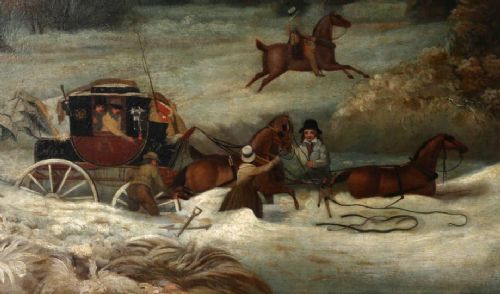
Delivery of the Mail was so important that when Stage coaches became stuck in snow drifts it was important to continue the journey on horseback in order to deliver the mail and seek assistance.

Notes

A stagecoach is a type of covered wagon used to carry passengers and goods inside. It is strongly sprung and generally drawn by four horses, usually four-in-hand. Widely used before the introduction of railway transport, it made regular trips between stages or stations, which were places of rest provided for stagecoach travelers. The business of running stagecoaches or the act of journeying in them was known as staging.
Originating in England, familiar images of the stagecoach are that of a Royal Mail coach passing through a turnpike gate, a Dickensian passenger coach covered in snow pulling up at a coaching inn, and a highwayman demanding a coach to "stand and deliver". The yard of ale drinking glass is associated by legend with stagecoach drivers, though was mainly used for drinking feats and special toasts.

The stagecoach was a four-wheeled vehicle pulled by horses or mules. The primary requirement was that it was used as a public conveyance, running on an established route and schedule. Vehicles that were used, included buckboards and dead axle wagons, surplus Army ambulances and celerity (or mud) coaches. Selection of the vehicle was made by the owner of the stage line, and he would choose the most efficient vehicle based upon the load to be carried, the road conditions, and the weather; and used a two, four or six-horse team based upon those factors and the type of car.

The stagecoach was supported on the thoroughbraces, which were leather straps supporting the body of the carriage and serving as shock absorbing springs (the stagecoach itself was sometimes called a "thoroughbrace"). The front or after compartment of a Continental stagecoach was called a coupé or coupe. An inside passenger or seat was an inside, while an outside passenger or seat was an outside. On the outside were two back seats facing one another, which the British called baskets. In addition to the stage driver who guided the vehicle, a shotgun messenger, armed with a coach gun, often rode as a guard.

The stagecoach traveled at an average speed of about five miles per hour, with the total daily mileage covered being around 60 or 70 miles.[4]

The term "stage" originally referred to the distance between stations on a route, the coach traveling the entire route in "stages," but through metonymy it came to apply to the coach. A fresh set of horses would be staged at the next station, so the coach could continue after a quick stop to rehitch the new horse team. Under this staging system, the resting, watering and feeding of the spent horses would not delay the coach.

The stagecoach was also called a stage or stage carriage. Sub-types included:

mail coach or post coach: used for carrying mail.

mud coach: lighter and smaller, with flat sides and simpler joinery.

road coach: revived in the United Kingdom during the last half of the 19th century.

Crude coaches were built from the 16th century. Without suspension, these coaches achieved very low speeds on the poor quality rutted roads of the time. By the mid 17th century, a basic stagecoach infrastructure had been put in place. The first stagecoach route started in 1610 and ran from Edinburgh to Leith. This was followed by a steady proliferation of other routes around the country. A string of coaching inns operated as stopping points for travellers on the route between London and Liverpool by the mid 17th century. The coach would depart every Monday and Thursday and took roughly ten days to make the journey during the summer months. They

Physical Dimensions
Height
75cm (29.53")
Width
96cm (37.80")
Depth
2cm (0.79")
Declaration

Artware Fineart has dated this Georgian Coaching Oil Painting to the 19th Century.

Reference Numbers
Sellingantiques Reference
SA363206
Dealers Internal Reference
3752
Description
James Pollard, 1792–1867

A Mail Coach in a snow drift with a Coachman leaving to seek assistance

oil on canvas

28 x 36 in. (71 x 92 cm.)

Delivery of the Mail was so important that when Stage coaches became stuck in snow drifts it was important to continue the journey on horseback in order to deliver the mail and seek assistance.
Artware Fineart
fig 1. An oil painting depicting a dark mail coach stuck in deep snow with horses and attendants struggling, while a figure rides off on horseback under a dark winter sky.
fig 1. Attributed to James Pollard, 1792–1867 A Mail Coach in a Snow Drift with a Coachman Leaving to Seek Assistance

Notes

A stagecoach is a type of covered wagon used to carry passengers and goods inside. It is strongly sprung and generally drawn by four horses, usually four-in-hand. Widely used before the introduction of railway transport, it made regular trips between stages or stations, which were places of rest provided for stagecoach travelers. The business of running stagecoaches or the act of journeying in them was known as staging.

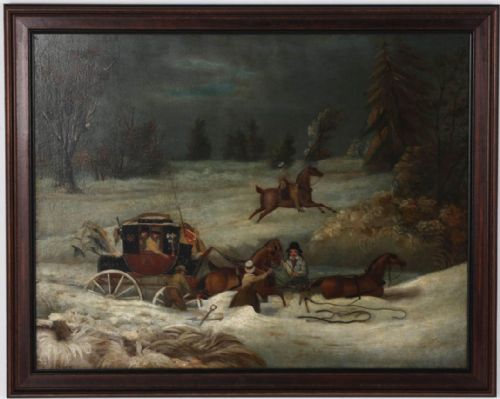
fig 2. An oil painting depicting a dark mail coach stuck in deep snow with horses and attendants struggling, while a figure rides off on horseback under a dark winter sky.
fig 2. Attributed to James Pollard, 1792–1867 A Mail Coach in a Snow Drift with a Coachman Leaving to Seek Assistance

Originating in England, familiar images of the stagecoach are that of a Royal Mail coach passing through a turnpike gate, a Dickensian passenger coach covered in snow pulling up at a coaching inn, and a highwayman demanding a coach to "stand and deliver". The yard of ale drinking glass is associated by legend with stagecoach drivers, though was mainly used for drinking feats and special toasts.

The stagecoach was a four-wheeled vehicle pulled by horses or mules. The primary requirement was that it was used as a public conveyance, running on an established route and schedule. Vehicles that were used, included buckboards and dead axle wagons, surplus Army ambulances and celerity (or mud) coaches. Selection of the vehicle was made by the owner of the stage line, and he would choose the most efficient vehicle based upon the load to be carried, the road conditions, and the weather; and used a two, four or six-horse team based upon those factors and the type of car.

The stagecoach was supported on the thoroughbraces, which were leather straps supporting the body of the carriage and serving as shock absorbing springs (the stagecoach itself was sometimes called a "thoroughbrace"). The front or after compartment of a Continental stagecoach was called a coupé or coupe. An inside passenger or seat was an inside, while an outside passenger or seat was an outside. On the outside were two back seats facing one another, which the British called baskets. In addition to the stage driver who guided the vehicle, a shotgun messenger, armed with a coach gun, often rode as a guard.

The stagecoach traveled at an average speed of about five miles per hour, with the total daily mileage covered being around 60 or 70 miles.[4]

The term "stage" originally referred to the distance between stations on a route, the coach traveling the entire route in "stages," but through metonymy it came to apply to the coach. A fresh set of horses would be staged at the next station, so the coach could continue after a quick stop to rehitch the new horse team. Under this staging system, the resting, watering and feeding of the spent horses would not delay the coach.

The stagecoach was also called a stage or stage carriage. Sub-types included:

mail coach or post coach: used for carrying mail.

mud coach: lighter and smaller, with flat sides and simpler joinery.

road coach: revived in the United Kingdom during the last half of the 19th century.

Crude coaches were built from the 16th century. Without suspension, these coaches achieved very low speeds on the poor quality rutted roads of the time. By the mid 17th century, a basic stagecoach infrastructure had been put in place. The first stagecoach route started in 1610 and ran from Edinburgh to Leith. This was followed by a steady proliferation of other routes around the country. A string of coaching inns operated as stopping points for travellers on the route between London and Liverpool by the mid 17th century. The coach would depart every Monday and Thursday and took roughly ten days to make the journey during the summer months. They

Height
75cm (29.53")
Width
96cm (37.80")
Depth
2cm (0.79")
Date of Manufacture

Artware Fineart has dated this Georgian Coaching Oil Painting to the 19th Century.

Reference Numbers
Sellingantiques Ref
SA363206
Dealers Internal Ref
3752
Artware Fineart
Sellingantiques verified Since Sep 2008
Dealer Profile

You can view the stock and full dealer information on the Artware Fineart Profile Page
PDF SHARE
SAVE
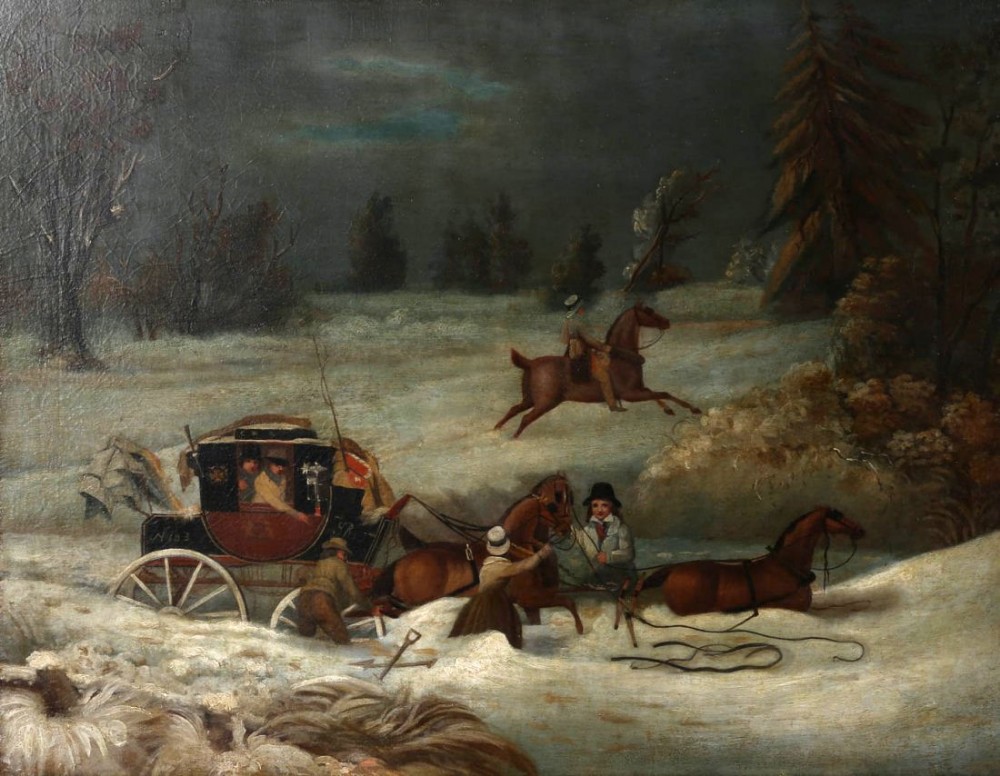
An oil painting depicting a dark mail coach stuck in deep snow with horses and attendants struggling, while a figure rides off on horseback under a dark winter sky.
1 / 3
Archive I An oil painting depicting a dark mail coach stuck in deep snow with horses and attendants struggling, while a figure rides off on horseback under a dark winter sky.

Attributed to James Pollard, 1792–1867 A Mail Coach in a Snow Drift with a Coachman Leaving to Seek Assistance
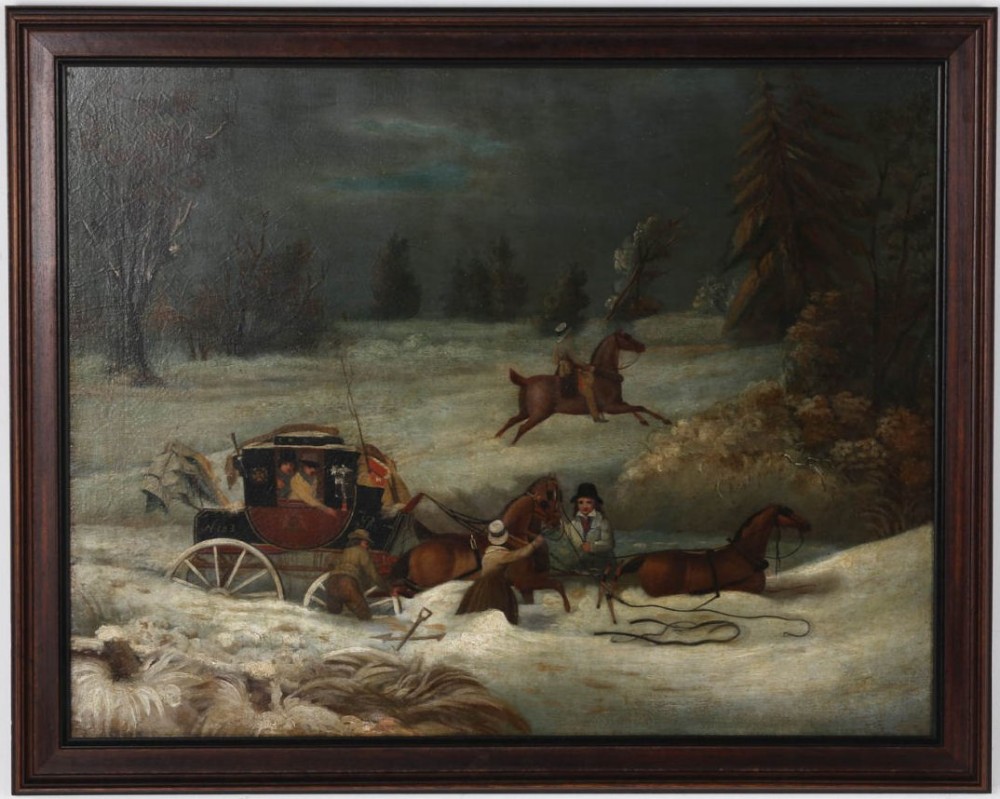
Archive II An oil painting depicting a dark mail coach stuck in deep snow with horses and attendants struggling, while a figure rides off on horseback under a dark winter sky. View II
Archive III An oil painting depicting a dark mail coach stuck in deep snow with horses and attendants struggling, while a figure rides off on horseback under a dark winter sky. View III
Enlarged Archival View
Telephone 07958 699 645
Location
18 La Gare
51 Surrey Row
London
SE1 0BZ
United Kingdom
Verified Since Sep 2008
Items For Sale 243
Items Sold 223
Artware Fineart
Verified Since Sep 2008
View Dealer Info
Location: 18 La Gare , 51 Surrey Row , London , SE1 0BZ , United Kingdom
Verified
Sep 2008
For Sale
243
Sold
223
An oil painting depicting a dark mail coach stuck in deep snow with horses and attendants struggling, while a figure rides off on horseback under a dark winter sky.
Attributed to James Pollard, 1792–1867 A Mail Coach in a snow drift with a Coachman leaving to seek assistance
Ref: SA363206
An oil painting depicting a dark mail coach stuck in deep snow with horses and attendants struggling, while a figure rides off on horseback under a dark winter sky.
Detail View 1
Detail View 2
Archival Detail
Every single antique dealer on our platform is individually approved by our internal team. We verify their professional trade history, ethical standards, and photographic quality to ensure a secure, high-standard buying environment. Upon joining, every dealer agrees to a strict 9-point code of conduct. While issues can occasionally arise, our dealers typically resolve them swiftly and directly with the buyer. In fact, since our founding in 2002, Sellingantiques has only had to step in to help resolve an issue on roughly five occasions—a true testament to the quality of our dealers and their dedication to your happiness.
Our dealers are highly experienced in packing and shipping fragile, high-value antiques. Because you are in direct contact with the dealer, you will be able to easily go through all available shipping and insurance options together to ensure your item arrives safely.
Antiques are the ultimate green purchase. By choosing historical pieces over newly manufactured goods, you completely eliminate the carbon footprint of modern mass production while preserving exceptional, timeless craftsmanship.

Georgian coaching art gained prominence in the early 19th century, documenting the network of mail and stagecoaches across Britain. Artists focused on the technical detail of carriages, horses, and human drama, often portraying the severe weather conditions faced during long journeys.

Paintings from this era were created using hand-ground mineral and organic pigments bound in linseed oil, applied onto stretched linen or cotton canvas. Frames were typically timber finished with water-gilding or dark japanned lacquers.

Authentic period paintings display natural age-related craquelure patterns across the paint surface, original stretcher key construction, and signs of historical oxidisation on the canvas backing. Accurate anatomical representation of horses and historic coach livery details also indicate period authenticity.

A traditional coaching scene works effectively when hung as a focal point above a timber fireplace mantelpiece or within a panelled study or hallway. Pairing historical oil artwork with modern architectural lighting creates an engaging contrast between old and new design elements.

Clean the canvas gently using a dry, soft-bristled brush to remove surface dust. Keep the painting away from direct sunlight, dampness, and localized heat sources, and consult a professional conservator for varnish removal or structural stabilization.
items
Add keywords to the filter
Price
£100
£250000
Era
Movements
Material
Origin
Stock Location
Freshness
Online Payments
Categories