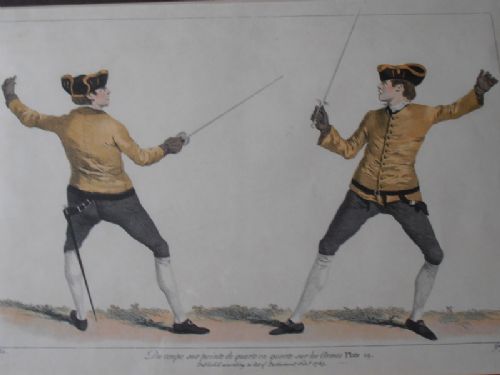
Marlborough Antiques & Interiors has dated this piece to the Victorian era.
GRIGNON, CHARLES (1717-1810), line-engraver, born in Russell Street, Covent Garden, on 25 Oct.
He studied as a boy under Hunert Gravelot [q. v.], and at the age of sixteen went to work under J. P. Le Bas in Paris, where he remained six months. He then returned to London, resumed work under Gravelot and later under G. Scotin, and about 1738 commenced work as an engraver on his own account. Being an excellent artist, combining good draughtsmanship and purity of line, Grignion obtained plenty of employment from the booksellers, and devoted himself to illustrating books, chiefly from the designs of Gravelot, F. Hayman, S. Wale, and J. H. Mortimer. He engraved the early designs of Stothard for Bell's ‘Poets.’ Among his important works were the plates to Albinus's ‘Anatomy,’ published by Knapton in 1757; some of Dalton's ‘Antique Statues;’ ‘Caractacus before the Emperor Claudius at Rome,’ after Hayman; the frontispiece to Smollett's ‘History of England’ (exhibited at the Society of Artists in 1761); ‘Phryne and Zenocrates,’ after Salvator Rosa; plates to Walpole's ‘Anecdotes of Painting;’ various portraits; landscapes after J. F. Barralet, W. Bellers, A. Heckel, and others. Hogarth thought so highly of Grignion that he employed him to work in his own house on his ‘Canvassing for Votes’ (plate ii. of ‘Four Prints of an Election,’ published in 1757), on his ‘Garrick as Richard III,’ his frontispiece and tailpiece to the Society of Artists' Catalogue, 1761, and other plates. Grignion lived for many years in James Street, Covent Garden, but for the last few years of his life resided in Kentish Town. His school of engraving was gradually superseded by the stronger school of Woollett and his followers, and Grignion, after fifty years of useful labour, found his profession insufficient to support himself and his family. In his ninetieth year a subscription was raised for his support, and he lived on charity till 1 Nov. 1810, when he died at his house in Kentish Town in his ninety-fourth year. He was buried in the church of St. John the Baptist, Kentish Town, beside his only son, who had died before him. A portrait of him in his ninety-second year was drawn by T. Uwins, R.A., for Charles Warren, the engraver, who wrote a biography of Grignion on the back; it is now in the print room at the British Museum, where there is also a pencil drawing by Grignion of Captain Richard Tyrell. Grignion was a fellow of the Society of Artists, and one of the committee appointed to form a royal academy
Marlborough Antiques & Interiors has dated this piece to the Victorian era.
We display a variety of antiques at all price levels, including furniture, paintings and other decorative items
You can view the stock and full dealer information on the Marlborough Antiques & Interiors Profile Page
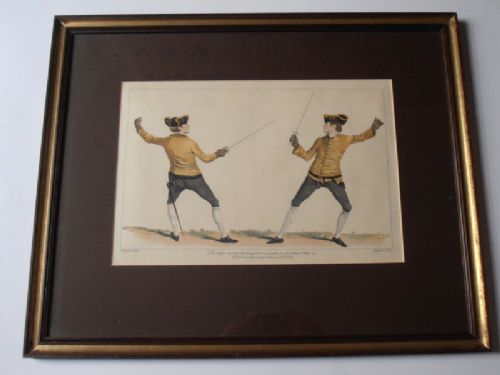
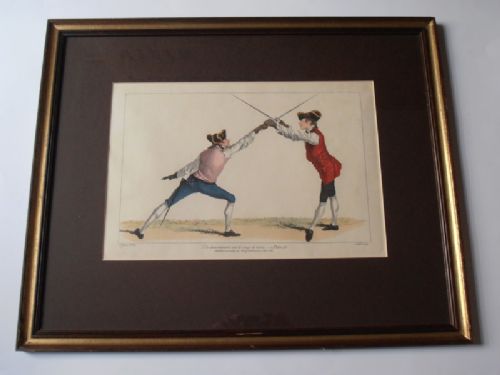
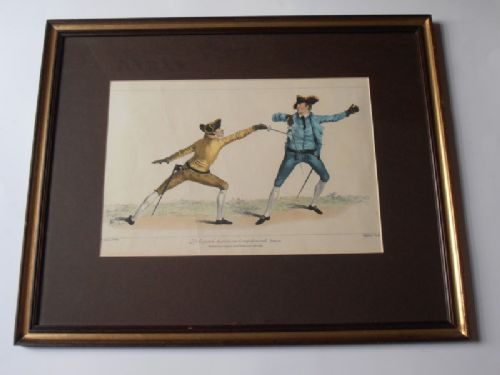
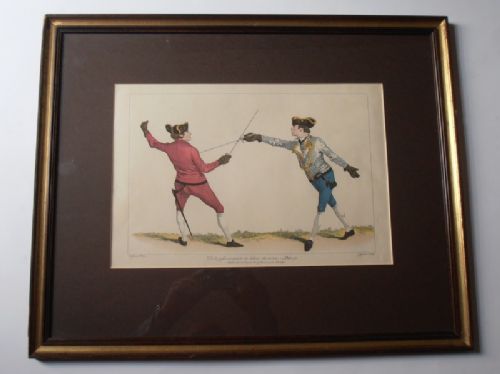
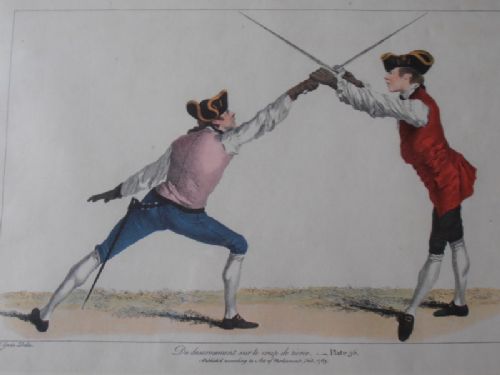
Charles Grignion After J Gwen , Set of Four Fencing Hand Coloured Engravings