

A sensitive portrait probably by one of Johnson's studio pupils (John Evans and Theodore Russel) painted under his supervision.
.JPG)
He found it necessary to have assistants in order to keep pace with the demand for his work.
Certainly this painting is, as Waterhouse wrote, 'very sensitive to character and beautifully drawn and meticulously painted'.
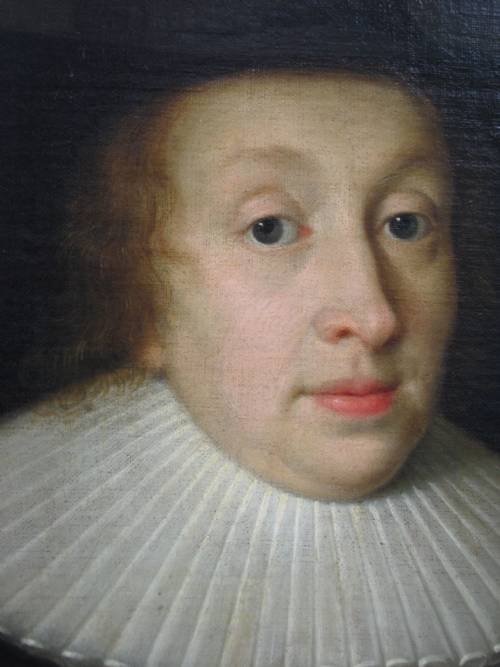
Johnson's portraits are often within a feigned oval, as is this one.
The lady wears the wide brimmed hat fashionable with both sexes at that time and especially favoured by the rich merchant class; her silk gown and fine lace are indications of her wealth and are carefully depicted.
.JPG)
In a period when black clothing was the fashion artists strove to depict the different nuances and textures of the fabrics as convincingly as possible.
They found that black is an ideal background with which to contrast the crisp white linen and rich lace and this dramatically accentuates the face and hand gestures. This extreme opposition between black and white is both austere and exciting, and is a characteristic feature of portraiture of this period.
The sitter has a pensive appearance..looking at the artist, but her thoughts seem far away.
CORNELIUS JOHNSON (Jonson, Jansen, Van Ceulen) 1593-1661 was born in London, the son of Flemish emigres.
Although Waterhouse thought he was trained in Holland it seems more likely (as Collins Baker has it) that Marcus Gheeraerts was his master in London.
Johnson is the most satisfying and 'English' of the portraitists working in England in the 1620s and 30s. He has a fine technique with a restrained and introspective style, with careful attention to the costume details.
His accurate portraits are never flattering but a sober and objective portrayal of his usual sitters: the gentry and lesser nobility. His style, and that of his studio of course, is easily identified by its coolness and restraint.
In 1632 he was made Painter to the King, but his wife's fears of the approaching Civil War caused him to retire to Holland in 1643. He continued to paint for the rest of his life, but was reportedly ruined by the extravagance of his second wife and died a poor man in Utrecht in 1661.
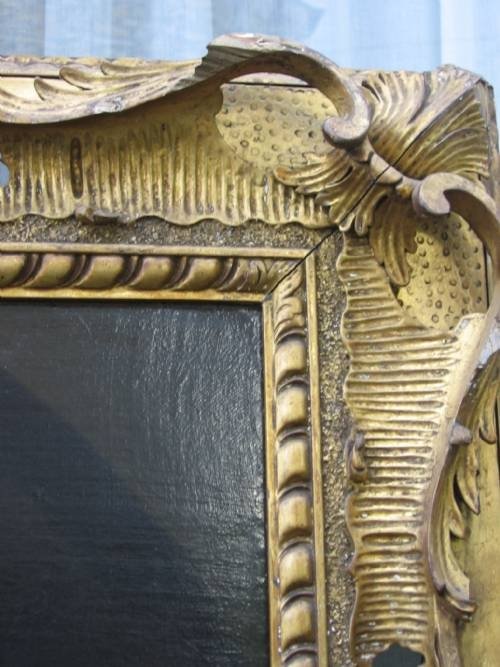
SIZE: 34 x 32 inc. frame.
PROVENANCE: a Somerset Private collection for the last 60/70 years.
Roy and nadine precious: specialists in portraiture from the 16th to the 20th century. Established in 1972.
You can view the stock and full dealer information on the Roy Precious - Antiques & Fine Art Profile Page
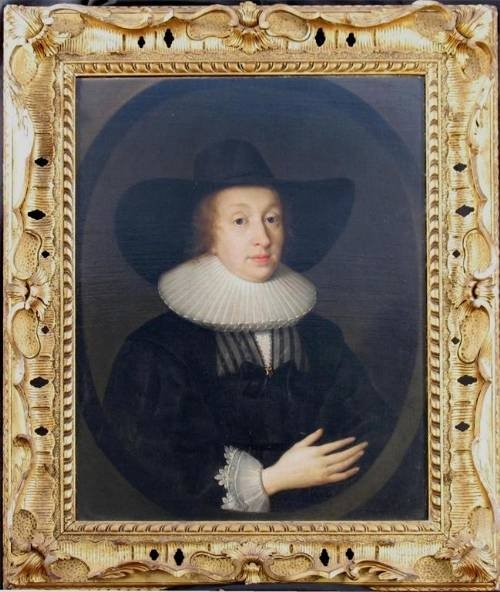
Sold....portrait of a Lady in a Black Hat C.1630; Studio of Cornelius Johnson
