7,706  PAGES BROWSED TODAY PAGES TODAY 36  ANTIQUES UPLOADED TODAY NEW ARRIVALS
ID #SA1227729
FOR SALE
£980
Email
Save
Mezzotint Portrait of Lady Mary Boynton by James Watson After Francis Cotes.
The Mezzotint Man
for sale €1,147     $1,245
£980
The Mezzotint Man

The Mezzotint Man

Sellingantiques Verified Since Mar 2026
View Dealers Stock Page
  • About Us
    Dealers in fine antiquarian portrait prints
Id #SA1227729
PDF SHARE
SAVE

Mezzotint Portrait of Lady Mary Boynton by James Watson After Francis Cotes.

18th century
Description

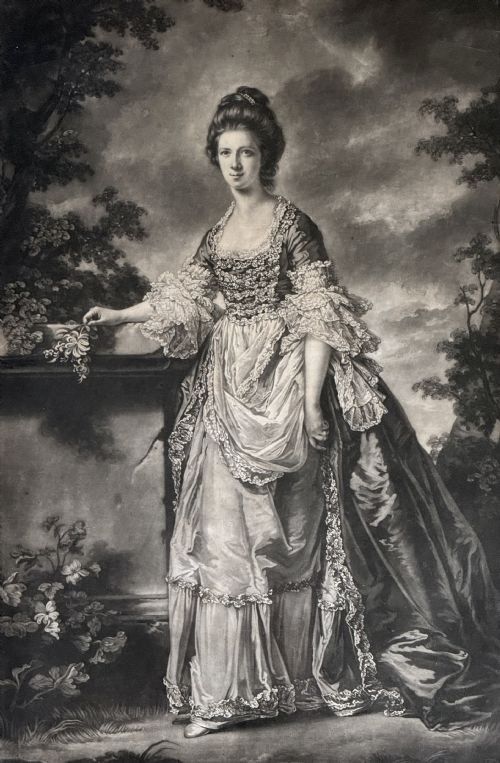
MEZZOTINT PORTRAIT OF LADY MARY BOYNTON BY JAMES WATSON AFTER FRANCIS COTES.

Fine 18th century mezzotint portrait of Lady Mary Boynton by James Watson, after Francis Cotes.

Mary Heblethwayte, Lady Boynton, 1749 - 1815. 2nd wife of Sir G. Boynton; afterwards wife of John Parkhurst, of Catesby Abbey)
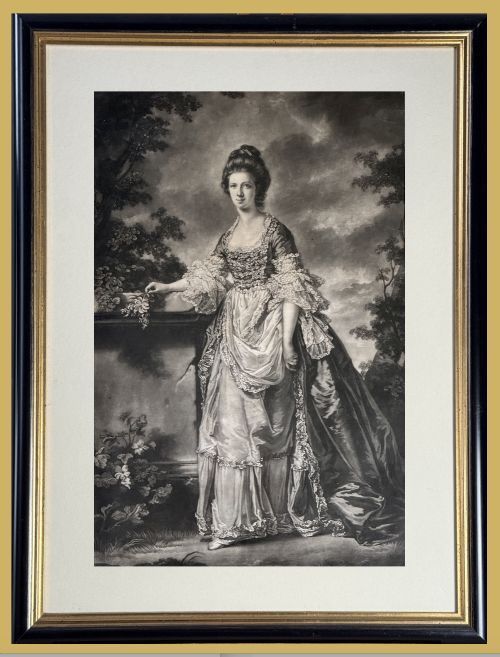
This large and fine mezzotint is in an excellent state of conservation and is housed in a quality ebonised frame with museum quality mount.

The sitter is depicted full length standing in a landscape, leaning her right hand on a stone pedestal adorned with flowers. She wears a highly detailed, fashionable 18th-century gown featuring an intricate lace-trimmed bodice and voluminous ruffled sleeves.

A heavy, dark overskirt draped over a lighter, shimmering underskirt. Her hair is worn in a vertiginous style which is typical of the late 1760s and early 1770s.

Portrait painter Francis Cotes was born in London; the son of a pharmacist and elder brother of the miniaturist Samuel Cotes. He was probably the most accomplished 18th-century British artist in the medium of pastels. From about 1757 he began to produce more work in oils. The drapery in his oil portraits was often painted by Peter Toms, who also worked for Sir Joshua Reynolds. Cotes became a founder member of the Royal Academy of Arts and exhibited 18 portraits at the Academy’s first two exhibitions of 1769 and 1770. However, by 1770 he was suffering from either kidney stones or gallstones. In the hope of dissolving them, Cotes drank a soap-based potion, which led to his death, by poisoning, on 19 July 1770.

James Watson was born in Dublin and initially trained at the Dublin Society. He later travelled to London, probably as a pupil of Irish printmaker James Macardell. Watson exhibited as a mezzotint engraver at the Society of Artists (1762-75), later becoming a fellow and, in 1770, the Director. After Macardell’s death in 1765, he inherited the role of principal engraver to Reynolds. He also engraved works by Gainsborough, Cotes, van Dyck, Rubens and others. From c.1762 he published his own works. He was able to enter semi-retirement by 1778 and, during his career of some 30 years, produced around 200 plates, most of which were portraits. He died in 1790 leaving a daughter, Caroline (also an engraver), and a son, James Edmund (a lawyer).

This mezzotint reflects the style of the Grand Manner of British portraiture, characterised by its idealized setting and the subject's elegant, poised stature.

Date: 1770

Sheet Dimensions: 63cm x 39cm.

Framed Dimensions: 77cm x 58cm.

Price: £980

All prices include UK mainland delivery. For other territories please ask.

Physical Dimensions
Height
77cm (30.31")
Width
58cm (22.83")
Depth
2cm (0.79")
Declaration

The Mezzotint Man has dated this Antique Portrait Mezzotint Engraving to the 18th Century.

Reference Numbers
Sellingantiques Reference
SA1227729
Description
MEZZOTINT PORTRAIT OF LADY MARY BOYNTON BY JAMES WATSON AFTER FRANCIS COTES.

Fine 18th century mezzotint portrait of Lady Mary Boynton by James Watson, after Francis Cotes.

Mary Heblethwayte, Lady Boynton, 1749 - 1815. 2nd wife of Sir G. Boynton; afterwards wife of John Parkhurst, of Catesby Abbey)

This large and fine mezzotint is in an excellent state of conservation and is housed in a quality ebonised frame with museum quality mount.
The Mezzotint Man
fig 1. A framed 18th-century monochrome mezzotint portrait depicting a woman in formal period dress standing beside a stone pedestal in a black frame with a gilt inner border.
fig 1. Mezzotint Portrait of Lady Mary Boynton by James Watson After Francis Cotes.

The sitter is depicted full length standing in a landscape, leaning her right hand on a stone pedestal adorned with flowers. She wears a highly detailed, fashionable 18th-century gown featuring an intricate lace-trimmed bodice and voluminous ruffled sleeves.

A heavy, dark overskirt draped over a lighter, shimmering underskirt. Her hair is worn in a vertiginous style which is typical of the late 1760s and early 1770s.

Portrait painter Francis Cotes was born in London; the son of a pharmacist and elder brother of the miniaturist Samuel Cotes. He was probably the most accomplished 18th-century British artist in the medium of pastels. From about 1757 he began to produce more work in oils. The drapery in his oil portraits was often painted by Peter Toms, who also worked for Sir Joshua Reynolds. Cotes became a founder member of the Royal Academy of Arts and exhibited 18 portraits at the Academy’s first two exhibitions of 1769 and 1770. However, by 1770 he was suffering from either kidney stones or gallstones. In the hope of dissolving them, Cotes drank a soap-based potion, which led to his death, by poisoning, on 19 July 1770.

James Watson was born in Dublin and initially trained at the Dublin Society. He later travelled to London, probably as a pupil of Irish printmaker James Macardell. Watson exhibited as a mezzotint engraver at the Society of Artists (1762-75), later becoming a fellow and, in 1770, the Director. After Macardell’s death in 1765, he inherited the role of principal engraver to Reynolds. He also engraved works by Gainsborough, Cotes, van Dyck, Rubens and others. From c.1762 he published his own works. He was able to enter semi-retirement by 1778 and, during his career of some 30 years, produced around 200 plates, most of which were portraits. He died in 1790 leaving a daughter, Caroline (also an engraver), and a son, James Edmund (a lawyer).

This mezzotint reflects the style of the Grand Manner of British portraiture, characterised by its idealized setting and the subject's elegant, poised stature.

Date: 1770

Sheet Dimensions: 63cm x 39cm.

Framed Dimensions: 77cm x 58cm.

Price: £980

All prices include UK mainland delivery. For other territories please ask.

Height
77cm (30.31")
Width
58cm (22.83")
Depth
2cm (0.79")
Date of Manufacture

The Mezzotint Man has dated this Antique Portrait Mezzotint Engraving to the 18th Century.

Reference Numbers
Sellingantiques Ref
SA1227729
The Mezzotint Man
The Mezzotint Man
Sellingantiques verified Since Mar 2026

Dealers in fine antiquarian portrait prints

Dealer Profile

You can view the stock and full dealer information on the The Mezzotint Man Profile Page
PDF SHARE
SAVE
A framed 18th-century monochrome mezzotint portrait depicting a woman in formal period dress standing beside a stone pedestal in a black frame with a gilt inner border.
1 / 2
Archive I A framed 18th-century monochrome mezzotint portrait depicting a woman in formal period dress standing beside a stone pedestal in a black frame with a gilt inner border.

MEZZOTINT PORTRAIT OF LADY MARY BOYNTON BY JAMES WATSON AFTER FRANCIS COTES.

Archive II A framed 18th-century monochrome mezzotint portrait depicting a woman in formal period dress standing beside a stone pedestal in a black frame with a gilt inner border. View II
Enlarged Archival View
Telephone 07889 859729
Location
North Yorkshire
United Kingdom
Verified Since Mar 2026
Items For Sale 33
Items Sold 9
The Mezzotint Man
The Mezzotint Man
Verified Since Mar 2026
View Dealer Info
Location: North Yorkshire, United Kingdom
Verified
Mar 2026
For Sale
33
Sold
9
A framed 18th-century monochrome mezzotint portrait depicting a woman in formal period dress standing beside a stone pedestal in a black frame with a gilt inner border.
MEZZOTINT PORTRAIT OF LADY MARY BOYNTON BY JAMES WATSON AFTER FRANCIS COTES.
Ref: SA1227729
A framed 18th-century monochrome mezzotint portrait depicting a woman in formal period dress standing beside a stone pedestal in a black frame with a gilt inner border.
Detail View 1
Archival Detail
Every single antique dealer on our platform is individually approved by our internal team. We verify their professional trade history, ethical standards, and photographic quality to ensure a secure, high-standard buying environment. Upon joining, every dealer agrees to a strict 9-point code of conduct. While issues can occasionally arise, our dealers typically resolve them swiftly and directly with the buyer. In fact, since our founding in 2002, Sellingantiques has only had to step in to help resolve an issue on roughly five occasions—a true testament to the quality of our dealers and their dedication to your happiness.
Our dealers are highly experienced in packing and shipping fragile, high-value antiques. Because you are in direct contact with the dealer, you will be able to easily go through all available shipping and insurance options together to ensure your item arrives safely.
Antiques are the ultimate green purchase. By choosing historical pieces over newly manufactured goods, you completely eliminate the carbon footprint of modern mass production while preserving exceptional, timeless craftsmanship.

A mezzotint portrait is an intaglio print created using a copper plate worked with a metal tool called a rocker to create thousands of tiny dots. This technique allowed printmakers in the Georgian era to reproduce oil paintings with continuous tonal depth and subtle shading.

Traditional mezzotints were printed on handmade rag paper using oil-based black ink. The images were pulled from hand-engraved copper plates that were inked and wiped prior to passing through a high-pressure rolling press.

Authentic 18th-century mezzotints feature visible plate impression marks around the image border, hand-laid paper texture often with watermarks, and tonal variations in dark areas rather than uniform mechanical dot patterns.

An antique portrait print can be mounted above a console table or sideboard, incorporated into a gallery wall alongside contemporary artwork, or placed in a study to provide historical contrast against modern furnishings.

To preserve antique paper prints, house them behind UV-filtering glass using acid-free mounting materials. Avoid hanging prints in direct sunlight or humid areas, and dust the exterior frame gently with a dry soft cloth.
items
Add keywords to the filter
Price
£100
£250000
Era
Movements
Material
Origin
Stock Location
Freshness
Online Payments
Categories