13,443  PAGES BROWSED TODAY PAGES TODAY 36  ANTIQUES UPLOADED TODAY NEW ARRIVALS
ID #SA1192156
FOR SALE
£950
Email
Save
Pair of 18th-century Naïve Topographical Paintings of Staplecross, Sussex
Antiques Decorative (Sussex)
for sale €1,112     $1,207
£950
Antiques Decorative (Sussex)

Antiques Decorative (Sussex)

Sellingantiques Verified Since May 2024
View Dealers Stock Page
  • About Us
    Timeless treasures: elevate your space with decorative art and antiques
Id #SA1192156
PDF SHARE
SAVE

Pair of 18th-century Naïve Topographical Paintings of Staplecross, Sussex

18th century
Description

Pair of 18th-Century Naïve Topographical Paintings of Staplecross, Sussex

Oil on pine panels, English School, circa 1740–1765

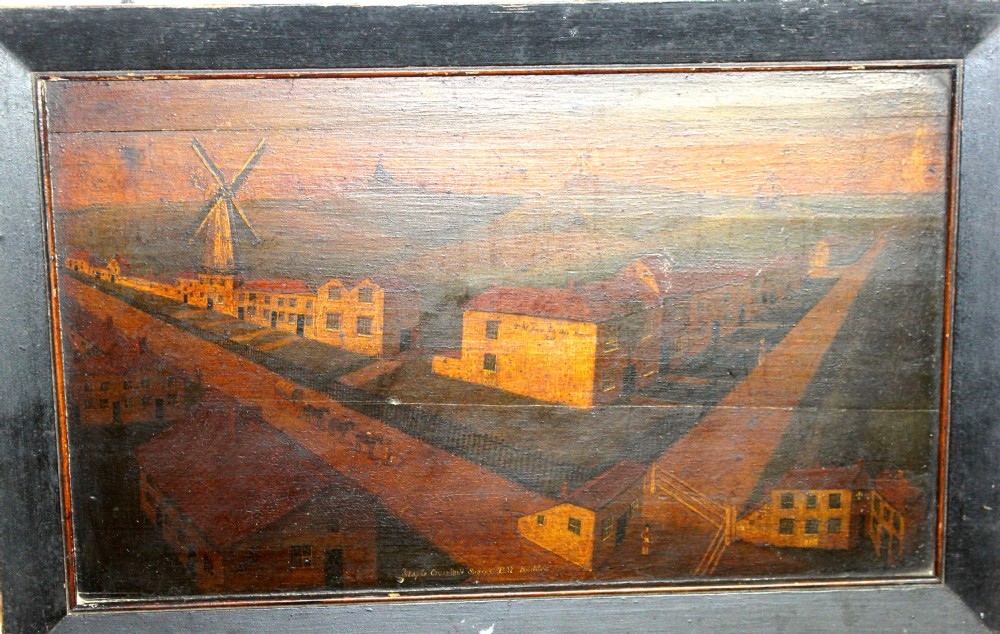
This rare and characterful pair of mid-18th-century vernacular oil paintings depict views of Staplecross in East Sussex,  also features the Cross Inn rendered in a naïve yet highly evocative provincial manner. Executed on pine panels and housed in simple early black-painted frames, the works function as documentary topographical records rather than purely decorative landscapes, preserving a visual account of the settlement and its working infrastructure during the Georgian period.

One panel presents an elevated, almost plan-like view of the village, with receding roads, clustered vernacular buildings, and a distinctive sense of spatial stacking typical of rural painters working outside academic conventions. The intuitive perspective and simplified architectural forms suggest a painter concerned with recording place and layout rather than illusionistic refinement. The restrained palette of warm earth tones, ochres, and umbers, thinly applied and absorbed into the timber support, is consistent with 18th-century provincial technique.

The companion panel depicts a windmill and associated buildings, identified by its painted inscription as “Staple Cross Mill, Sussex – Its Builders.” This inscription, integral to the paint surface and contemporary with the work, indicates the picture was likely made to commemorate the construction or rebuilding of the mill — a point of communal and economic importance. Such record paintings were often commissioned by estate owners, local patrons, or working communities to mark significant infrastructure or settlement development. The windmill acts as a locational anchor, reinforcing the paintings’ documentary function.

A second, later ink inscription on one panel reads “T.M. born in this house 1781.” Written over the paint surface in a different hand, this appears to be a personal or familial annotation added decades after the paintings were made, suggesting the works remained locally owned and connected to the buildings depicted. This layered history enhances their value as lived objects embedded in the social fabric of the area.

Stylistically, the pair aligns with Sussex and Kent vernacular painting traditions, where estate views, house portraits, and village records were produced by self-taught or regionally trained hands. The emphasis on buildings, roads, and functional structures over landscape drama distinguishes them from academic landscape painting and places them firmly within the tradition of practical, place-based art.

Condition reflects honest age: surface wear, oxidation, and stable craquelure consistent with oil on softwood supports, with no evidence of later overpainting. These qualities contribute to their authenticity and historical presence.

As a surviving pair with inscriptions identifying both place and purpose, these paintings represent a scarce and appealing example of 18th-century English provincial topographical art, offering both aesthetic charm and tangible connection to Sussex local history.

Physical Dimensions
Height
32cm (12.60")
Width
49cm (19.29")
Declaration

Antiques Decorative (Sussex) has dated this Naive Topographical Landscape Painting to the 1750s.

Reference Numbers
Sellingantiques Reference
SA1192156
Dealers Notes

Shipping Options Delivery Time Price

Furniture Shipping UK Delivery in 1-2 weeks £75

Paintings UK, £35

Paintings rest of world please contact for a quote

EU Furniture delivery Contact us for a quote delivery within 4 weeks

*International delivery buyers are responsible for import charges and local taxes*

**Worldwide delivery Contact us for a quote**

For payments don't hesitate to get in touch with us for Visa/credit/bank transfer.

Description
Pair of 18th-Century Naïve Topographical Paintings of Staplecross, Sussex

Oil on pine panels, English School, circa 1740–1765

This rare and characterful pair of mid-18th-century vernacular oil paintings depict views of Staplecross in East Sussex,  also features the Cross Inn rendered in a naïve yet highly evocative provincial manner. Executed on pine panels and housed in simple early black-painted frames, the works function as documentary topographical records rather than purely decorative landscapes, preserving a visual account of the settlement and its working infrastructure during the Georgian period.

One panel presents an elevated, almost plan-like view of the village, with receding roads, clustered vernacular buildings, and a distinctive sense of spatial stacking typical of rural painters working outside academic conventions.

The intuitive perspective and simplified architectural forms suggest a painter concerned with recording place and layout rather than illusionistic refinement.
Antiques Decorative (Sussex)

The restrained palette of warm earth tones, ochres, and umbers, thinly applied and absorbed into the timber support, is consistent with 18th-century provincial technique.

fig 1. An 18th-century naive topographical oil painting of Staplecross in Sussex depicting village roads, buildings, and a windmill in a dark wooden frame.
fig 1. Pair of 18th-century Naïve Topographical Paintings of Staplecross, Sussex

The companion panel depicts a windmill and associated buildings, identified by its painted inscription as “Staple Cross Mill, Sussex – Its Builders.” This inscription, integral to the paint surface and contemporary with the work, indicates the picture was likely made to commemorate the construction or rebuilding of the mill — a point of communal and economic importance. Such record paintings were often commissioned by estate owners, local patrons, or working communities to mark significant infrastructure or settlement development. The windmill acts as a locational anchor, reinforcing the paintings’ documentary function.

fig 2. An 18th-century naive topographical oil painting of Staplecross in Sussex depicting village roads, buildings, and a windmill in a dark wooden frame.
fig 2. Pair of 18th-century Naïve Topographical Paintings of Staplecross, Sussex

A second, later ink inscription on one panel reads “T.M. born in this house 1781.” Written over the paint surface in a different hand, this appears to be a personal or familial annotation added decades after the paintings were made, suggesting the works remained locally owned and connected to the buildings depicted. This layered history enhances their value as lived objects embedded in the social fabric of the area.

fig 3. An 18th-century naive topographical oil painting of Staplecross in Sussex depicting village roads, buildings, and a windmill in a dark wooden frame.
fig 3. Pair of 18th-century Naïve Topographical Paintings of Staplecross, Sussex

Stylistically, the pair aligns with Sussex and Kent vernacular painting traditions, where estate views, house portraits, and village records were produced by self-taught or regionally trained hands. The emphasis on buildings, roads, and functional structures over landscape drama distinguishes them from academic landscape painting and places them firmly within the tradition of practical, place-based art.

fig 4. An 18th-century naive topographical oil painting of Staplecross in Sussex depicting village roads, buildings, and a windmill in a dark wooden frame.
fig 4. Pair of 18th-century Naïve Topographical Paintings of Staplecross, Sussex

Condition reflects honest age: surface wear, oxidation, and stable craquelure consistent with oil on softwood supports, with no evidence of later overpainting. These qualities contribute to their authenticity and historical presence.

fig 5. An 18th-century naive topographical oil painting of Staplecross in Sussex depicting village roads, buildings, and a windmill in a dark wooden frame.
fig 5. Pair of 18th-century Naïve Topographical Paintings of Staplecross, Sussex

As a surviving pair with inscriptions identifying both place and purpose, these paintings represent a scarce and appealing example of 18th-century English provincial topographical art, offering both aesthetic charm and tangible connection to Sussex local history.

Height
32cm (12.60")
Width
49cm (19.29")
Date of Manufacture

Antiques Decorative (Sussex) has dated this Naive Topographical Landscape Painting to the 1750s.

Reference Numbers
Sellingantiques Ref
SA1192156
Antiques Decorative (Sussex)
Sellingantiques verified Since May 2024

Timeless treasures: elevate your space with decorative art and antiques

Dealer Profile

You can view the stock and full dealer information on the Antiques Decorative (Sussex) Profile Page
PDF SHARE
SAVE
An 18th-century naive topographical oil painting of Staplecross in Sussex depicting village roads, buildings, and a windmill in a dark wooden frame.
1 / 7
Archive I An 18th-century naive topographical oil painting of Staplecross in Sussex depicting village roads, buildings, and a windmill in a dark wooden frame.

Pair of 18th-century Naïve Topographical Paintings of Staplecross, Sussex

Archive II An 18th-century naive topographical oil painting of Staplecross in Sussex depicting village roads, buildings, and a windmill in a dark wooden frame. View II
Archive III An 18th-century naive topographical oil painting of Staplecross in Sussex depicting village roads, buildings, and a windmill in a dark wooden frame. View III
Archive IV An 18th-century naive topographical oil painting of Staplecross in Sussex depicting village roads, buildings, and a windmill in a dark wooden frame. View IV
Archive V An 18th-century naive topographical oil painting of Staplecross in Sussex depicting village roads, buildings, and a windmill in a dark wooden frame. View V
Archive VI An 18th-century naive topographical oil painting of Staplecross in Sussex depicting village roads, buildings, and a windmill in a dark wooden frame. View VI
Archive VII An 18th-century naive topographical oil painting of Staplecross in Sussex depicting village roads, buildings, and a windmill in a dark wooden frame. View VII
Enlarged Archival View
Telephone 07565 761917
Location
East Sussex
United Kingdom

By appointment only.
Verified Since May 2024
Items For Sale 59
Items Sold 38
Antiques Decorative (Sussex)
Verified Since May 2024
View Dealer Info
Location: East Sussex, United Kingdom, , By appointment only.
Verified
May 2024
For Sale
59
Sold
38
An 18th-century naive topographical oil painting of Staplecross in Sussex depicting village roads, buildings, and a windmill in a dark wooden frame.
Pair of 18th-Century Naïve Topographical Paintings of Staplecross, Sussex
Ref: SA1192156
An 18th-century naive topographical oil painting of Staplecross in Sussex depicting village roads, buildings, and a windmill in a dark wooden frame.
Detail View 1
Detail View 2
Detail View 3
Detail View 4
Detail View 6
Detail View 8
Archival Detail
Every single antique dealer on our platform is individually approved by our internal team. We verify their professional trade history, ethical standards, and photographic quality to ensure a secure, high-standard buying environment. Upon joining, every dealer agrees to a strict 9-point code of conduct. While issues can occasionally arise, our dealers typically resolve them swiftly and directly with the buyer. In fact, since our founding in 2002, Sellingantiques has only had to step in to help resolve an issue on roughly five occasions—a true testament to the quality of our dealers and their dedication to your happiness.
Our dealers are highly experienced in packing and shipping fragile, high-value antiques. Because you are in direct contact with the dealer, you will be able to easily go through all available shipping and insurance options together to ensure your item arrives safely.
Antiques are the ultimate green purchase. By choosing historical pieces over newly manufactured goods, you completely eliminate the carbon footprint of modern mass production while preserving exceptional, timeless craftsmanship.

Naive topographical paintings from the 18th century were created by self-taught artists, focusing on recording specific local landscapes, villages, and architecture with flattened perspective and direct graphical detail.

Artists during this era typically applied oil paints onto solid wood panels or stretched canvas, finished with natural varnishes and framed in simple stained pine or ebonised timber.

Authentic period works display natural craquelure across the paint surface, historic wood shrinkage or panel movement, hand-carved framing, and natural oxidisation on the reverse.

These historical works serve as focal points when mounted above sideboards or within gallery walls, providing a grounding historical element against contemporary or neutral backdrops.

Position paintings away from direct heat sources, draughts, and sunlight to prevent panel warping. Dust gently using a dry, soft brush without applying water or chemical solvents.
items
Add keywords to the filter
Price
£100
£250000
Era
Movements
Material
Origin
Stock Location
Freshness
Online Payments
Categories