7,683  PAGES BROWSED TODAY PAGES TODAY 36  ANTIQUES UPLOADED TODAY NEW ARRIVALS
ID #SA1189405
FOR SALE
£1,000
Email
Save
Exceptional Meiji Period Satsuma Vase, Attributed to the Kinkozan Circle, C. 1890
Ritas Bazaar
Id #SA1189405
PDF SHARE
SAVE

Exceptional Meiji Period Satsuma Vase, Attributed to the Kinkozan Circle, C. 1890

19th century
For Sale by Ritas Bazaar
Description

This refined miniature Satsuma vase represents a level of craftsmanship reserved for the most accomplished masters of the late Meiji period. Executed around the end of the 19th century, the vase combines technical virtuosity, compositional balance, and an extraordinary density of detail within a compact cabinet scale.

The surface is animated by a finely painted genre scene depicting women and a child in a landscaped garden setting, surrounded by flowering trees and delicate seasonal flora. The figures are rendered with remarkable naturalism: facial features remain balanced and expressive even under magnification, while the proportions of garments and posture are preserved with exceptional accuracy.

Particularly notable is the use of meticulously applied gold stippling, arranged in precise and evenly spaced rows across the background. This technique—often compared to sharkskin or pointillist texturing—is closely associated with the highest tier of Kyoto Satsuma decoration and recalls the refined surface treatments seen in the works of Yabu Meizan. The gold is not merely painted but carefully layered to create depth and visual rhythm.

The relief decoration (moriage) is another defining feature. Flowers and elements of the women’s costumes are raised to the touch, a labor-intensive technique reserved for elite workshop production. Achieving such refinement on a vase of modest size demands exceptional control and mastery; the consistency and clarity of detail here strongly indicate the hand of a highly skilled artist.

The base shows traces of a former signature or inscription, now worn and unreadable. While a definitive attribution is therefore impossible, specialists commonly associate works of this style, quality, and technical language with Kinkozan or a closely related master within the Kinkozan circle.

Beyond its artistic merits, this vase embodies the enduring appeal of genuine Meiji-period Satsuma. In periods of market uncertainty, museum-quality decorative arts with proven historical significance continue to attract collectors and investors alike, serving as a stable and tangible store of cultural value.

Measurements

Dimensions: Height 12.3 cm; Diameter 7 cm.

Shipping & Packaging

Please study the accompanying photographs carefully as they form an integral part of this description.

If you have any questions, we will be happy to answer them.

The item will be shipped with full tracking and insurance.

It is important to note that shipping costs include labour, packaging and postage.

Physical Dimensions
Height
12.3cm (4.84")
Width
7cm (2.76")
Depth
7cm (2.76")
Declaration

Ritas Bazaar has dated this Japanese Meiji Satsuma Vase to the 19th Century.

Reference Numbers
Sellingantiques Reference
SA1189405
Dealers Internal Reference
B1603
Description
This refined miniature Satsuma vase represents a level of craftsmanship reserved for the most accomplished masters of the late Meiji period.
Executed around the end of the 19th century, the vase combines technical virtuosity, compositional balance, and an extraordinary density of detail within a compact cabinet scale.
Ritas Bazaar
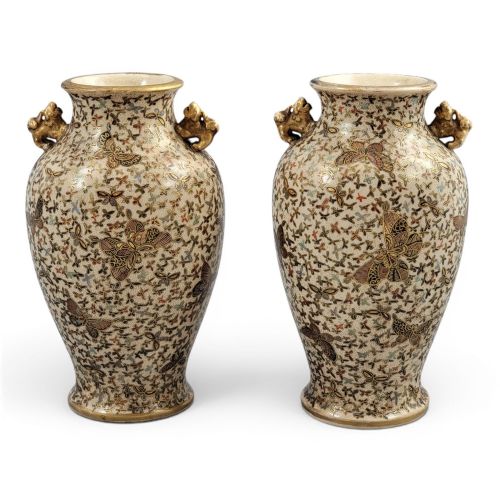
fig 1. An antique Japanese Satsuma earthenware vase featuring figures painted in polychrome enamels and gold details against a cream crackle glaze, bordered by cobalt blue and gilded bands.
fig 1. Exceptional Meiji Period Satsuma Vase, Attributed to the Kinkozan Circle, C. 1890

The surface is animated by a finely painted genre scene depicting women and a child in a landscaped garden setting, surrounded by flowering trees and delicate seasonal flora. The figures are rendered with remarkable naturalism: facial features remain balanced and expressive even under magnification, while the proportions of garments and posture are preserved with exceptional accuracy.

fig 2. An antique Japanese Satsuma earthenware vase featuring figures painted in polychrome enamels and gold details against a cream crackle glaze, bordered by cobalt blue and gilded bands.
fig 2. Exceptional Meiji Period Satsuma Vase, Attributed to the Kinkozan Circle, C. 1890

Particularly notable is the use of meticulously applied gold stippling, arranged in precise and evenly spaced rows across the background. This technique—often compared to sharkskin or pointillist texturing—is closely associated with the highest tier of Kyoto Satsuma decoration and recalls the refined surface treatments seen in the works of Yabu Meizan. The gold is not merely painted but carefully layered to create depth and visual rhythm.

fig 3. An antique Japanese Satsuma earthenware vase featuring figures painted in polychrome enamels and gold details against a cream crackle glaze, bordered by cobalt blue and gilded bands.
fig 3. Exceptional Meiji Period Satsuma Vase, Attributed to the Kinkozan Circle, C. 1890

The relief decoration (moriage) is another defining feature. Flowers and elements of the women’s costumes are raised to the touch, a labor-intensive technique reserved for elite workshop production. Achieving such refinement on a vase of modest size demands exceptional control and mastery; the consistency and clarity of detail here strongly indicate the hand of a highly skilled artist.

fig 4. An antique Japanese Satsuma earthenware vase featuring figures painted in polychrome enamels and gold details against a cream crackle glaze, bordered by cobalt blue and gilded bands.
fig 4. Exceptional Meiji Period Satsuma Vase, Attributed to the Kinkozan Circle, C. 1890

The base shows traces of a former signature or inscription, now worn and unreadable. While a definitive attribution is therefore impossible, specialists commonly associate works of this style, quality, and technical language with Kinkozan or a closely related master within the Kinkozan circle.

fig 5. An antique Japanese Satsuma earthenware vase featuring figures painted in polychrome enamels and gold details against a cream crackle glaze, bordered by cobalt blue and gilded bands.
fig 5. Exceptional Meiji Period Satsuma Vase, Attributed to the Kinkozan Circle, C. 1890

Beyond its artistic merits, this vase embodies the enduring appeal of genuine Meiji-period Satsuma. In periods of market uncertainty, museum-quality decorative arts with proven historical significance continue to attract collectors and investors alike, serving as a stable and tangible store of cultural value.

fig 6. An antique Japanese Satsuma earthenware vase featuring figures painted in polychrome enamels and gold details against a cream crackle glaze, bordered by cobalt blue and gilded bands.
fig 6. Exceptional Meiji Period Satsuma Vase, Attributed to the Kinkozan Circle, C. 1890

Measurements

Dimensions: Height 12.3 cm; Diameter 7 cm.

Shipping & Packaging

Please study the accompanying photographs carefully as they form an integral part of this description.

If you have any questions, we will be happy to answer them.

The item will be shipped with full tracking and insurance.

It is important to note that shipping costs include labour, packaging and postage.

Height
12.3cm (4.84")
Width
7cm (2.76")
Depth
7cm (2.76")
Date of Manufacture

Ritas Bazaar has dated this Japanese Meiji Satsuma Vase to the 19th Century.

Reference Numbers
Sellingantiques Ref
SA1189405
Dealers Internal Ref
B1603
Ritas Bazaar
Sellingantiques verified Since Nov 2025
Dealer Profile

You can view the stock and full dealer information on the Ritas Bazaar Profile Page

PDF SHARE
SAVE
An antique Japanese Satsuma earthenware vase featuring figures painted in polychrome enamels and gold details against a cream crackle glaze, bordered by cobalt blue and gilded bands.
1 / 10
Archive I An antique Japanese Satsuma earthenware vase featuring figures painted in polychrome enamels and gold details against a cream crackle glaze, bordered by cobalt blue and gilded bands.

Exceptional Meiji Period Satsuma Vase, Attributed to the Kinkozan Circle, c. 1890

Archive II An antique Japanese Satsuma earthenware vase featuring figures painted in polychrome enamels and gold details against a cream crackle glaze, bordered by cobalt blue and gilded bands. View II
Archive III An antique Japanese Satsuma earthenware vase featuring figures painted in polychrome enamels and gold details against a cream crackle glaze, bordered by cobalt blue and gilded bands. View III
Archive IV An antique Japanese Satsuma earthenware vase featuring figures painted in polychrome enamels and gold details against a cream crackle glaze, bordered by cobalt blue and gilded bands. View IV
Archive V An antique Japanese Satsuma earthenware vase featuring figures painted in polychrome enamels and gold details against a cream crackle glaze, bordered by cobalt blue and gilded bands. View V
Archive VI An antique Japanese Satsuma earthenware vase featuring figures painted in polychrome enamels and gold details against a cream crackle glaze, bordered by cobalt blue and gilded bands. View VI
Archive VII An antique Japanese Satsuma earthenware vase featuring figures painted in polychrome enamels and gold details against a cream crackle glaze, bordered by cobalt blue and gilded bands. View VII
Archive VIII An antique Japanese Satsuma earthenware vase featuring figures painted in polychrome enamels and gold details against a cream crackle glaze, bordered by cobalt blue and gilded bands. View VIII
Archive IX An antique Japanese Satsuma earthenware vase featuring figures painted in polychrome enamels and gold details against a cream crackle glaze, bordered by cobalt blue and gilded bands. View IX
Archive X An antique Japanese Satsuma earthenware vase featuring figures painted in polychrome enamels and gold details against a cream crackle glaze, bordered by cobalt blue and gilded bands. View X
FURTHER BROWSING

Visitors also looked at these ⇣

Enlarged Archival View
Telephone 07434 626011
Location
Hertfordshire
United Kingdom
Verified Since Nov 2025
Items For Sale 223
Items Sold 37
Ritas Bazaar
Verified Since Nov 2025
View Dealer Info
Location: Hertfordshire, United Kingdom
Verified
Nov 2025
For Sale
223
Sold
37
An antique Japanese Satsuma earthenware vase featuring figures painted in polychrome enamels and gold details against a cream crackle glaze, bordered by cobalt blue and gilded bands.
Exceptional Meiji Period Satsuma Vase, Attributed to the Kinkozan Circle, c. 1890
Ref: SA1189405
An antique Japanese Satsuma earthenware vase featuring figures painted in polychrome enamels and gold details against a cream crackle glaze, bordered by cobalt blue and gilded bands.
Detail View 1
Detail View 2
Detail View 3
Detail View 4
Detail View 5
Detail View 6
Detail View 7
Detail View 8
Detail View 9
Archival Detail
Every single antique dealer on our platform is individually approved by our internal team. We verify their professional trade history, ethical standards, and photographic quality to ensure a secure, high-standard buying environment. Upon joining, every dealer agrees to a strict 9-point code of conduct. While issues can occasionally arise, our dealers typically resolve them swiftly and directly with the buyer. In fact, since our founding in 2002, Sellingantiques has only had to step in to help resolve an issue on roughly five occasions—a true testament to the quality of our dealers and their dedication to your happiness.
Our dealers are highly experienced in packing and shipping fragile, high-value antiques. Because you are in direct contact with the dealer, you will be able to easily go through all available shipping and insurance options together to ensure your item arrives safely.
Antiques are the ultimate green purchase. By choosing historical pieces over newly manufactured goods, you completely eliminate the carbon footprint of modern mass production while preserving exceptional, timeless craftsmanship.

Satsuma ware from the Meiji era (18681912) is recognisable by its cream-coloured earthenware body, finely crazed glaze, and detailed overglaze enamel and gilt decoration depicting figurative or floral scenes.

Authentic Satsuma pottery was crafted using low-fired earthenware clay featuring a delicate crackle glaze, decorated with multi-coloured overglaze enamels and applied gold leaf or paint.

Genuine Meiji Satsuma ceramics feature fine micro-crackle glazes, dense hand-painted enamelwork, precise gilding, and frequently bear painter or workshop marks on the base in gold or red enamel.

Place a Satsuma vase on a mantelpiece, console table, or display cabinet where its intricate details and gilded accents can catch natural light without overwhelming surrounding decor.

Dust gently with a soft microfibre cloth or dry brush, avoiding immersion in water or abrasive chemicals, as moisture can penetrate the crackle glaze and damage overglaze gilding.
items
Add keywords to the filter
Price
£100
£250000
Era
Movements
Material
Origin
Stock Location
Freshness
Online Payments
Categories