12,283  PAGES BROWSED TODAY PAGES TODAY 36  ANTIQUES UPLOADED TODAY NEW ARRIVALS
ID #SA1181585
FOR SALE
£3,150
Email
Save
Fine Antique French Kingwood Ormolu Bureau Plat Desk After Linke 19th C
Regent Antiques
for sale €3,686     $4,001
£3,150
Regent Antiques

Regent Antiques

Sellingantiques Verified Since Sep 2016
View Dealers Stock Page
  • About Us
    We specialise in english and continental furniture, silver, porcelain and decorative items.
  • Trade Associations
    Regent Antiques is a registered member of LAPADA  CINOA
Id #SA1181585
PDF SHARE
SAVE

Fine Antique French Kingwood Ormolu Bureau Plat Desk After Linke 19th C

19th century
For Sale by Regent Antiques
Description

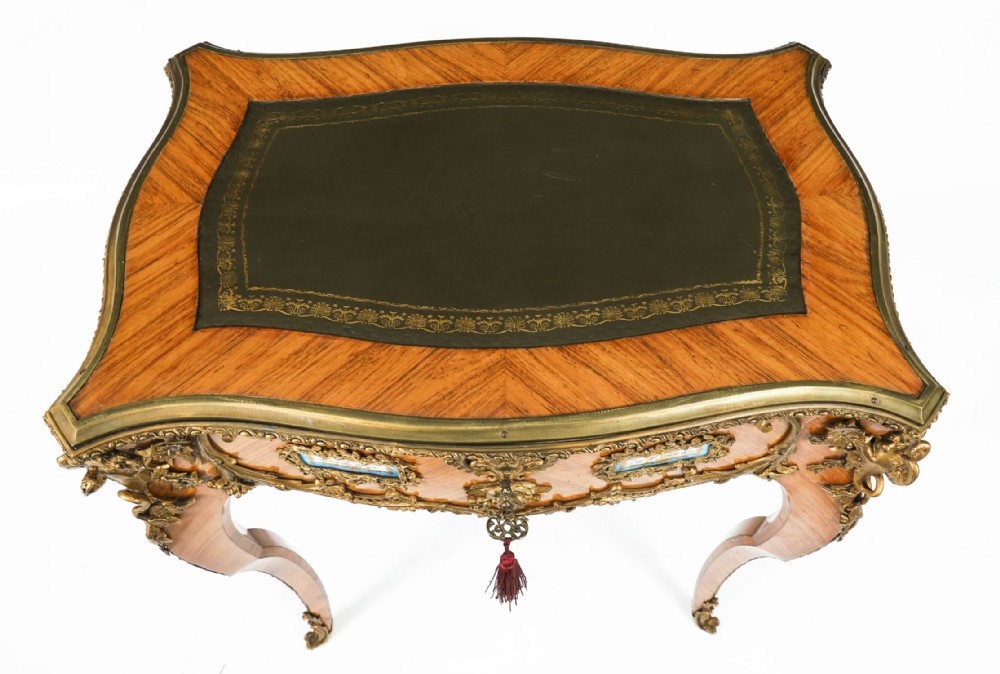
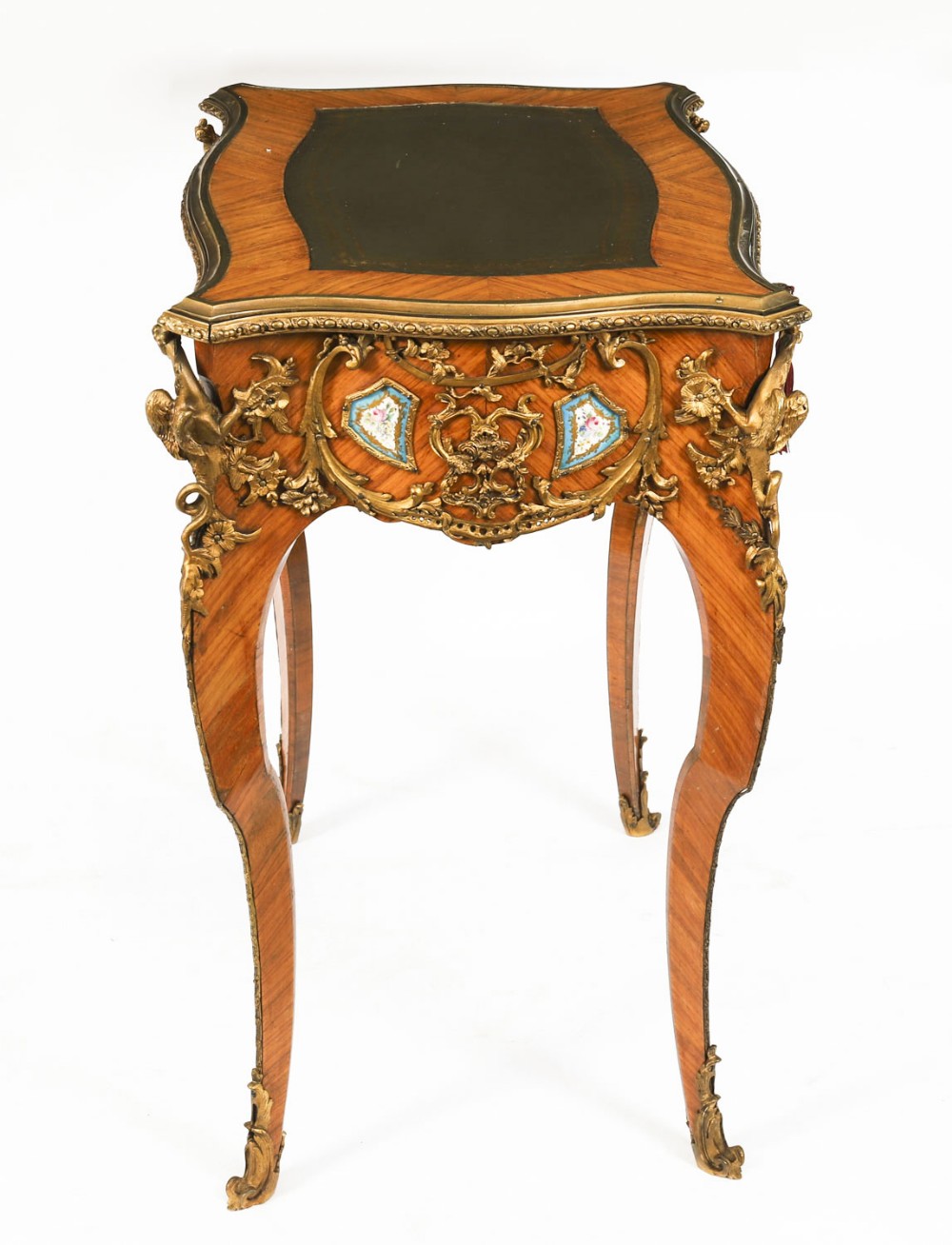
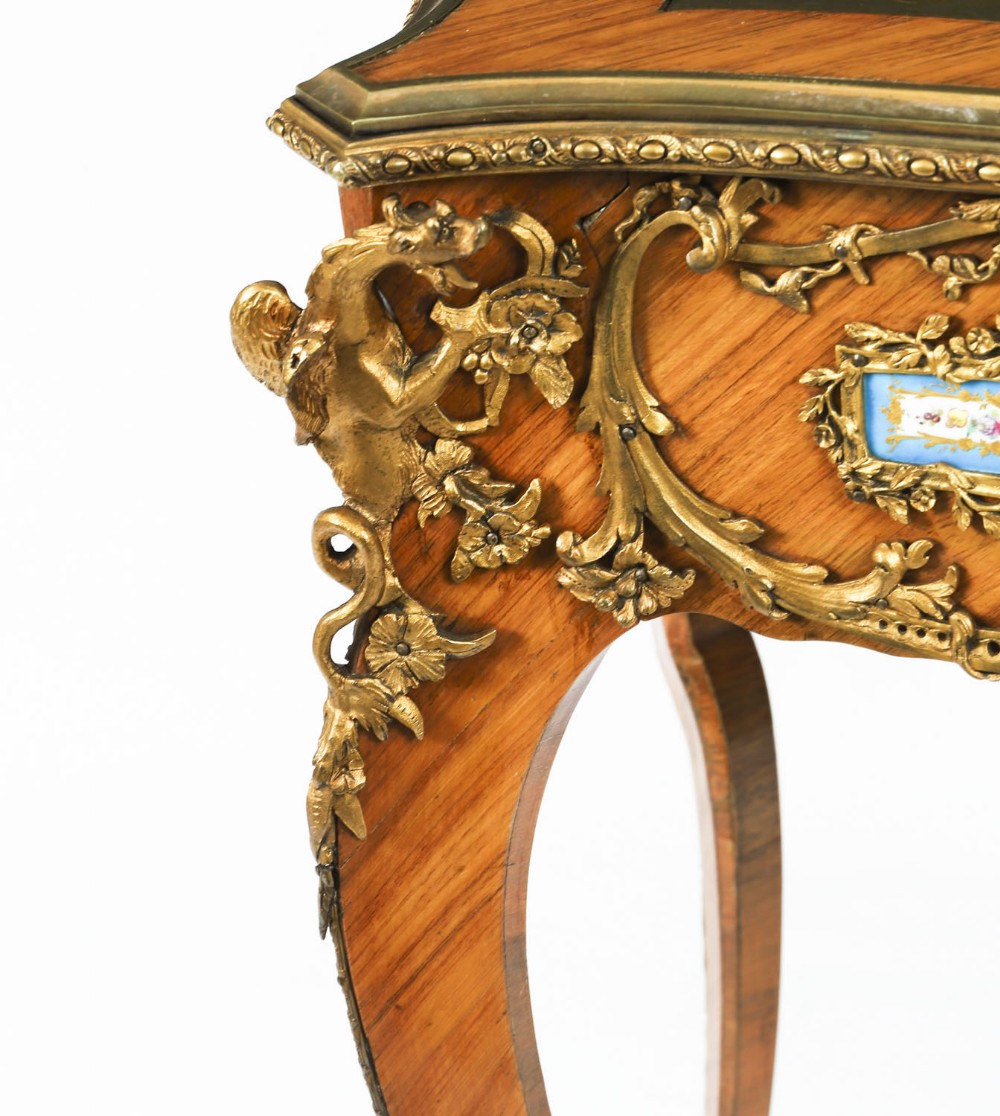
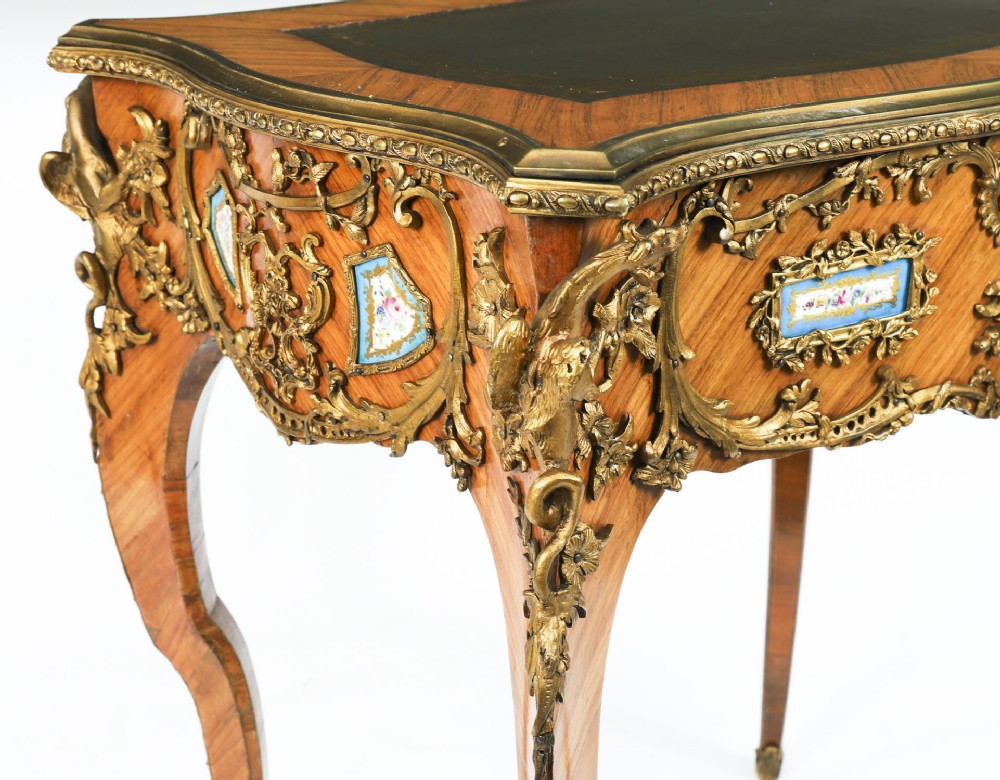
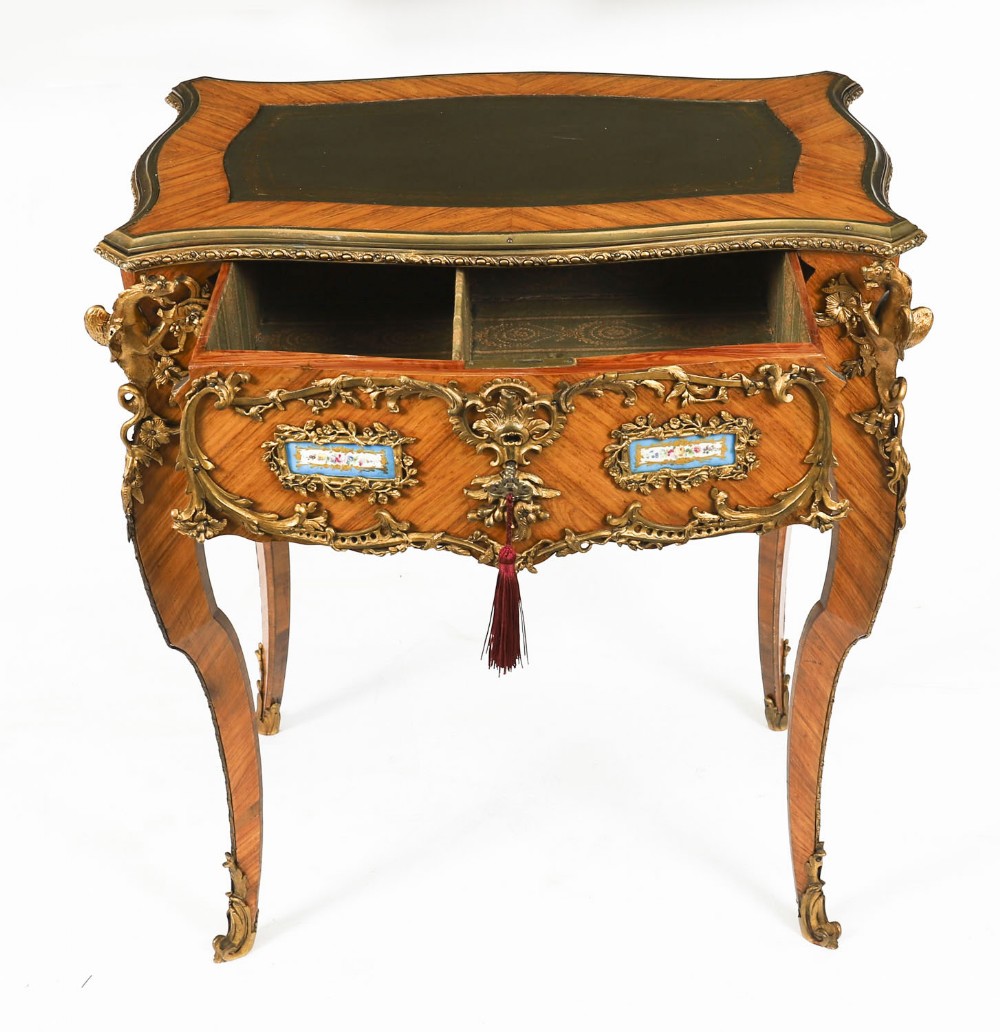
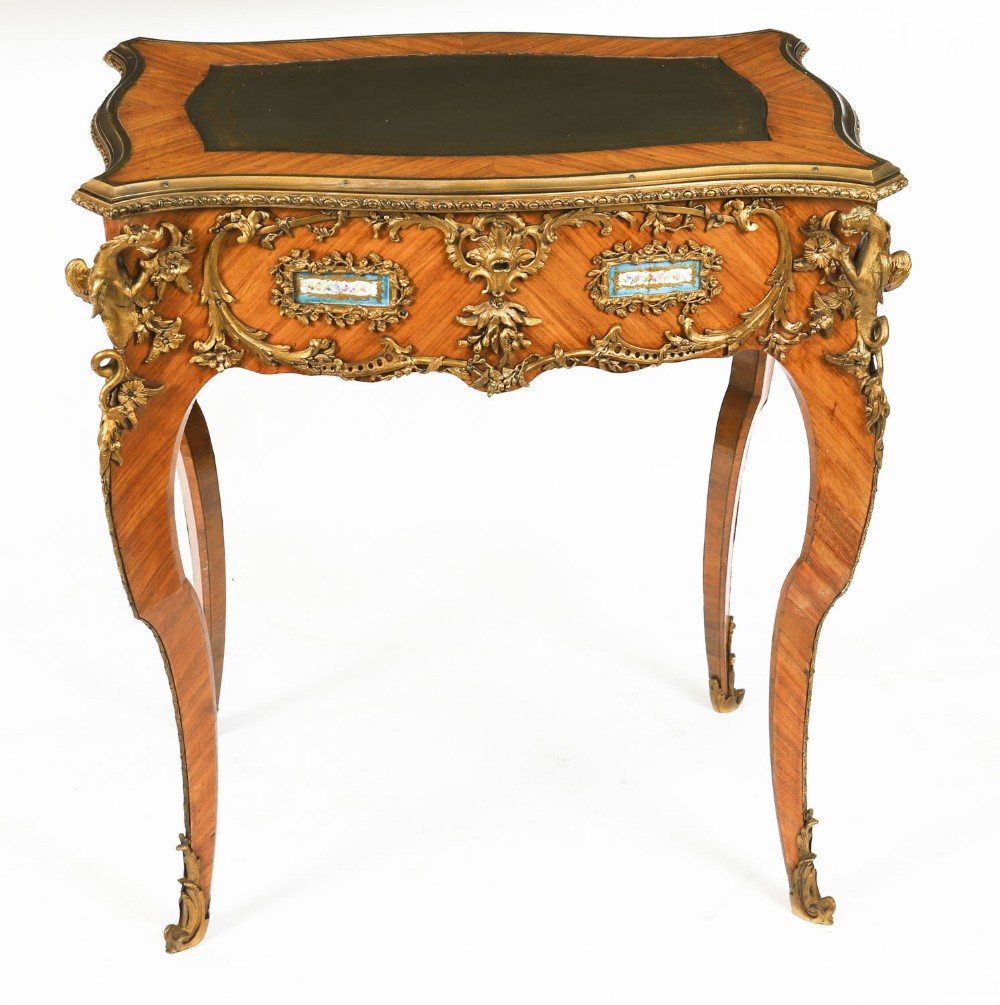
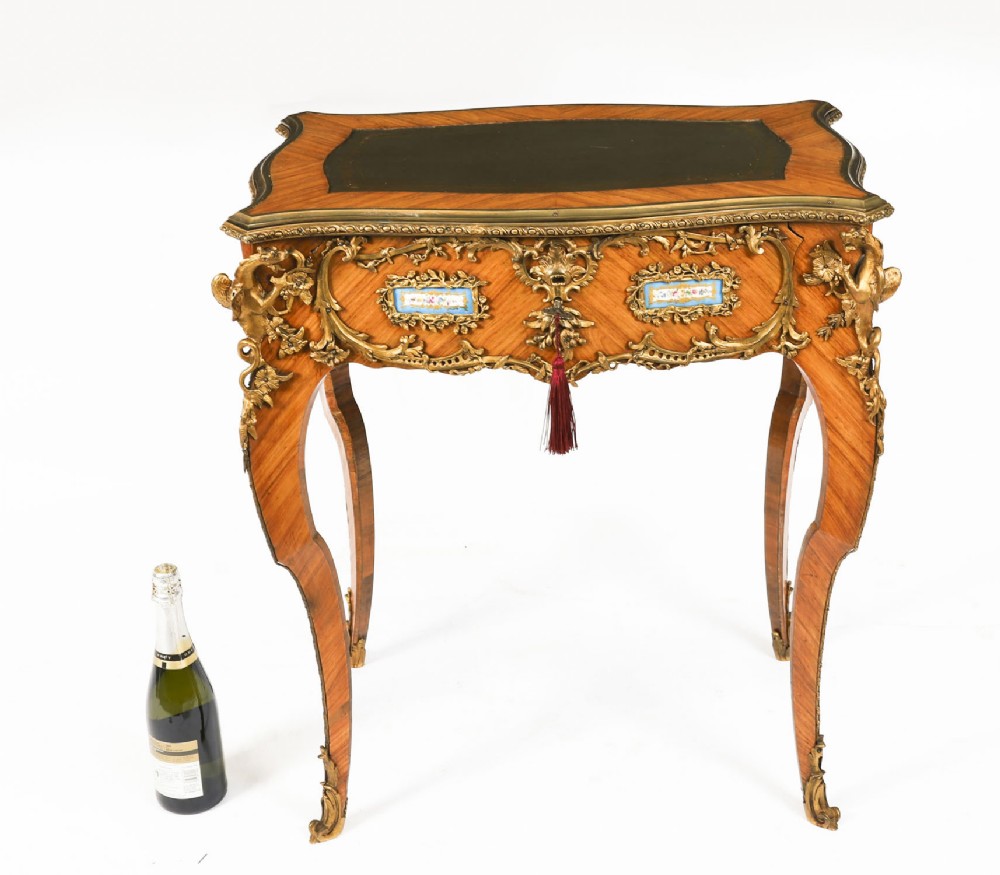
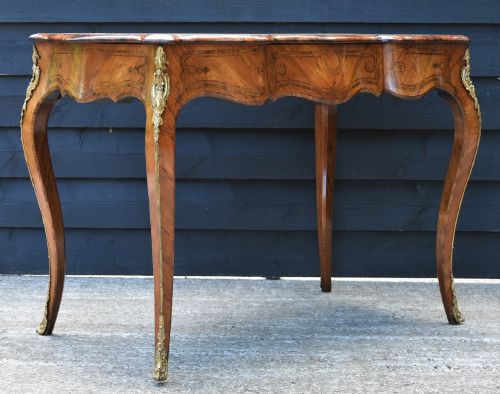
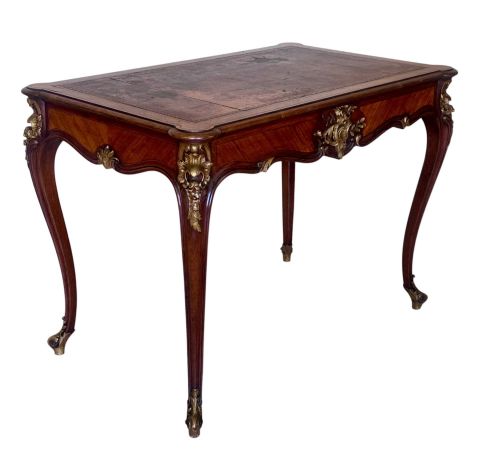
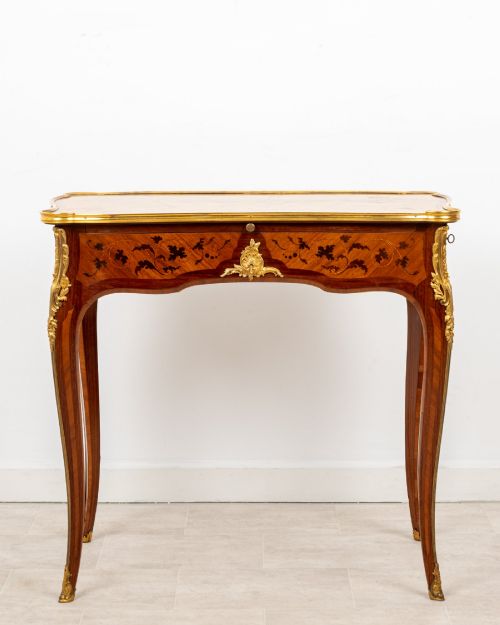
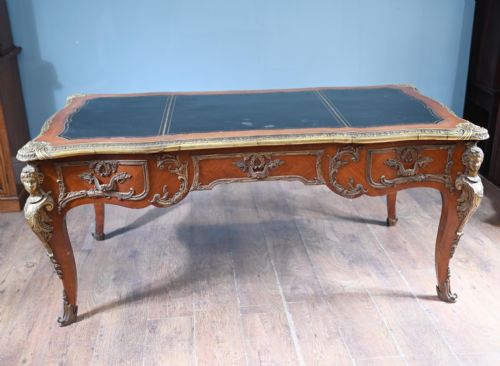
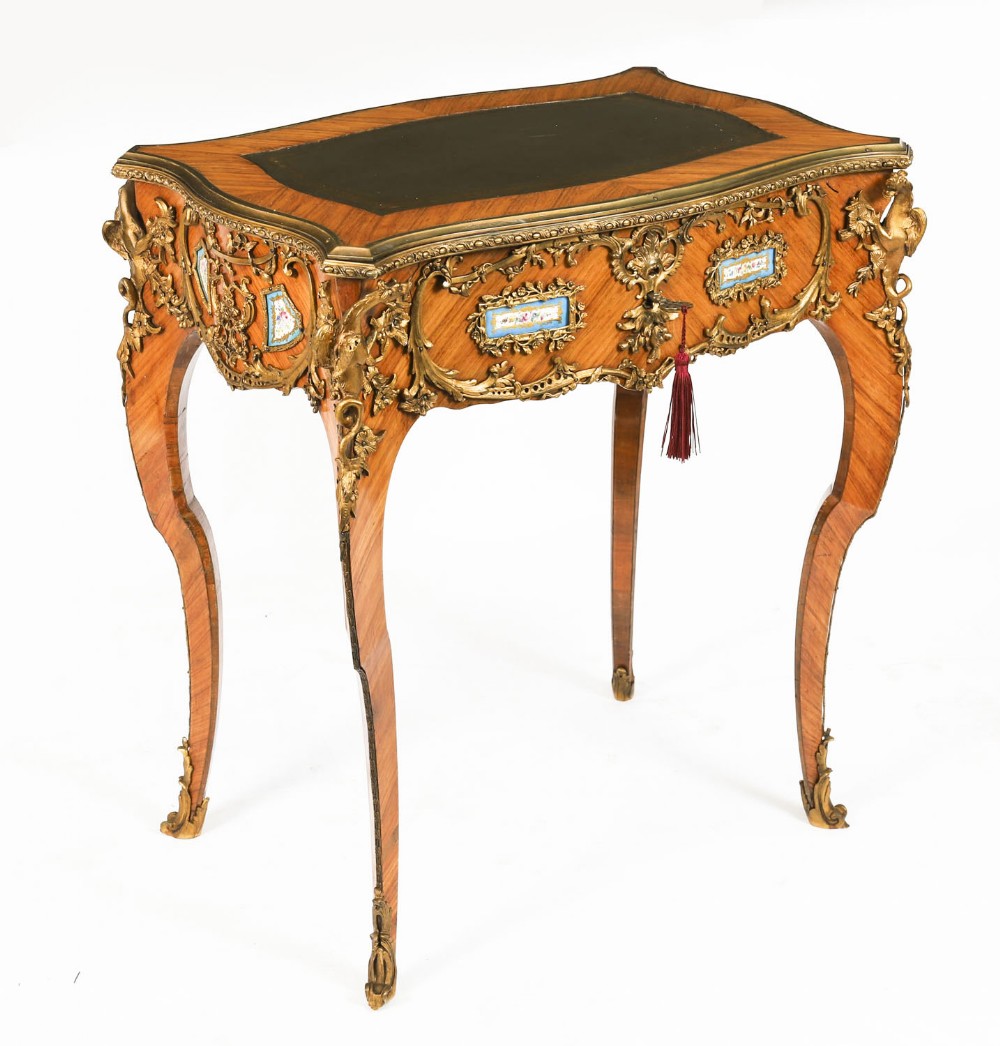
A fine antique French king wood, porcelain and ormolu mounted bureau plat, in the manner of Linke, Circa 1860 in date.


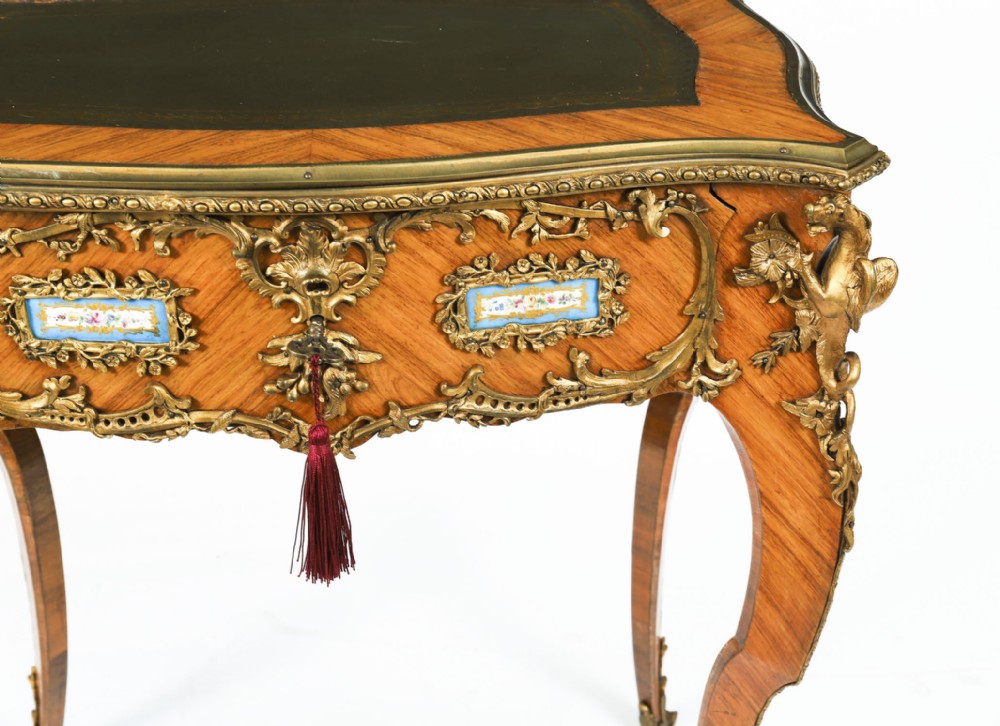
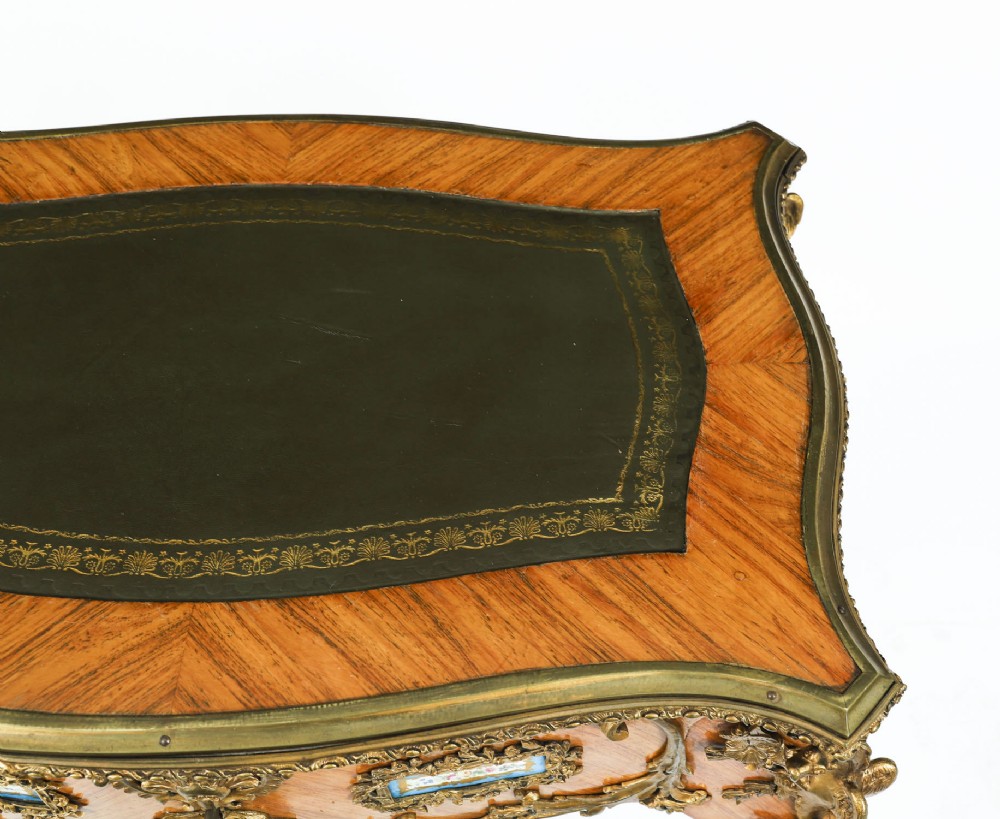
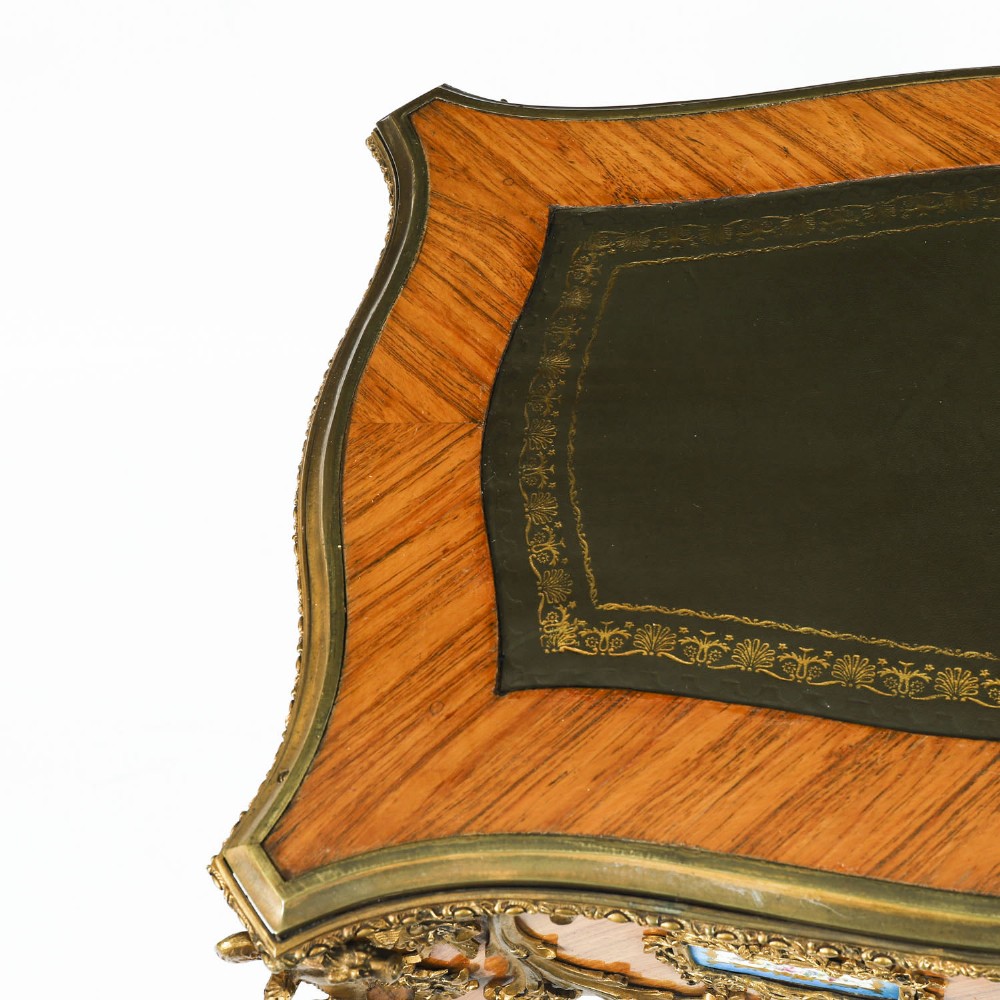
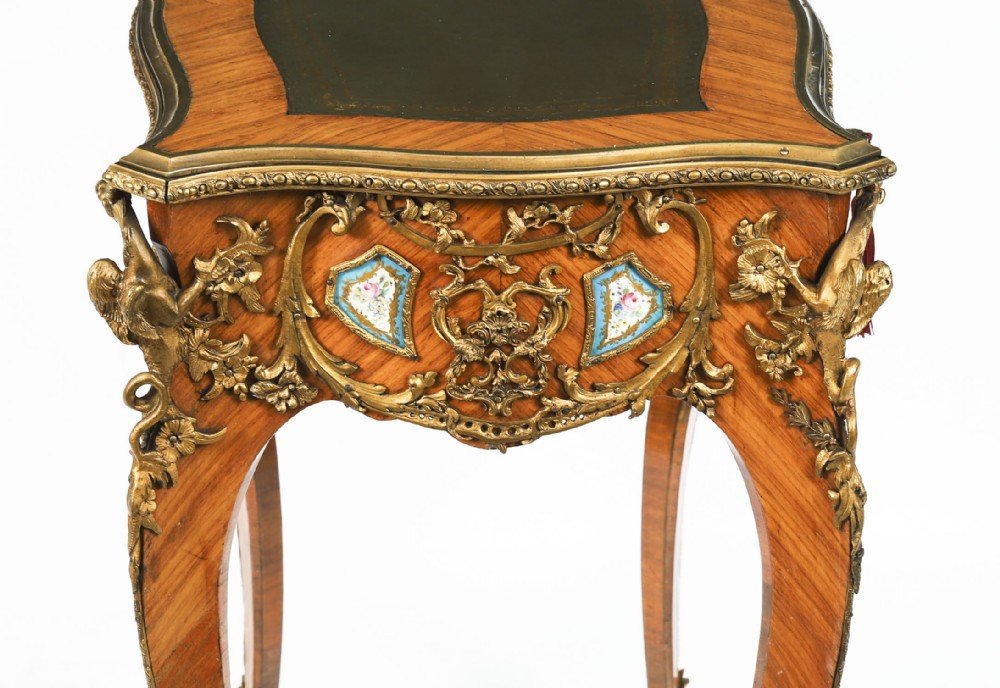
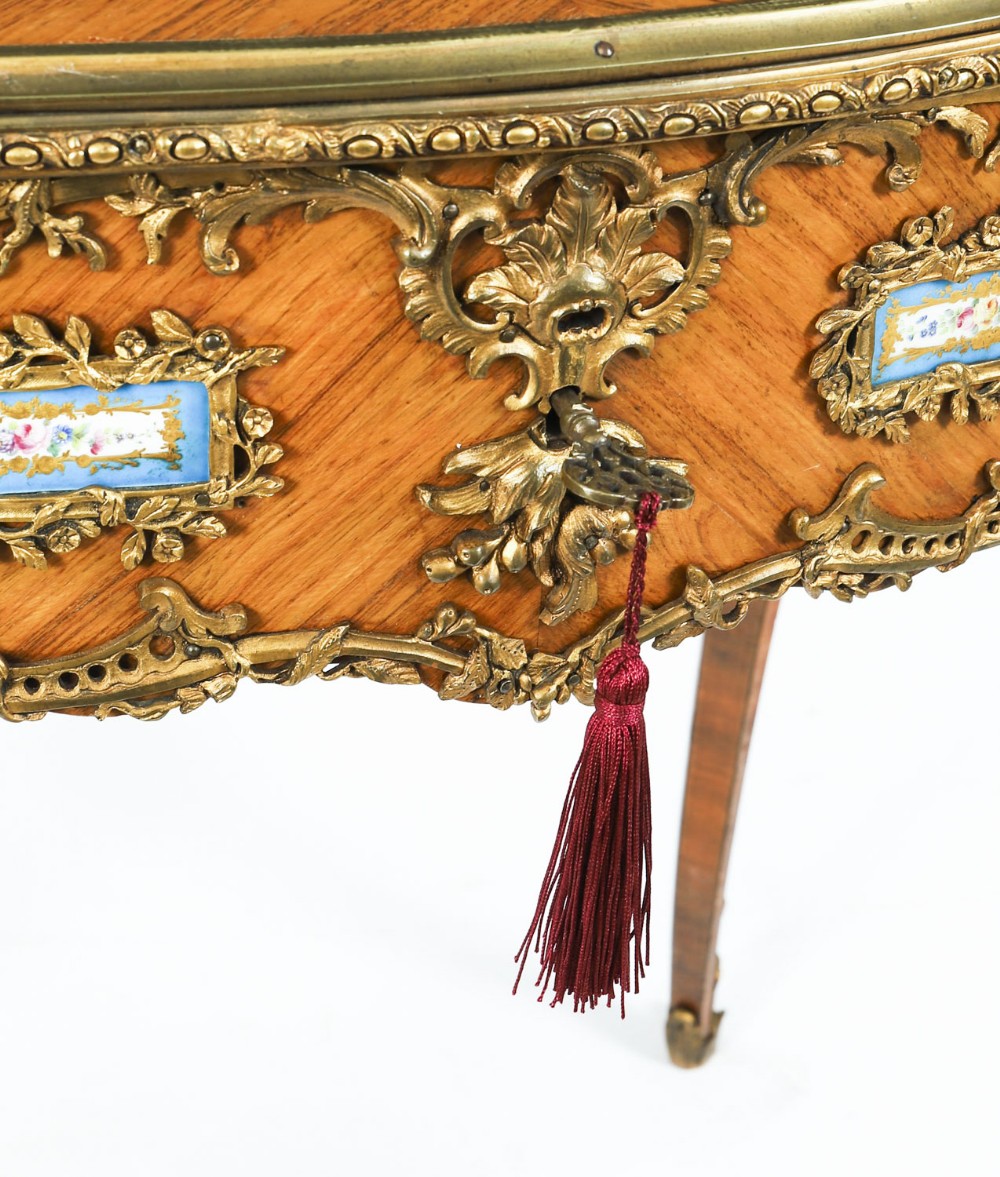
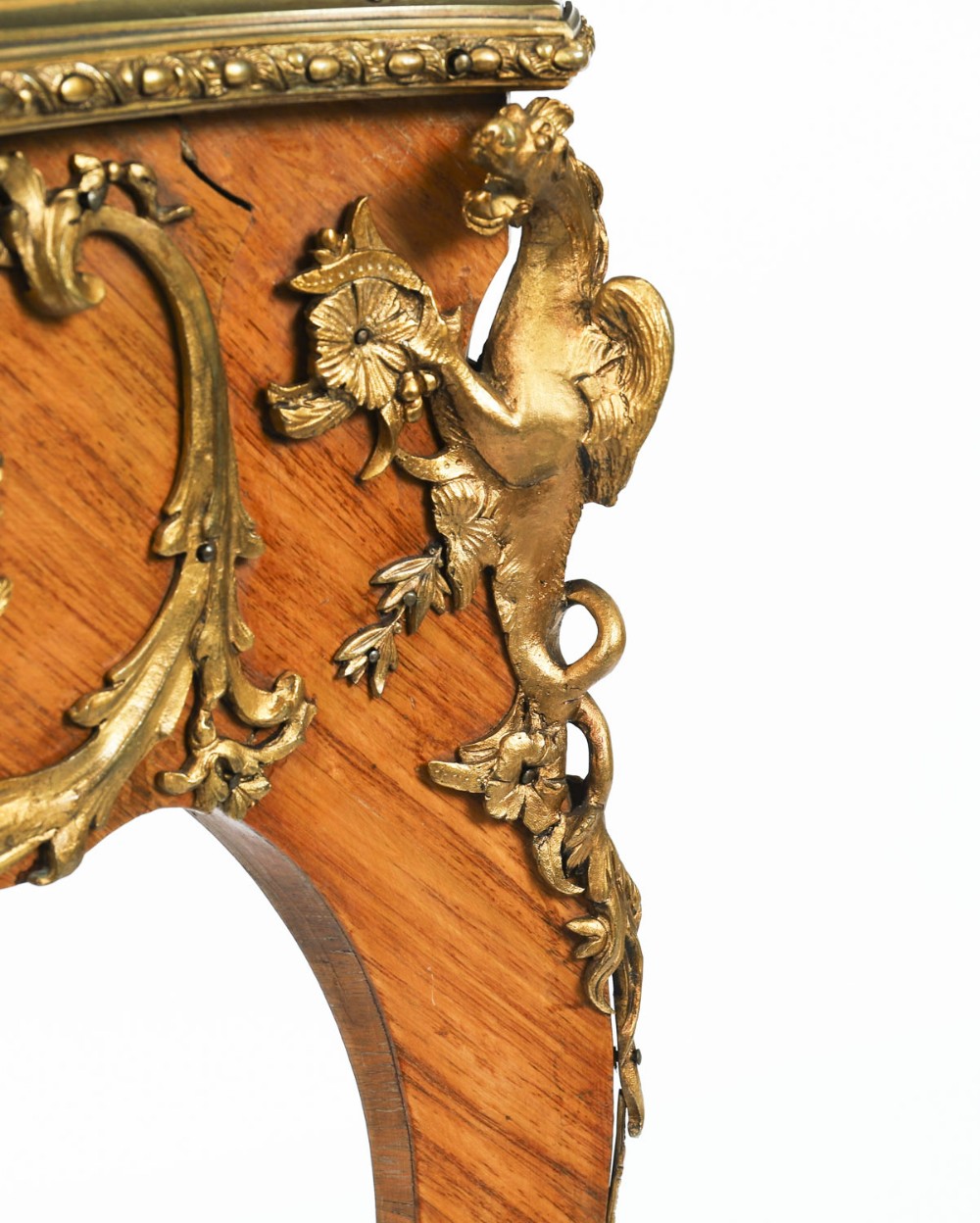
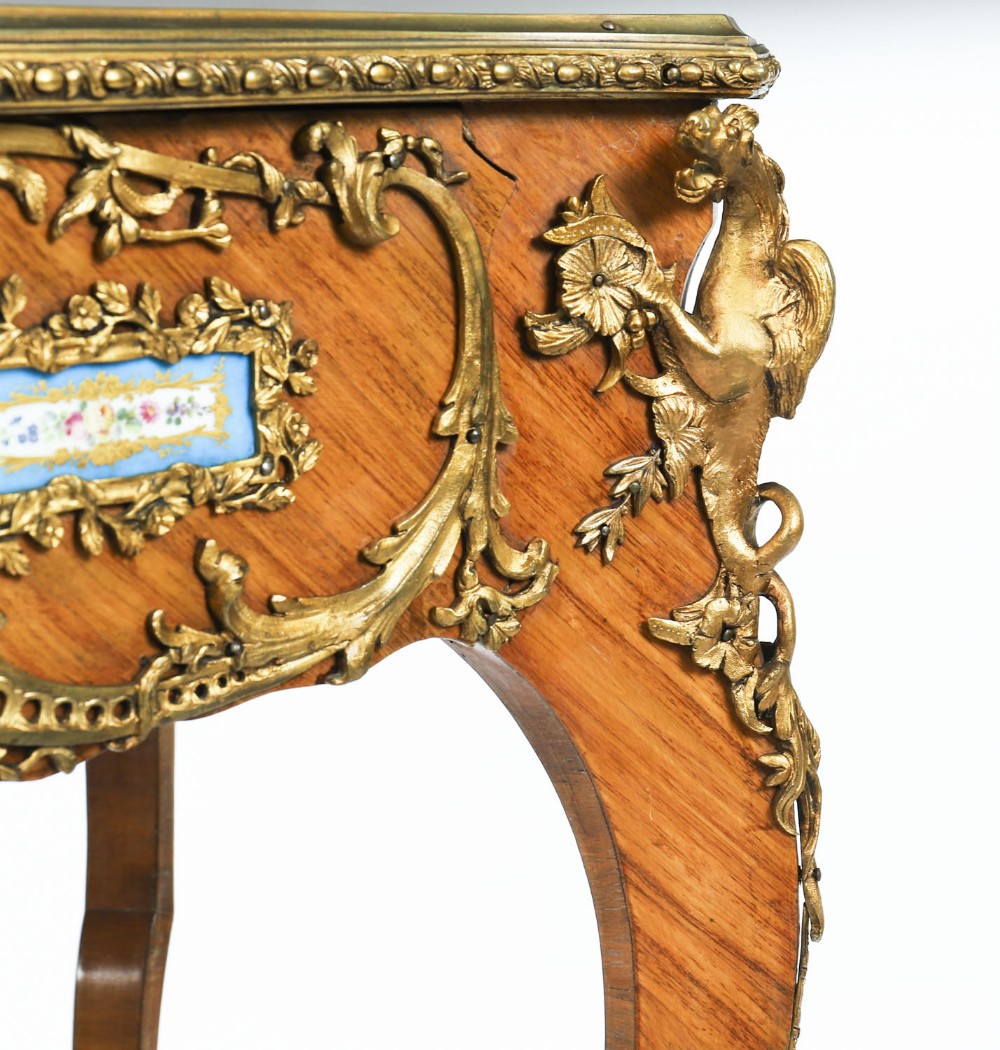
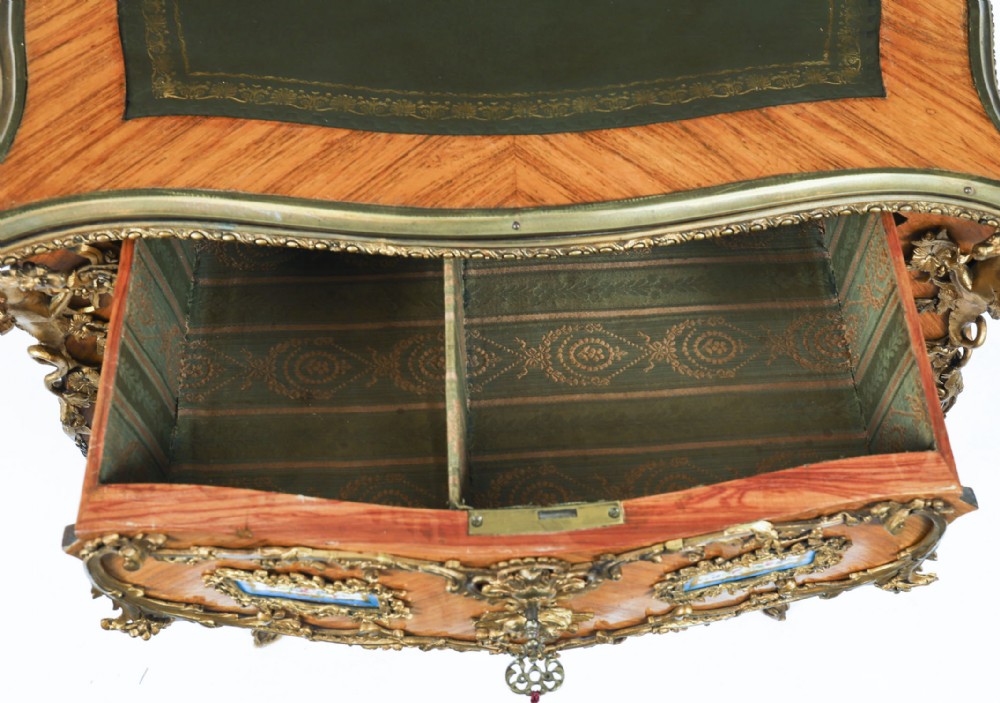
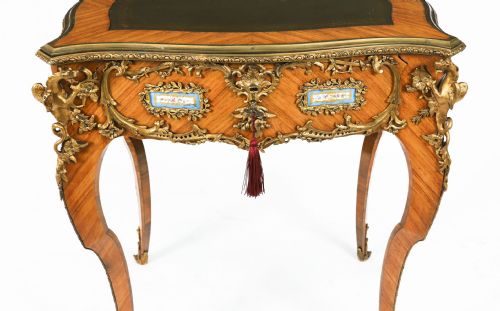
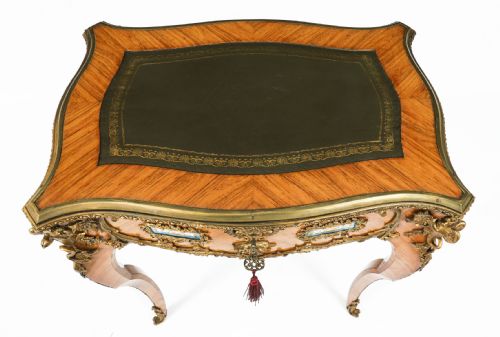
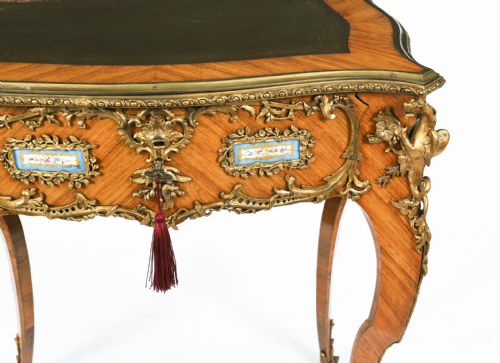
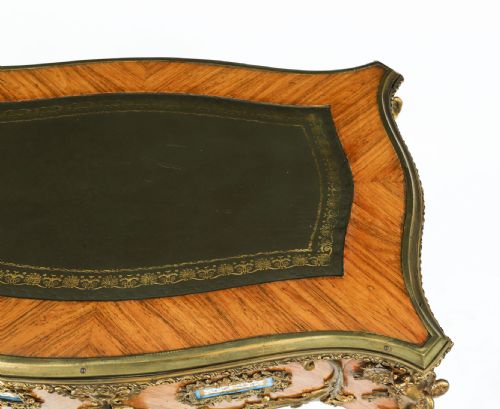
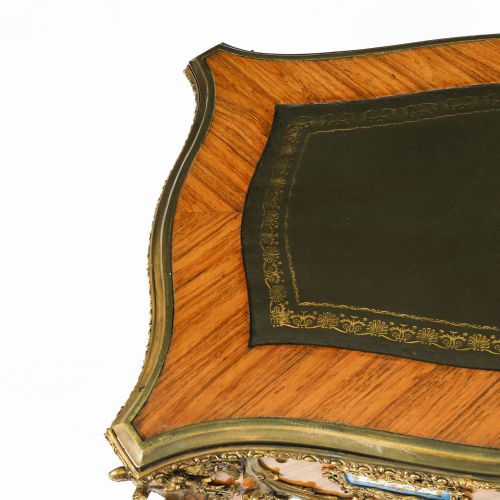
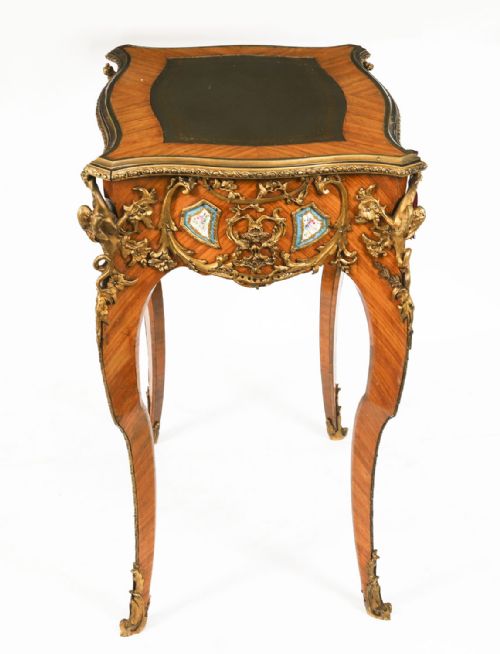
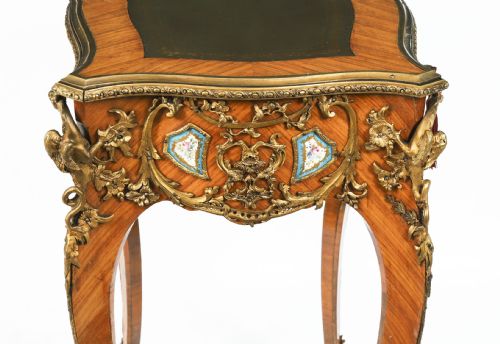
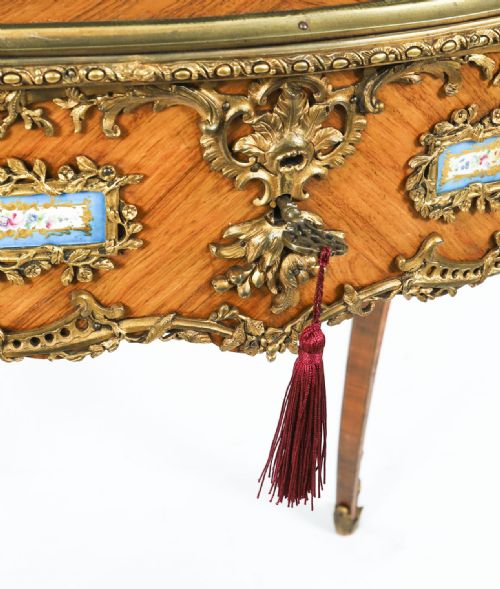
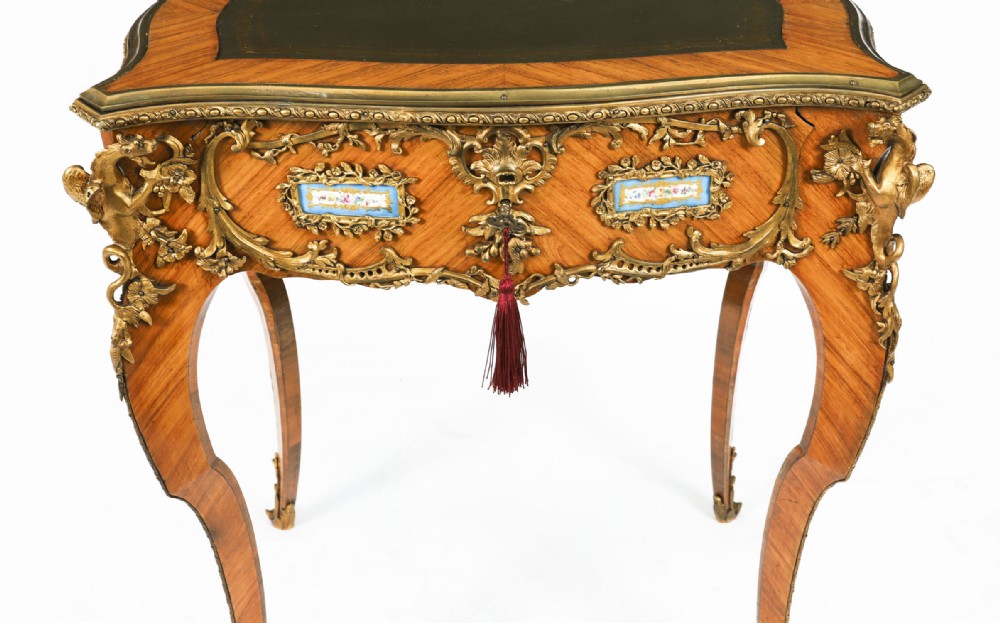
The shaped ormolu mounted serpentine top is fitted with a gold toold green leather inset writing surface, above an undulating frieze inset with a floral ormolu centred cartouche and framed Sevres panels. The front features a centre drawer surmounted by dragon espagnolettes apex corners.
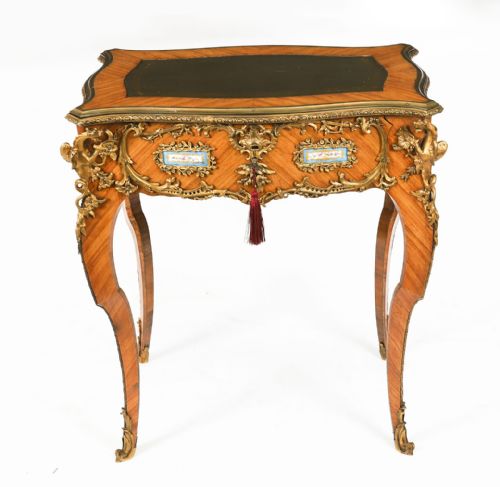
 

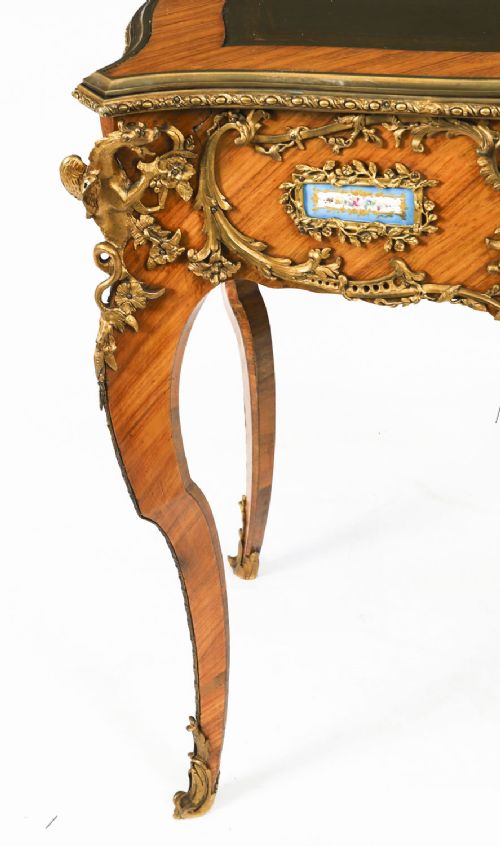
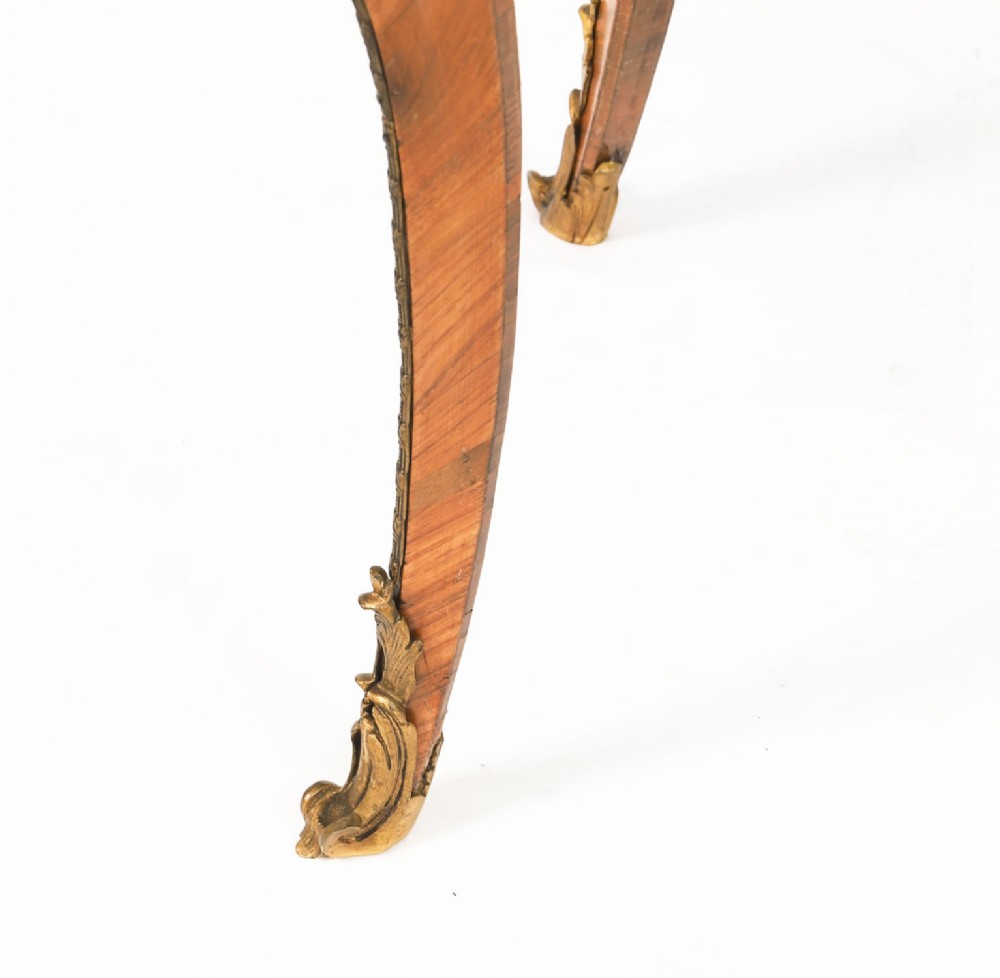
The table is raised on cabriole legs terminating in shell-capped scrolled sabots.


This is a truly fine quality piece which is sure to get noticed wherever it is placed.


Condition:

In excellent condition, please see photos for confirmation.
Dimensions in cm:

Height 77 cm x Width 69 cm x Depth 47 cm

Dimensions in inches:

Height 2 foot, 6 inches x Width 2 foot, 3 inches x Depth 1 foot, 6 inches

FRANÇOIS LINKE (1855–1946)

François Linke, the most important French ébéniste of his time. Born in Bohemia in 1855, Linke moved to Paris in 1881 where he established his now-famous workshop and showroom. Linke's superior work spread quickly through France and he soon eclipsed even the finest furniture houses of Paris. Today, Linke is counted among the most important furniture makers of the late 19th and early 20th centuries, and his work is dearly coveted by collectors. Linke is celebrated for designing highly innovative furnishings by infusing the Rococo style with the Art Nouveau trends of Paris and this Louis XV style desk exemplifies his highly original style.
King Wood

is a classic furniture wood, almost exclusively used for inlays on very fine furniture. Occasionally it is used in the solid for small items and turned work, including parts of billiard cues, e.g., those made by John Parris. It is brownish-purple with many fine darker stripes and occasional irregular swirls. Occasionally it contains pale streaks of a similar colour to sapwood.
The wood is very dense and hard and can be brought to a spectacular finish. it turns well but due to its density and hardness can be difficult to work with hand tools. It also has a tendency to blunt the tools due to its abrasive properties.
Ormolu - (from French 'or moulu', signifying ground or pounded gold) is an 18th-century English term for applying finely ground, high-carat gold in a mercury amalgam to an object of bronze.The mercury is driven off in a kiln leaving behind a gold-coloured veneer known as 'gilt bronze'.
The manufacture of true ormolu employs a process known as mercury-gilding or fire-gilding, in which a solution of nitrate of mercury is applied to a piece of copper, brass, or bronze, followed by the application of an amalgam of gold and mercury. The item was then exposed to extreme heat until the mercury burned off and the gold remained, adhered to the metal object.
Sevres Porcelain

traces its roots in France to early craftsmen who had small manufacturing operations in such places as Lille, Rouen. St. Cloud, and most notably Chantilly. It is from Chantilly that a cadre of workers migrated to the Chateau de Vincennes near Paris to form a larger porcelain manufactory in 1738.
French King Louis XV, perhaps inspired by his rumoured relationship with mistress Madame de Pompadour, took an intense interest in porcelain and moved the operation in 1756 to even larger quarters in the Paris suburb of Sevres. Sevres was also conveniently near the home of Madame de Pompadour and the King's own Palace at Versailles.
From the outset the king's clear aim was to produce Sevres Porcelain that surpassed the established Saxony works of Meissen and Dresden. Though the French lacked an ample supply of kaolin, a required ingredient for hard-paste porcelain (pate dure), their soft-paste porcelain (pate tendre) was fired at a lower temperature and was thus compatible with a wider variety of colours and glazes that in many cases were also richer an

Physical Dimensions
Height
77cm (30.31")
Width
69cm (27.17")
Depth
47cm (18.50")
Declaration

Regent Antiques has dated this French Kingwood Bureau Plat to the 1860s.

Reference Numbers
Sellingantiques Reference
SA1181585
Dealers Internal Reference
A4812
Description
A fine antique French king wood, porcelain and ormolu mounted bureau plat, in the manner of Linke, Circa 1860 in date.


The shaped ormolu mounted serpentine top is fitted with a gold toold green leather inset writing surface, above an undulating frieze inset with a floral ormolu centred cartouche and framed Sevres panels. The front features a centre drawer surmounted by dragon espagnolettes apex corners.

fig 1. A 19th-century French kingwood bureau plat featuring cabriole legs, gilt-bronze mounts, inset porcelain plaques, and a dark leather writing top.
fig 1. Fine Antique French Kingwood Ormolu Bureau Plat Desk After Linke 19th C


The table is raised on cabriole legs terminating in shell-capped scrolled sabots.


This is a truly fine quality piece which is sure to get noticed wherever it is placed.


Condition:

In excellent condition, please see photos for confirmation.

fig 2. A 19th-century French kingwood bureau plat featuring cabriole legs, gilt-bronze mounts, inset porcelain plaques, and a dark leather writing top.
fig 2. Fine Antique French Kingwood Ormolu Bureau Plat Desk After Linke 19th C

Dimensions in cm:

Height 77 cm x Width 69 cm x Depth 47 cm

Dimensions in inches:

Height 2 foot, 6 inches x Width 2 foot, 3 inches x Depth 1 foot, 6 inches

FRANÇOIS LINKE (1855–1946)

François Linke, the most important French ébéniste of his time.

Born in Bohemia in 1855, Linke moved to Paris in 1881 where he established his now-famous workshop and showroom.
Regent Antiques

Linke's superior work spread quickly through France and he soon eclipsed even the finest furniture houses of Paris. Today, Linke is counted among the most important furniture makers of the late 19th and early 20th centuries, and his work is dearly coveted by collectors. Linke is celebrated for designing highly innovative furnishings by infusing the Rococo style with the Art Nouveau trends of Paris and this Louis XV style desk exemplifies his highly original style.

fig 3. A 19th-century French kingwood bureau plat featuring cabriole legs, gilt-bronze mounts, inset porcelain plaques, and a dark leather writing top.
fig 3. Fine Antique French Kingwood Ormolu Bureau Plat Desk After Linke 19th C

King Wood

is a classic furniture wood, almost exclusively used for inlays on very fine furniture. Occasionally it is used in the solid for small items and turned work, including parts of billiard cues, e.g., those made by John Parris. It is brownish-purple with many fine darker stripes and occasional irregular swirls. Occasionally it contains pale streaks of a similar colour to sapwood.

fig 4. A 19th-century French kingwood bureau plat featuring cabriole legs, gilt-bronze mounts, inset porcelain plaques, and a dark leather writing top.
fig 4. Fine Antique French Kingwood Ormolu Bureau Plat Desk After Linke 19th C

The wood is very dense and hard and can be brought to a spectacular finish. it turns well but due to its density and hardness can be difficult to work with hand tools. It also has a tendency to blunt the tools due to its abrasive properties.

fig 5. A 19th-century French kingwood bureau plat featuring cabriole legs, gilt-bronze mounts, inset porcelain plaques, and a dark leather writing top.
fig 5. Fine Antique French Kingwood Ormolu Bureau Plat Desk After Linke 19th C

Ormolu - (from French 'or moulu', signifying ground or pounded gold) is an 18th-century English term for applying finely ground, high-carat gold in a mercury amalgam to an object of bronze.The mercury is driven off in a kiln leaving behind a gold-coloured veneer known as 'gilt bronze'.

fig 6. A 19th-century French kingwood bureau plat featuring cabriole legs, gilt-bronze mounts, inset porcelain plaques, and a dark leather writing top.
fig 6. Fine Antique French Kingwood Ormolu Bureau Plat Desk After Linke 19th C

The manufacture of true ormolu employs a process known as mercury-gilding or fire-gilding, in which a solution of nitrate of mercury is applied to a piece of copper, brass, or bronze, followed by the application of an amalgam of gold and mercury. The item was then exposed to extreme heat until the mercury burned off and the gold remained, adhered to the metal object.

fig 7. A 19th-century French kingwood bureau plat featuring cabriole legs, gilt-bronze mounts, inset porcelain plaques, and a dark leather writing top.
fig 7. Fine Antique French Kingwood Ormolu Bureau Plat Desk After Linke 19th C

Sevres Porcelain

traces its roots in France to early craftsmen who had small manufacturing operations in such places as Lille, Rouen. St. Cloud, and most notably Chantilly. It is from Chantilly that a cadre of workers migrated to the Chateau de Vincennes near Paris to form a larger porcelain manufactory in 1738.

fig 8. A 19th-century French kingwood bureau plat featuring cabriole legs, gilt-bronze mounts, inset porcelain plaques, and a dark leather writing top.
fig 8. Fine Antique French Kingwood Ormolu Bureau Plat Desk After Linke 19th C

French King Louis XV, perhaps inspired by his rumoured relationship with mistress Madame de Pompadour, took an intense interest in porcelain and moved the operation in 1756 to even larger quarters in the Paris suburb of Sevres. Sevres was also conveniently near the home of Madame de Pompadour and the King's own Palace at Versailles.

fig 9. A 19th-century French kingwood bureau plat featuring cabriole legs, gilt-bronze mounts, inset porcelain plaques, and a dark leather writing top.
fig 9. Fine Antique French Kingwood Ormolu Bureau Plat Desk After Linke 19th C

From the outset the king's clear aim was to produce Sevres Porcelain that surpassed the established Saxony works of Meissen and Dresden. Though the French lacked an ample supply of kaolin, a required ingredient for hard-paste porcelain (pate dure), their soft-paste porcelain (pate tendre) was fired at a lower temperature and was thus compatible with a wider variety of colours and glazes that in many cases were also richer an

Height
77cm (30.31")
Width
69cm (27.17")
Depth
47cm (18.50")
Date of Manufacture

Regent Antiques has dated this French Kingwood Bureau Plat to the 1860s.

Reference Numbers
Sellingantiques Ref
SA1181585
Dealers Internal Ref
A4812
Regent Antiques
Regent Antiques
Sellingantiques verified Since Sep 2016

We specialise in english and continental furniture, silver, porcelain and decorative items.

Dealer Profile

You can view the stock and full dealer information on the Regent Antiques Profile Page

Trade Associations

Regent Antiques is a registered member of LAPADA  CINOA
PDF SHARE
SAVE
A 19th-century French kingwood bureau plat featuring cabriole legs, gilt-bronze mounts, inset porcelain plaques, and a dark leather writing top.
1 / 20
Archive I A 19th-century French kingwood bureau plat featuring cabriole legs, gilt-bronze mounts, inset porcelain plaques, and a dark leather writing top.

Fine Antique French Kingwood Ormolu Bureau Plat Desk After Linke 19th C
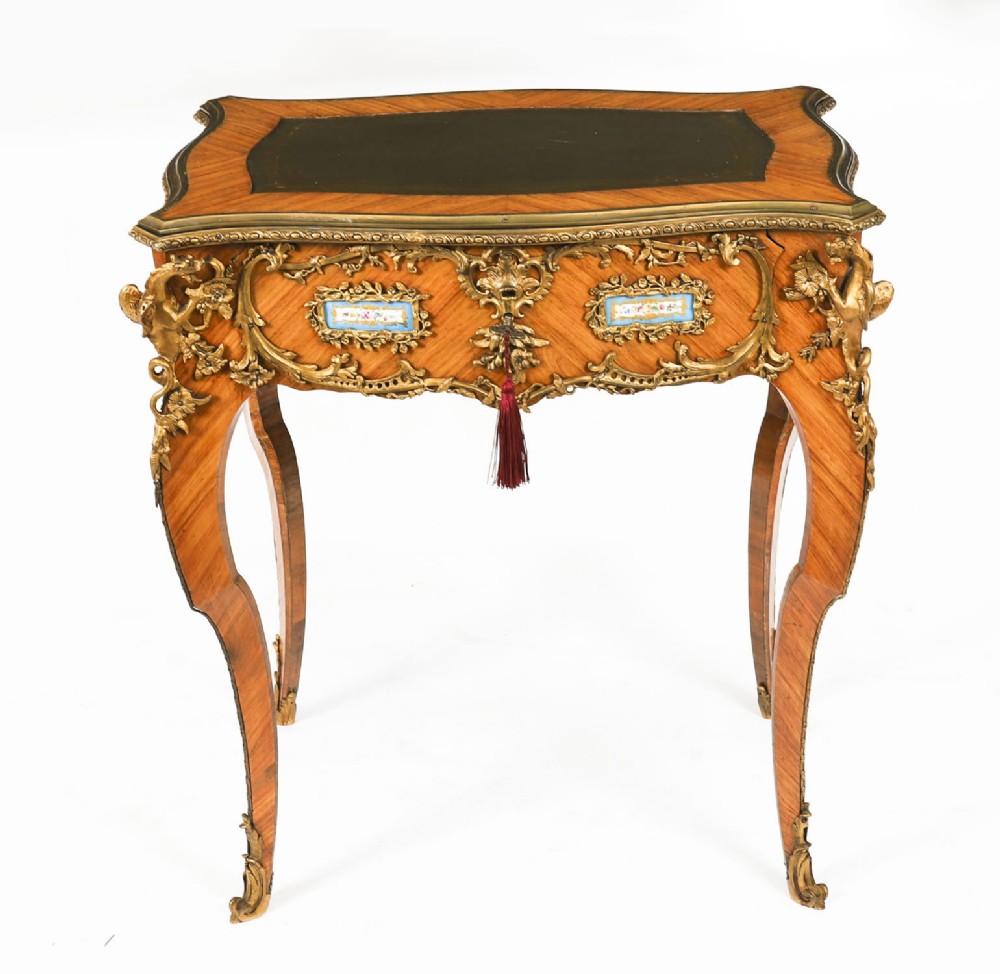
Archive II A 19th-century French kingwood bureau plat featuring cabriole legs, gilt-bronze mounts, inset porcelain plaques, and a dark leather writing top. View II
Archive III A 19th-century French kingwood bureau plat featuring cabriole legs, gilt-bronze mounts, inset porcelain plaques, and a dark leather writing top. View III
Archive IV A 19th-century French kingwood bureau plat featuring cabriole legs, gilt-bronze mounts, inset porcelain plaques, and a dark leather writing top. View IV
Archive V A 19th-century French kingwood bureau plat featuring cabriole legs, gilt-bronze mounts, inset porcelain plaques, and a dark leather writing top. View V
Archive VI A 19th-century French kingwood bureau plat featuring cabriole legs, gilt-bronze mounts, inset porcelain plaques, and a dark leather writing top. View VI
Archive VII A 19th-century French kingwood bureau plat featuring cabriole legs, gilt-bronze mounts, inset porcelain plaques, and a dark leather writing top. View VII
Archive VIII A 19th-century French kingwood bureau plat featuring cabriole legs, gilt-bronze mounts, inset porcelain plaques, and a dark leather writing top. View VIII
Archive IX A 19th-century French kingwood bureau plat featuring cabriole legs, gilt-bronze mounts, inset porcelain plaques, and a dark leather writing top. View IX
Archive X A 19th-century French kingwood bureau plat featuring cabriole legs, gilt-bronze mounts, inset porcelain plaques, and a dark leather writing top. View X
Archive XI A 19th-century French kingwood bureau plat featuring cabriole legs, gilt-bronze mounts, inset porcelain plaques, and a dark leather writing top. View XI
Archive XII A 19th-century French kingwood bureau plat featuring cabriole legs, gilt-bronze mounts, inset porcelain plaques, and a dark leather writing top. View XII
Archive XIII A 19th-century French kingwood bureau plat featuring cabriole legs, gilt-bronze mounts, inset porcelain plaques, and a dark leather writing top. View XIII
Archive XIV A 19th-century French kingwood bureau plat featuring cabriole legs, gilt-bronze mounts, inset porcelain plaques, and a dark leather writing top. View XIV
Archive XV A 19th-century French kingwood bureau plat featuring cabriole legs, gilt-bronze mounts, inset porcelain plaques, and a dark leather writing top. View XV
Archive XVI A 19th-century French kingwood bureau plat featuring cabriole legs, gilt-bronze mounts, inset porcelain plaques, and a dark leather writing top. View XVI
Archive XVII A 19th-century French kingwood bureau plat featuring cabriole legs, gilt-bronze mounts, inset porcelain plaques, and a dark leather writing top. View XVII
Archive XVIII A 19th-century French kingwood bureau plat featuring cabriole legs, gilt-bronze mounts, inset porcelain plaques, and a dark leather writing top. View XVIII
Archive XIX A 19th-century French kingwood bureau plat featuring cabriole legs, gilt-bronze mounts, inset porcelain plaques, and a dark leather writing top. View XIX
Archive XX A 19th-century French kingwood bureau plat featuring cabriole legs, gilt-bronze mounts, inset porcelain plaques, and a dark leather writing top. View XX
FURTHER BROWSING

Visitors also looked at these ⇣

Enlarged Archival View
Location
Manor Warehouse
318 Green Lanes
London
N4 1BX
United Kingdom
Verified Since Sep 2016
Items For Sale 659
Items Sold 2,608
Regent Antiques
Regent Antiques
Verified Since Sep 2016
View Dealer Info
Location: Manor Warehouse, 318 Green Lanes, London, N4 1BX, United Kingdom
Verified
Sep 2016
For Sale
659
Sold
2,608
A 19th-century French kingwood bureau plat featuring cabriole legs, gilt-bronze mounts, inset porcelain plaques, and a dark leather writing top.
Fine Antique French Kingwood Ormolu Bureau Plat Desk After Linke 19th C
Ref: SA1181585
A 19th-century French kingwood bureau plat featuring cabriole legs, gilt-bronze mounts, inset porcelain plaques, and a dark leather writing top.
Detail View 1
Detail View 2
Detail View 3
Detail View 4
Detail View 5
Detail View 6
Detail View 7
Detail View 8
Detail View 9
Detail View 10
Detail View 11
Detail View 12
Detail View 13
Detail View 14
Detail View 15
Detail View 16
Detail View 17
Detail View 18
Detail View 19
Archival Detail
Every single antique dealer on our platform is individually approved by our internal team. We verify their professional trade history, ethical standards, and photographic quality to ensure a secure, high-standard buying environment. Upon joining, every dealer agrees to a strict 9-point code of conduct. While issues can occasionally arise, our dealers typically resolve them swiftly and directly with the buyer. In fact, since our founding in 2002, Sellingantiques has only had to step in to help resolve an issue on roughly five occasions—a true testament to the quality of our dealers and their dedication to your happiness.
Our dealers are highly experienced in packing and shipping fragile, high-value antiques. Because you are in direct contact with the dealer, you will be able to easily go through all available shipping and insurance options together to ensure your item arrives safely.
Antiques are the ultimate green purchase. By choosing historical pieces over newly manufactured goods, you completely eliminate the carbon footprint of modern mass production while preserving exceptional, timeless craftsmanship.

A bureau plat is a flat-topped writing table that originated in late 17th-century France, typically featuring drawers within the frieze and supported by cabriole or straight legs.

These desks are frequently constructed using hardwoods decorated with kingwood or rosewood veneers, accented with gilt-bronze ormolu mounts, inset porcelain plaques, and leather writing surfaces.

Authentic 19th-century pieces display finely chased brass or bronze mounts, quarter-veneered marquetry or parquetry, solid timber drawer linings, and hand-cut dovetail joinery.

Position the desk as a standalone focal piece in a study or living area, pairing it with a tailored armchair and minimalist modern lighting.

Dust regularly with a dry microfibre cloth, apply natural beeswax sparingly to wood surfaces while avoiding metal mounts, and position away from direct sunlight or heat sources.
items
Add keywords to the filter
Price
£100
£250000
Era
Movements
Material
Origin
Stock Location
Freshness
Online Payments
Categories