Cheshire Antiques Consultant Ltd has dated this Jacobite Noble Portrait Painting to the 19th Century.
Subject & Medium
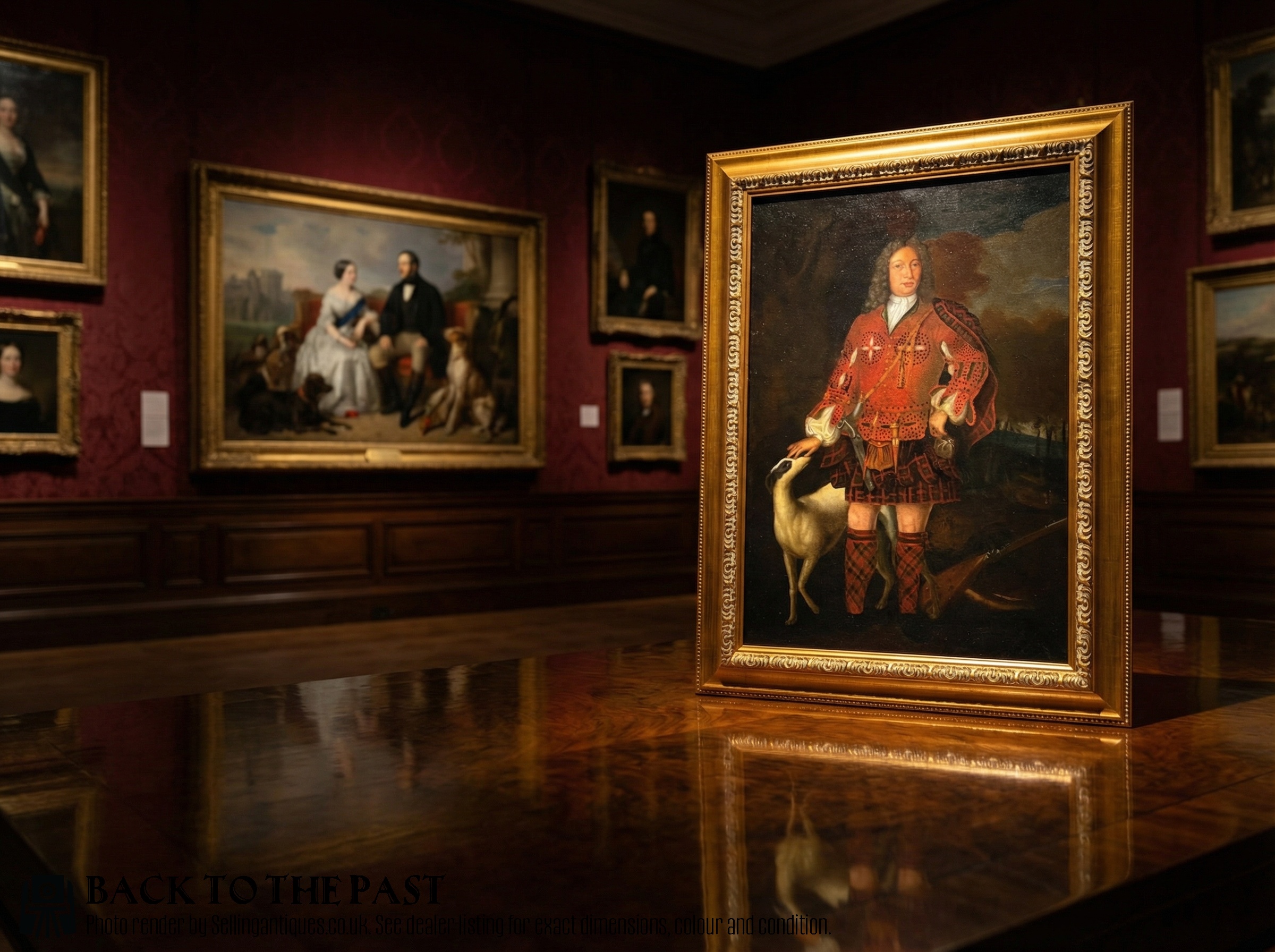
Painted in the late 19th century c.1870 after the Old Master Richard Waitt, it captures both the likeness and the legend of a Highland lord whose fate was bound to the Stuart cause.

The medium of oil allows for rich tonal variation: the deep red of the sitter’s coat, the crisp white of his lace cravat and cuffs, the subdued greens and blues of his tartan stockings, and the warm flesh tones framed by his flowing periwig.

Composition & Technique
Lord Duffus is portrayed full-length in Highland dress, posed with martial dignity, his hand resting on the hilt of his sword. At his side sits a noble Scottish deerhound, gazing upward in loyalty, while a game bird lies in the foreground — symbols of fidelity, landownership, and aristocratic privilege.

The background reveals a storm-lit Highland landscape, merging portraiture with history painting. Stylistically, the artist works after Waitt: the sitter’s features and costume are carefully modeled in smooth, academic brushwork, while the sky and dog are treated with looser, expressive strokes. The palette — rich reds, earthy browns, Highland greens, and cool gray-blues — enhances the sitter’s commanding presence.

This is both a faithful homage to Richard Waitt and a Victorian celebration of Scotland’s romantic, Jacobite past.
About Kenneth Sutherland, 3rd Lord Duffus (d. 1732)
Kenneth Sutherland inherited the title of 3rd Lord Duffus, one of the most distinguished noble seats in the Scottish Highlands. A committed Jacobite, he supported the 1715 rising in favor of the exiled Stuart monarchy. For this act of loyalty, he paid the ultimate price: his lands and title were stripped from him by the Crown.

To his contemporaries, he was a man of noble birth and martial courage. To later generations — especially in the Victorian era — he became the embodiment of the romantic Highland laird: dressed in tartan, sword at his side, with loyal hound and dramatic Highland sky.

This portrait preserves both his likeness and the mythos of a Jacobite lord — loyal, noble, and tied to a vanished Highland world.
About the Artist
Richard Waitt (active c. 1708–1732), regarded as a Scottish Old Master portraitist, was renowned for his clan portraits at Castle Grant. These works remain some of the most important visual records of early 18th-century Highland life.

The present painting is a late 19th-century stylistic work after Waitt, created at a time when Victorian collectors were eager to celebrate Scotland’s historic clans and Jacobite heritage.
Signed
Unsigned, as expected for later works after Waitt.

Framed
Recently reframed in a fine moulded Larson-Juhl frame fitted with museum-quality AR70 protective glass, offering both elegant presentation and conservation-grade protection.
Size
Frame dimensions: 74 cm high × 53.5 cm wide × 2 cm depth

Provenance
Kenneth Sutherland, 3rd Lord Duffus (d. 1732) — his lands and title were forfeited after the 1715 Jacobite rising. This later portrait, painted in his likeness, preserves that dramatic chapter of Highland history.

Later relined by Winsor & Newton, London
Notable Scottish Auction House
Curated by Cheshire Antiques Consultant LTD
Exhibited at the Famous Lord Hill Museum
Why You’ll Love It
A portrait after the Old Master Richard Waitt, one of Scotland’s great portraitists.

A sitter whose Jacobite sacrifice lends historical drama and romance.
Richly painted Highland costume, loyal hound, and dramatic sky.
Documented provenance and museum exhibition history — rare for a Victorian copy.
Recently restored and displayed in a Larson-Juhl museum-quality frame with AR70 pr
Cheshire Antiques Consultant Ltd has dated this Jacobite Noble Portrait Painting to the 19th Century.
Source the historic in 17th, 18th, 19th & 20th century fine arts, painting, sculptures & collectibles
You can view the stock and full dealer information on the Cheshire Antiques Consultant Ltd Profile Page

Painting Jacobite Noble Portrait Kenneth Sutherland 3rd Lord Duffus 1732