11,836  PAGES BROWSED TODAY PAGES TODAY 36  ANTIQUES UPLOADED TODAY NEW ARRIVALS
ID #SA1153400
FOR SALE
£750
Email
Save
Japanese Satsuma Sugar Bowl, Signed Shozan, Kyoto Studio, Meiji Period, C.1880
Gillers Antiques Ltd
for sale €878     $953
£750
Gillers Antiques Ltd

Gillers Antiques Ltd

Sellingantiques Verified Since Mar 2023
View Dealers Stock Page
Id #SA1153400
PDF SHARE
SAVE

Japanese Satsuma Sugar Bowl, Signed Shozan, Kyoto Studio, Meiji Period, C.1880

19th century
Description

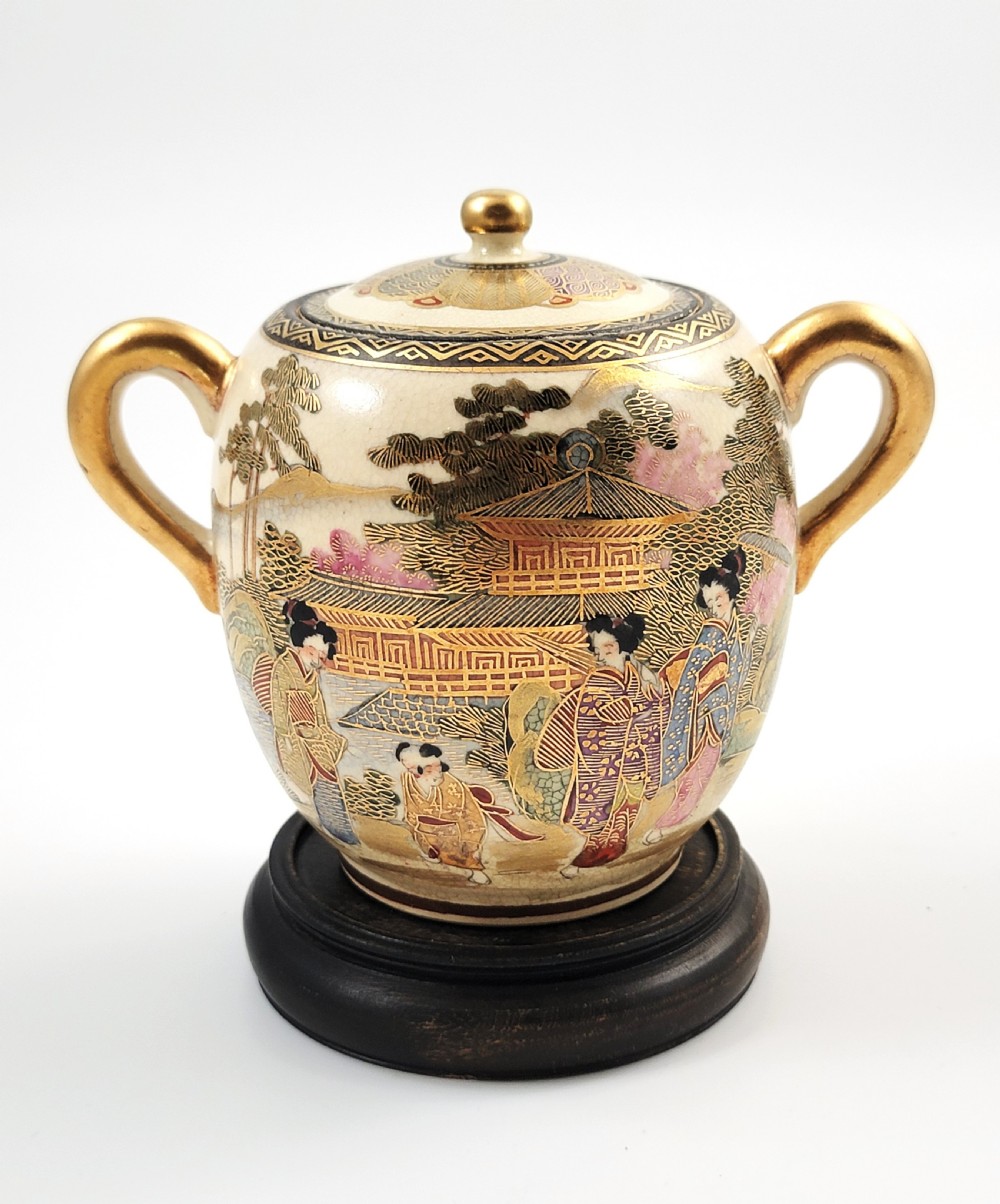
A Japanese Satsuma sugar bowl with lid, dating to the Meiji period (circa 1880), signed by the Kyoto artist Shozan (??). The piece is finely painted with a continuous scene of court ladies and children in a stylised garden landscape. The composition includes architectural elements, foliage, and traditional pattern borders. The twin handles and lid finial are highlighted in gold. The base bears a gilt-on-black mark reading Shozan — a known Kyoto studio decorator active in the late 19th century. Shozan's work is characterised by meticulous enamel painting and refined use of gold, intended for export to Western markets. Comparable examples have been noted in Bonhams auction records and museum collections. The original turned wood stand is included in the sale, although not counted in the measurements.

Condition: Excellent antique condition. No chips, cracks, or restoration.

Dimensions: Height (excluding stand) 12 cm, Width 14 cm, Depth 9 cm. Weight approx. 540 g.

Please study the accompanying photographs carefully as they form an integral part of this description. If you have any questions, we will be happy to answer them. The item will be shipped with full tracking and insurance.

Declaration

Gillers Antiques Ltd has dated this Japanese Satsuma Sugar Bowl to the 1880s.

Reference Numbers
Sellingantiques Reference
SA1153400
Description
A Japanese Satsuma sugar bowl with lid, dating to the Meiji period (circa 1880), signed by the Kyoto artist Shozan (??).
The piece is finely painted with a continuous scene of court ladies and children in a stylised garden landscape.
Gillers Antiques Ltd

The composition includes architectural elements, foliage, and traditional pattern borders. The twin handles and lid finial are highlighted in gold. The base bears a gilt-on-black mark reading Shozan — a known Kyoto studio decorator active in the late 19th century. Shozan's work is characterised by meticulous enamel painting and refined use of gold, intended for export to Western markets. Comparable examples have been noted in Bonhams auction records and museum collections. The original turned wood stand is included in the sale, although not counted in the measurements.

fig 1. A lidded Japanese Satsuma ceramic sugar bowl with two gilt handles, crackle glaze, and hand-painted figures in a landscape.
fig 1. Japanese Satsuma Sugar Bowl, Signed Shozan, Kyoto Studio, Meiji Period, C.1880

Condition: Excellent antique condition. No chips, cracks, or restoration.

Dimensions: Height (excluding stand) 12 cm, Width 14 cm, Depth 9 cm. Weight approx. 540 g.

Please study the accompanying photographs carefully as they form an integral part of this description. If you have any questions, we will be happy to answer them. The item will be shipped with full tracking and insurance.

Date of Manufacture

Gillers Antiques Ltd has dated this Japanese Satsuma Sugar Bowl to the 1880s.

Reference Numbers
Sellingantiques Ref
SA1153400
Gillers Antiques Ltd
Sellingantiques verified Since Mar 2023
Dealer Profile

You can view the stock and full dealer information on the Gillers Antiques Ltd Profile Page
PDF SHARE
SAVE
A lidded Japanese Satsuma ceramic sugar bowl with two gilt handles, crackle glaze, and hand-painted figures in a landscape.
1 / 12
Archive I A lidded Japanese Satsuma ceramic sugar bowl with two gilt handles, crackle glaze, and hand-painted figures in a landscape.

Japanese Satsuma Sugar Bowl, Signed Shozan, Kyoto Studio, Meiji Period, C.1880

Archive II A lidded Japanese Satsuma ceramic sugar bowl with two gilt handles, crackle glaze, and hand-painted figures in a landscape. View II
Archive III A lidded Japanese Satsuma ceramic sugar bowl with two gilt handles, crackle glaze, and hand-painted figures in a landscape. View III
Archive IV A lidded Japanese Satsuma ceramic sugar bowl with two gilt handles, crackle glaze, and hand-painted figures in a landscape. View IV
Archive V A lidded Japanese Satsuma ceramic sugar bowl with two gilt handles, crackle glaze, and hand-painted figures in a landscape. View V
Archive VI A lidded Japanese Satsuma ceramic sugar bowl with two gilt handles, crackle glaze, and hand-painted figures in a landscape. View VI
Archive VII A lidded Japanese Satsuma ceramic sugar bowl with two gilt handles, crackle glaze, and hand-painted figures in a landscape. View VII
Archive VIII A lidded Japanese Satsuma ceramic sugar bowl with two gilt handles, crackle glaze, and hand-painted figures in a landscape. View VIII
Archive IX A lidded Japanese Satsuma ceramic sugar bowl with two gilt handles, crackle glaze, and hand-painted figures in a landscape. View IX
Archive X A lidded Japanese Satsuma ceramic sugar bowl with two gilt handles, crackle glaze, and hand-painted figures in a landscape. View X
Archive XI A lidded Japanese Satsuma ceramic sugar bowl with two gilt handles, crackle glaze, and hand-painted figures in a landscape. View XI
Archive XII A lidded Japanese Satsuma ceramic sugar bowl with two gilt handles, crackle glaze, and hand-painted figures in a landscape. View XII
Enlarged Archival View
Telephone 07738 009924
Location
Buckland House
Buntingford
Hertfordshire
SG9 0PY
United Kingdom
Verified Since Mar 2023
Items For Sale 401
Items Sold 564
Gillers Antiques Ltd
Verified Since Mar 2023
View Dealer Info
Location: Buckland House, Buntingford, Hertfordshire, SG9 0PY, United Kingdom
Verified
Mar 2023
For Sale
401
Sold
564
A lidded Japanese Satsuma ceramic sugar bowl with two gilt handles, crackle glaze, and hand-painted figures in a landscape.
Japanese Satsuma Sugar Bowl, Signed Shozan, Kyoto Studio, Meiji Period, c.1880
Ref: SA1153400
A lidded Japanese Satsuma ceramic sugar bowl with two gilt handles, crackle glaze, and hand-painted figures in a landscape.
Detail View 1
Detail View 2
Detail View 3
Detail View 4
Detail View 5
Detail View 6
Detail View 7
Detail View 8
Detail View 9
Detail View 10
Detail View 11
Archival Detail
Every single antique dealer on our platform is individually approved by our internal team. We verify their professional trade history, ethical standards, and photographic quality to ensure a secure, high-standard buying environment. Upon joining, every dealer agrees to a strict 9-point code of conduct. While issues can occasionally arise, our dealers typically resolve them swiftly and directly with the buyer. In fact, since our founding in 2002, Sellingantiques has only had to step in to help resolve an issue on roughly five occasions—a true testament to the quality of our dealers and their dedication to your happiness.
Our dealers are highly experienced in packing and shipping fragile, high-value antiques. Because you are in direct contact with the dealer, you will be able to easily go through all available shipping and insurance options together to ensure your item arrives safely.
Antiques are the ultimate green purchase. By choosing historical pieces over newly manufactured goods, you completely eliminate the carbon footprint of modern mass production while preserving exceptional, timeless craftsmanship.

Satsuma ware is a style of Japanese earthenware originating from Kagoshima that gained international recognition during the Meiji period (18681912). It is characterised by its pale, crackle-glazed earthenware body, detailed overglaze enamels, and intricate gilding depicting landscapes, figures, or geometric patterns.

Satsuma ceramic pieces are crafted using a low-fired, cream-toned earthenware base that forms a fine network of crackle lines during cooling. Artisans manually apply polychrome overglaze enamels and gold leaf, which are fixed onto the vessel through subsequent lower-temperature kiln firings.

Authentic pieces generally display an ivory-toned ceramic body with uniform surface crazing and detailed painted scenes. Many export items created during the Meiji period carry red or gold maker marks, studio stamps, or the Shimazu family crest on the base.

These decorative vessels serve as visual focal points when styled on a sideboard, mantelpiece, or open shelving unit. Positioned against neutral backdrops or alongside minimalist wood furniture, the intricate gilded artwork draws focus without visually overwhelming the surrounding room.

Clean Satsuma ceramics strictly by dusting with a dry, soft microfibre cloth. Avoid immersion in water or chemical detergents, as moisture can seep into the crackle glaze and degrade the porous earthenware body or loosen delicate overglaze gilding.
items
Add keywords to the filter
Price
£100
£250000
Era
Movements
Material
Origin
Stock Location
Freshness
Online Payments
Categories