30,246  PAGES BROWSED TODAY PAGES TODAY 74  ANTIQUES UPLOADED TODAY NEW ARRIVALS
ID #SA1145542
FOR SALE
£1,800
Email
Save
Italian School Painting (Xviii) of the Conversion of Saint Paul, Follower of Antonio Tempesta (1555–1630)
Westcoast Fine Art
for sale €2,106     $2,286
£1,800
Westcoast Fine Art

Westcoast Fine Art

Sellingantiques Verified Since May 2025
View Dealers Stock Page
  • About Us
    Westcoast fine art ltd is a UK based dealer in fine classical works of art.
Id #SA1145542
PDF SHARE
SAVE

Italian School Painting (Xviii) of the Conversion of Saint Paul, Follower of Antonio Tempesta (1555–1630)

18th century
Description

Italian School (XVIII) Follower of Antonio Tempesta (1555–1630)

Title: The Conversion of St. Paul

Date: 18th Century

Medium: Oil on canvas

Provenance: From a private London collection.
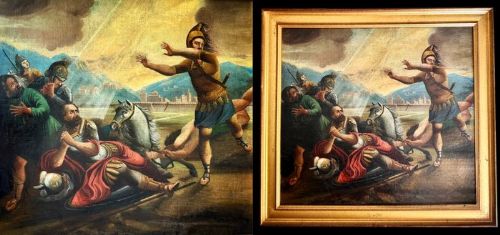
Measurements: overall measurements with the frame are 61cm x 57 x 3cm and the painting itself measured at 52cm x 47cm.

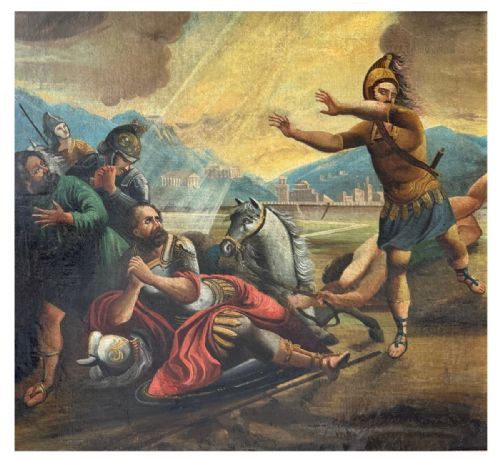
The present work depicts a scene from the Bible commonly known as the conversion of Paul. The conversion of Paul the Apostle (also the Pauline conversion, Damascene conversion, Damascus Christophany and Paul's transformation on the road to Damascus) was, according to the New Testament, an event in the life of Saul/Paul the Apostle that led him to cease persecuting early Christians and to become a follower of Jesus.
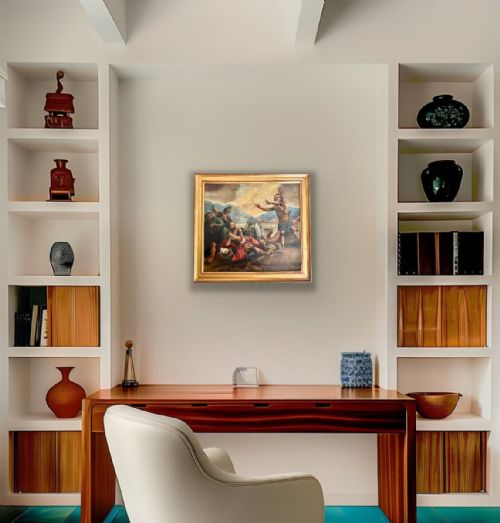
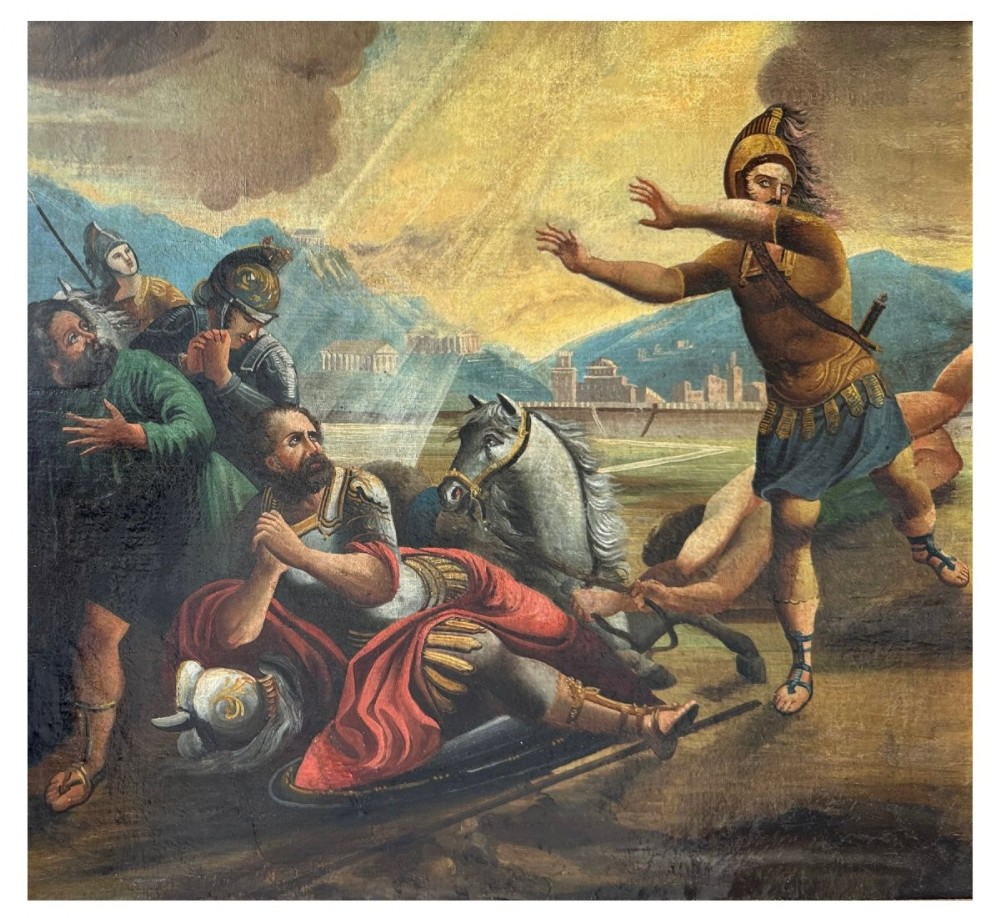
Paul had persecuted Christians in Jerusalem but was struck down on the road to Damascus by a vision of Christ, who asked him why. Paul was blinded, and Christ sent a man to restore his sight. He was then baptised and set out to preach Christ’s word. The present work depicts the dramatic moment of terror when the skies split open and heaven was revealed. Paul’s horse rolls to the ground, taking him with it.
Stylistically, the present work is distinctly of the Roman school but also shows a bit of a Flemish influence, hence the connection with the work of Antonio Tempesta, an Italian artist who was influenced by the work of the Flemish school of artists. The wonderfully theatrical composition is masterfully executed and wonderfully pleasing.
Antonio Tempesta, also called il Tempestino (1555 – 5 August 1630), was an Italian painter and engraver, whose art acted as a point of connection between Baroque Rome and the culture of Antwerp. Much of his work depicts major battles and historical figures.

He was born and trained in Florence and painted in a variety of styles, influenced to some degree by "Counter-Maniera" or Counter-Mannerism. He enrolled in the Florentine Accademia delle Arti del Disegno in 1576. He was a pupil of Santi di Tito, then of the Flemish painter Joannes Stradanus. He was part of the large team of artists working under Giorgio Vasari on the interior decoration of the Palazzo Vecchio in Florence.

His favourite subjects were battles, cavalcades, and processions. He relocated to Rome, where he associated with artists from the Habsburg Netherlands, which may have led to his facility with landscape painting.

Tempesta received his earliest artistic training at Florence’s Accademia del Disegno, first studying under Santi di Tito and soon after apprenticing with Giorgio Vasari on designs for the Palazzo Vecchio. He then headed to Rome, where he contributed to decoration at the Vatican Palace along with several prominent private dwellings, including the Villa Lante in Bagnaia (1578-1579) and the Villa Farnese in Caprarola (1579-1583).

In addition to his vivacious imagery that drew themes from mythology and the classical world, Tempesta is also celebrated for his marvelous 12-plate Plan of the City of Rome. Initially published in 1593, Tempesta’s map provided one of the most detailed interpretations of Rome of his day.

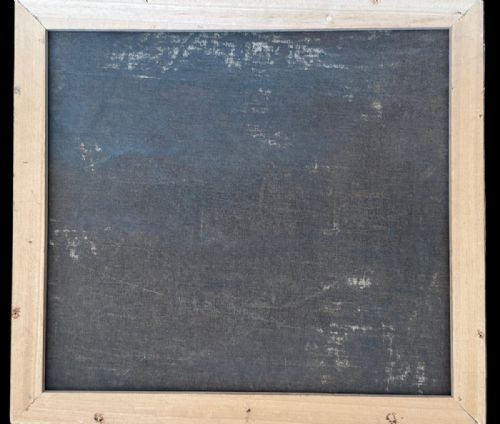
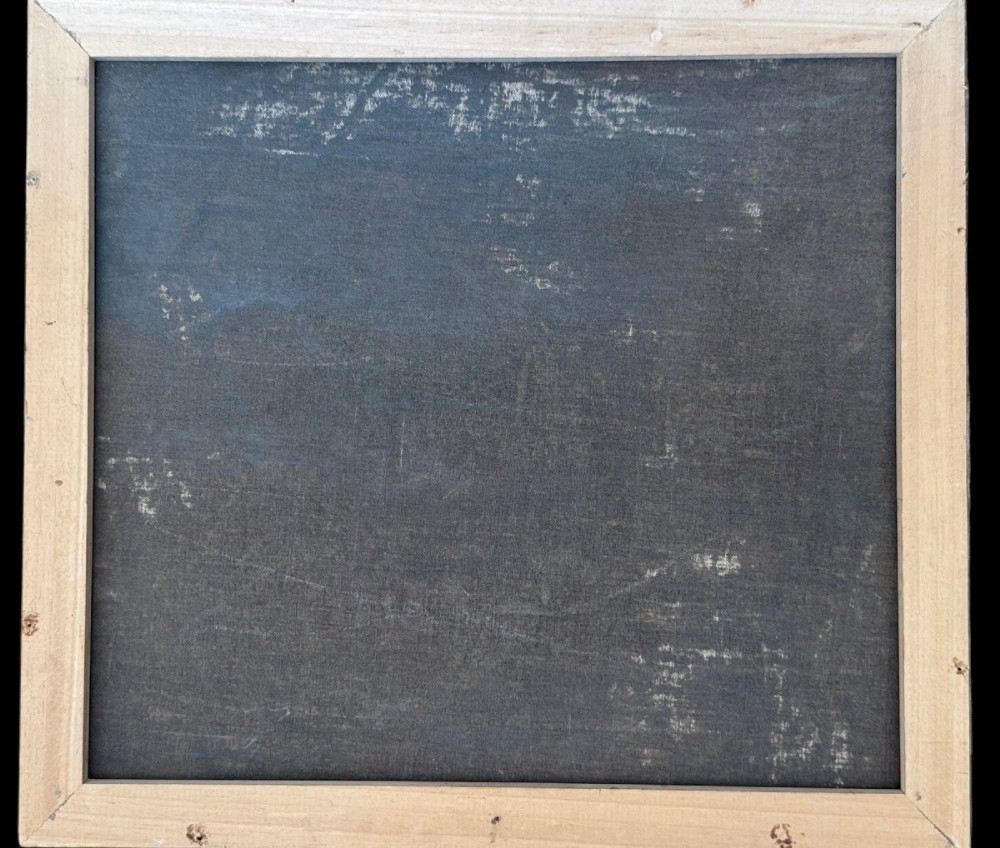
Condition report. The painting is in good overall condition for its antiquity. The original canvas has been laid down onto a new canvas we estimate to be circa 1970 and possibly a wax lining method. The stretcher bars were evidently renewed at that time . The canvas is in good tension . There has been some restoration and intervention with areas of retouching predominately to the background and retouching throughout but well blended. The paint surface is stable with craquelure commensurate with the paintings age throughout .

The contemporary frame is offered as a gift see note below regarding frames.

Please note.

The frame that is included in the pictures above has been added to the artwork by a third party/the seller, as such it is not an int

Physical Dimensions
Height
57cm (22.44")
Width
61cm (24.02")
Depth
3cm (1.18")
Declaration

Westcoast Fine Art has dated this Italian Baroque Oil Painting to the 18th Century.

Reference Numbers
Sellingantiques Reference
SA1145542
Dealers Notes

****Westcoast Fine Art is always willing to consider reasonable offers from prospective buyers. Please feel free to send us an inquiry regarding any proposal or offer; we will review and respond within 24 hours.

Please enquire about shipping before making a purchase.

Note:

The buyer is responsible for paying any import duties and associated taxes in the destination country. All works will be professionally packed and insured for shipment.

Shipping:

Please contact for exact shipping charges before purchasing

1) UK shipping please enquire

2) EU shipping please enquire

3) For other worldwide shipping, please contact us.

We offer a 14-day return period to the EU and UK, provided the painting is returned in the same condition as received, packaged to the same packaging standards and insured at the price paid to Westcoast Fine Art Ltd for the artwork.

**The buyer is responsible for paying any customs charges of the destination country. We always advise the buyer to check with their local customs authorities for customs tariffs.

The frame is a gift and is therefore being provided to you at no additional cost. Any damages to the frame during transit do not give the buyer a basis for a claim or validate a request for the cancellation of a sale.

Westcoast Fine Art is a trademark of Westcoast Fine Art Ltd. Registered in England and Wales No. 15030029.

Registered office: 71-75 Shelton Street, Covent Garden, London, United Kingdom, WC2H 9JQ

***Westcoast Fine Art is always willing to consider reasonable offers from prospective buyers. Please feel free to send us an inquiry regarding any proposal or offer; we will review and respond within 24 hours.

Note:

The buyer is responsible for paying any import duties and associated taxes in the destination country. All works will be professionally packed and insured for shipment.

Shipping:

Please contact for exact shipping charges before purchasing

1) UK shipping please request price

2) EU shipping please request price

3) For other worldwide shipping, please request price

We offer a 14-day return period to the EU and UK, provided the painting is returned in the same condition as received, packaged to the same packaging standards and insured at the price paid to Westcoast Fine Art Ltd for the artwork.

*The buyer is responsible for paying any customs charges of the destination country. We always advise the buyer to check with their local customs authorities for customs tariffs.

The frame is a gift and is therefore being provided to you at no additional cost. Any damages to the frame during transit do not give the buyer a basis for a claim or validate a request for the cancellation of a sale.

Westcoast Fine Art is a trademark of Westcoast Fine Art Ltd. Registered in England and Wales No. 15030029.

Registered office: 71-75 Shelton Street, Covent Garden, London, United Kingdom, WC2H 9JQ

Description
Italian School (XVIII) Follower of Antonio Tempesta (1555–1630)

Title: The Conversion of St. Paul

Date: 18th Century

Medium: Oil on canvas

Provenance: From a private London collection.

Measurements: overall measurements with the frame are 61cm x 57 x 3cm and the painting itself measured at 52cm x 47cm.
Westcoast Fine Art
fig 1. An eighteenth-century Italian school oil painting depicting the biblical scene of the Conversion of Saint Paul set in a gilt wood frame.
fig 1. Italian School Painting (Xviii) of the Conversion of Saint Paul, Follower of Antonio Tempesta (1555–1630)

The present work depicts a scene from the Bible commonly known as the conversion of Paul. The conversion of Paul the Apostle (also the Pauline conversion, Damascene conversion, Damascus Christophany and Paul's transformation on the road to Damascus) was, according to the New Testament, an event in the life of Saul/Paul the Apostle that led him to cease persecuting early Christians and to become a follower of Jesus.

fig 2. An eighteenth-century Italian school oil painting depicting the biblical scene of the Conversion of Saint Paul set in a gilt wood frame.
fig 2. Italian School Painting (Xviii) of the Conversion of Saint Paul, Follower of Antonio Tempesta (1555–1630)

Paul had persecuted Christians in Jerusalem but was struck down on the road to Damascus by a vision of Christ, who asked him why. Paul was blinded, and Christ sent a man to restore his sight. He was then baptised and set out to preach Christ’s word. The present work depicts the dramatic moment of terror when the skies split open and heaven was revealed. Paul’s horse rolls to the ground, taking him with it.

fig 3. An eighteenth-century Italian school oil painting depicting the biblical scene of the Conversion of Saint Paul set in a gilt wood frame.
fig 3. Italian School Painting (Xviii) of the Conversion of Saint Paul, Follower of Antonio Tempesta (1555–1630)

Stylistically, the present work is distinctly of the Roman school but also shows a bit of a Flemish influence, hence the connection with the work of Antonio Tempesta, an Italian artist who was influenced by the work of the Flemish school of artists. The wonderfully theatrical composition is masterfully executed and wonderfully pleasing.

fig 4. An eighteenth-century Italian school oil painting depicting the biblical scene of the Conversion of Saint Paul set in a gilt wood frame.
fig 4. Italian School Painting (Xviii) of the Conversion of Saint Paul, Follower of Antonio Tempesta (1555–1630)

Antonio Tempesta, also called il Tempestino (1555 – 5 August 1630), was an Italian painter and engraver, whose art acted as a point of connection between Baroque Rome and the culture of Antwerp. Much of his work depicts major battles and historical figures.

He was born and trained in Florence and painted in a variety of styles, influenced to some degree by "Counter-Maniera" or Counter-Mannerism. He enrolled in the Florentine Accademia delle Arti del Disegno in 1576. He was a pupil of Santi di Tito, then of the Flemish painter Joannes Stradanus. He was part of the large team of artists working under Giorgio Vasari on the interior decoration of the Palazzo Vecchio in Florence.

His favourite subjects were battles, cavalcades, and processions. He relocated to Rome, where he associated with artists from the Habsburg Netherlands, which may have led to his facility with landscape painting.

Tempesta received his earliest artistic training at Florence’s Accademia del Disegno, first studying under Santi di Tito and soon after apprenticing with Giorgio Vasari on designs for the Palazzo Vecchio. He then headed to Rome, where he contributed to decoration at the Vatican Palace along with several prominent private dwellings, including the Villa Lante in Bagnaia (1578-1579) and the Villa Farnese in Caprarola (1579-1583).

In addition to his vivacious imagery that drew themes from mythology and the classical world, Tempesta is also celebrated for his marvelous 12-plate Plan of the City of Rome. Initially published in 1593, Tempesta’s map provided one of the most detailed interpretations of Rome of his day.

Condition report. The painting is in good overall condition for its antiquity. The original canvas has been laid down onto a new canvas we estimate to be circa 1970 and possibly a wax lining method. The stretcher bars were evidently renewed at that time . The canvas is in good tension . There has been some restoration and intervention with areas of retouching predominately to the background and retouching throughout but well blended. The paint surface is stable with craquelure commensurate with the paintings age throughout .

The contemporary frame is offered as a gift see note below regarding frames.

Please note.

The frame that is included in the pictures above has been added to the artwork by a third party/the seller, as such it is not an int

Height
57cm (22.44")
Width
61cm (24.02")
Depth
3cm (1.18")
Date of Manufacture

Westcoast Fine Art has dated this Italian Baroque Oil Painting to the 18th Century.

Reference Numbers
Sellingantiques Ref
SA1145542
Westcoast Fine Art
Westcoast Fine Art
Sellingantiques verified Since May 2025

Westcoast fine art ltd is a UK based dealer in fine classical works of art.

Dealer Profile

You can view the stock and full dealer information on the Westcoast Fine Art Profile Page

PDF SHARE
SAVE
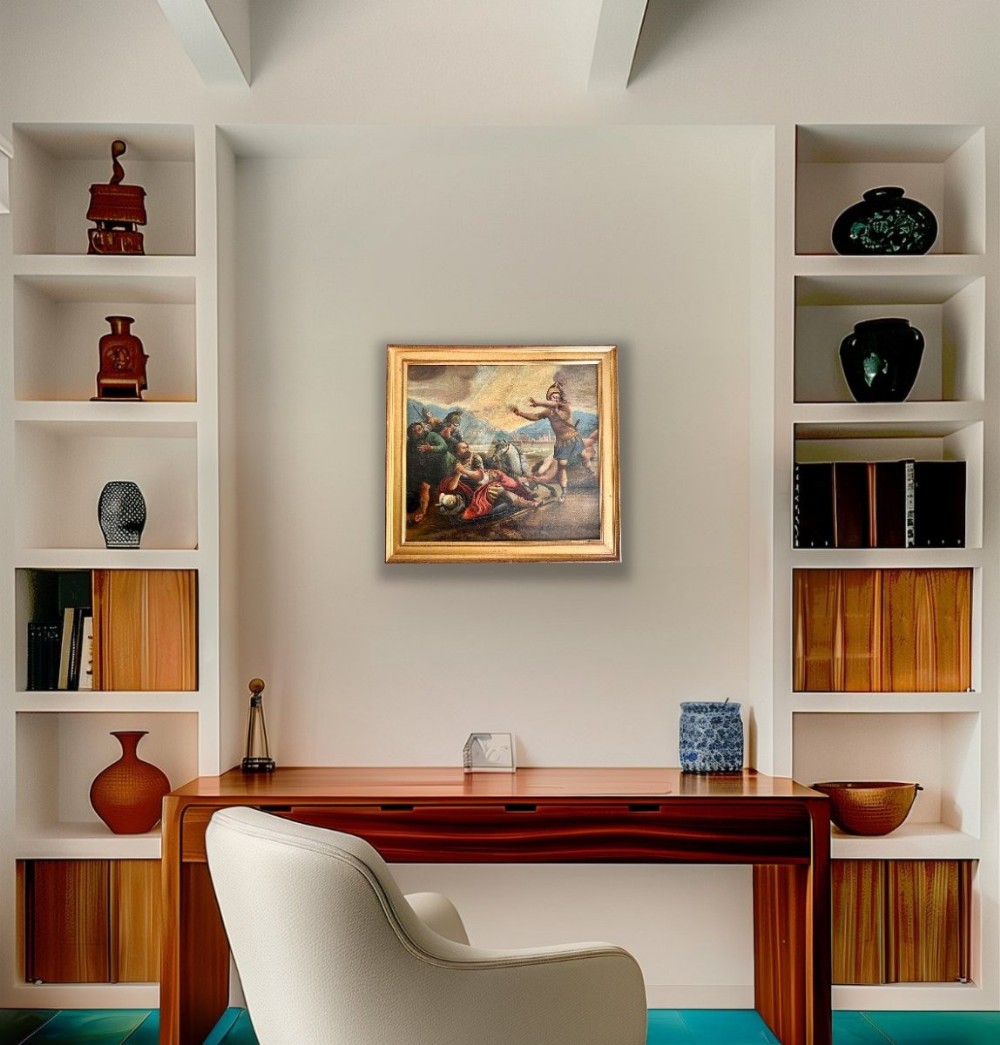
An eighteenth-century Italian school oil painting depicting the biblical scene of the Conversion of Saint Paul set in a gilt wood frame.
1 / 5
Archive I An eighteenth-century Italian school oil painting depicting the biblical scene of the Conversion of Saint Paul set in a gilt wood frame.

Italian School Painting (Xviii) of the Conversion of Saint Paul, Follower of Antonio Tempesta (1555–1630)
Archive II An eighteenth-century Italian school oil painting depicting the biblical scene of the Conversion of Saint Paul set in a gilt wood frame. View II
Archive III An eighteenth-century Italian school oil painting depicting the biblical scene of the Conversion of Saint Paul set in a gilt wood frame. View III
Archive IV An eighteenth-century Italian school oil painting depicting the biblical scene of the Conversion of Saint Paul set in a gilt wood frame. View IV
Archive V An eighteenth-century Italian school oil painting depicting the biblical scene of the Conversion of Saint Paul set in a gilt wood frame. View V
FURTHER BROWSING

Visitors also looked at these ⇣

Enlarged Archival View
Telephone 07466 158064
Location
Northwest London
United Kingdom
Verified Since May 2025
Items For Sale 32
Items Sold 12
Westcoast Fine Art
Westcoast Fine Art
Verified Since May 2025
View Dealer Info
Location: Northwest London, United Kingdom
Verified
May 2025
For Sale
32
Sold
12
An eighteenth-century Italian school oil painting depicting the biblical scene of the Conversion of Saint Paul set in a gilt wood frame.
Italian School Painting (XVIII) of The Conversion Of Saint Paul, Follower of Antonio Tempesta (1555–1630)
Ref: SA1145542
An eighteenth-century Italian school oil painting depicting the biblical scene of the Conversion of Saint Paul set in a gilt wood frame.
Detail View 1
Detail View 2
Detail View 3
Detail View 4
Archival Detail
Every single antique dealer on our platform is individually approved by our internal team. We verify their professional trade history, ethical standards, and photographic quality to ensure a secure, high-standard buying environment. Upon joining, every dealer agrees to a strict 9-point code of conduct. While issues can occasionally arise, our dealers typically resolve them swiftly and directly with the buyer. In fact, since our founding in 2002, Sellingantiques has only had to step in to help resolve an issue on roughly five occasions—a true testament to the quality of our dealers and their dedication to your happiness.
Our dealers are highly experienced in packing and shipping fragile, high-value antiques. Because you are in direct contact with the dealer, you will be able to easily go through all available shipping and insurance options together to ensure your item arrives safely.
Antiques are the ultimate green purchase. By choosing historical pieces over newly manufactured goods, you completely eliminate the carbon footprint of modern mass production while preserving exceptional, timeless craftsmanship.

Eighteenth-century Italian School religious artworks frequently display dynamic compositions, dramatic lighting, and theatrical figurative posing derived from Baroque traditions. Artists often depicted scriptural narratives with intense emotion, rendered in rich, earthy pigments on canvas.

Paintings from this period were predominantly created using hand-ground mineral and organic pigments bound with linseed oil on hand-woven linen canvas. Frames were typically crafted from timber, carved by hand, and finished with gold leaf gilding over a gesso ground.

Authenticity is evaluated through age-appropriate craquelure patterns, natural varnish oxidisation, historical stretcher bar construction, and evidence of period-correct hand-forged nails or wooden pegs. Scientific examination of pigment composition and canvas weave also provides structural verification.

A large historical canvas serves as a focal point when positioned above a fireplace mantelpiece or console table in a modern space. The warm tones of gilded frames provide a striking contrast against neutral modern wall palettes.

Dusting should be performed gently with a dry, soft-bristle brush, avoiding household chemical cleaners or water. Paintings must be kept in stable humidity environments away from direct sunlight, heat sources, and dampness, with professional restoration undertaken for varnish discolouration.
items
Add keywords to the filter
Price
£100
£250000
Era
Movements
Material
Origin
Stock Location
Freshness
Online Payments
Categories