6,199  PAGES BROWSED TODAY PAGES TODAY 0  ANTIQUES UPLOADED TODAY NEW ARRIVALS
ID #SA1043597
FOR SALE
£4,800
Email
Save
Set of 8 18th Century Jan Wandelaar Engravings Skeleton and Muscles
Karen Tarleton
for sale €5,616     $6,096
£4,800

Karen Tarleton

Sellingantiques Verified Since Mar 2011
View Dealers Stock Page
Id #SA1043597
PDF SHARE
SAVE

Set of 8 18th Century Jan Wandelaar Engravings Skeleton and Muscles

18th century
For Sale by Karen Tarleton
Description

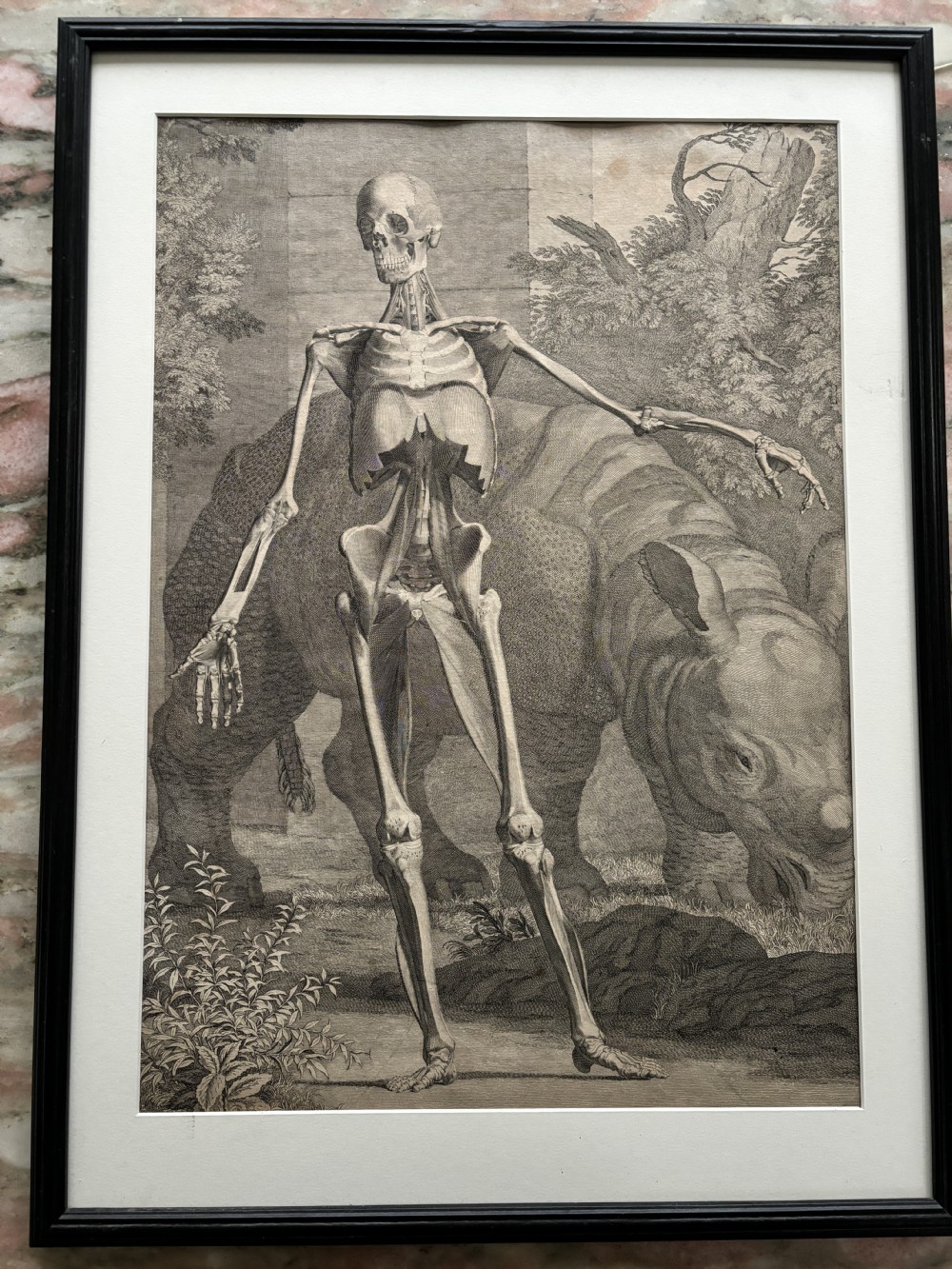
A set of 8 engravings of the most magnificent plates from amongst the most artistically perfect of the atomical atlases.

Bernhard Siegfried Albinus is perhaps best known for his monumental Tabulae sceleti et musculorum corporis humani, which was published in Leyden in 1747, largely at his own expense. The artist and engraver with whom Albinus did nearly all of his work was Jan Wandelaar (1690–1759). In an attempt to increase the scientific accuracy of anatomical illustration, Albinus and Wandelaar devised a new technique of placing nets with square webbing at specified intervals between the artist and the anatomical specimen and copying the images using the grid patterns. Tabulae was highly criticized by such engravers as Petrus Camper, especially for the whimsical backgrounds added to many of the pieces by Wandelaar, but Albinus staunchly defended Wandelaar and his work.

The most famous of these engravings are the ones with Clara the Rhinocerus incorporating the first accurately drawn depictions of a living rhinoceros. Wandelaar drew the exotic animal from life at the Amsterdam zoo, where the first living specimen to arrive in Europe, nicknamed Clara, was brought in 1741. Albinus and Wandelaar, who had already been working on their anatomical atlas for many years, proclaimed Clara as its symbol, capitalizing on her popularity with the European public to help promote their upcoming project.

Please call or email me for further information.

Many thanks

Karen

07866 475069

Physical Dimensions
Height
64cm (25.20")
Width
48cm (18.90")
Depth
1cm (0.39")
Declaration

Karen Tarleton has dated this Jan Wandelaar Anatomical Engraving to the 18th Century.

Reference Numbers
Sellingantiques Reference
SA1043597
Description
A set of 8 engravings of the most magnificent plates from amongst the most artistically perfect of the atomical atlases.
Bernhard Siegfried Albinus is perhaps best known for his monumental Tabulae sceleti et musculorum corporis humani, which was published in Leyden in 1747, largely at his own expense.
Karen Tarleton

The artist and engraver with whom Albinus did nearly all of his work was Jan Wandelaar (1690–1759). In an attempt to increase the scientific accuracy of anatomical illustration, Albinus and Wandelaar devised a new technique of placing nets with square webbing at specified intervals between the artist and the anatomical specimen and copying the images using the grid patterns. Tabulae was highly criticized by such engravers as Petrus Camper, especially for the whimsical backgrounds added to many of the pieces by Wandelaar, but Albinus staunchly defended Wandelaar and his work.

fig 1. A framed monochrome 18th-century anatomical engraving depicting a human skeleton posed in front of a rhinoceros in a landscape.
fig 1. Set of 8 18th Century Jan Wandelaar Engravings Skeleton and Muscles

The most famous of these engravings are the ones with Clara the Rhinocerus incorporating the first accurately drawn depictions of a living rhinoceros. Wandelaar drew the exotic animal from life at the Amsterdam zoo, where the first living specimen to arrive in Europe, nicknamed Clara, was brought in 1741. Albinus and Wandelaar, who had already been working on their anatomical atlas for many years, proclaimed Clara as its symbol, capitalizing on her popularity with the European public to help promote their upcoming project.

Please call or email me for further information.

Many thanks

Karen

07866 475069

Height
64cm (25.20")
Width
48cm (18.90")
Depth
1cm (0.39")
Date of Manufacture

Karen Tarleton has dated this Jan Wandelaar Anatomical Engraving to the 18th Century.

Reference Numbers
Sellingantiques Ref
SA1043597
Karen Tarleton
Sellingantiques verified Since Mar 2011
Dealer Profile

You can view the stock and full dealer information on the Karen Tarleton Profile Page
PDF SHARE
SAVE
A framed monochrome 18th-century anatomical engraving depicting a human skeleton posed in front of a rhinoceros in a landscape.
1 / 8
Archive I A framed monochrome 18th-century anatomical engraving depicting a human skeleton posed in front of a rhinoceros in a landscape.

Set of 8 18th Century Jan Wandelaar Engravings Skeleton and Muscles

Archive II A framed monochrome 18th-century anatomical engraving depicting a human skeleton posed in front of a rhinoceros in a landscape. View II
Archive III A framed monochrome 18th-century anatomical engraving depicting a human skeleton posed in front of a rhinoceros in a landscape. View III
Archive IV A framed monochrome 18th-century anatomical engraving depicting a human skeleton posed in front of a rhinoceros in a landscape. View IV
Archive V A framed monochrome 18th-century anatomical engraving depicting a human skeleton posed in front of a rhinoceros in a landscape. View V
Archive VI A framed monochrome 18th-century anatomical engraving depicting a human skeleton posed in front of a rhinoceros in a landscape. View VI
Archive VII A framed monochrome 18th-century anatomical engraving depicting a human skeleton posed in front of a rhinoceros in a landscape. View VII
Archive VIII A framed monochrome 18th-century anatomical engraving depicting a human skeleton posed in front of a rhinoceros in a landscape. View VIII
Enlarged Archival View
Telephone 07866 475069
Location
Misterton
Somerset
United Kingdom
Dealer Profile Page sellingantiques.co.uk/sandc
Verified Since Mar 2011
Items For Sale 97
Items Sold 1,584
Karen Tarleton
Verified Since Mar 2011
View Dealer Info
Location: Misterton, Somerset, United Kingdom
Verified
Mar 2011
For Sale
97
Sold
1,584
A framed monochrome 18th-century anatomical engraving depicting a human skeleton posed in front of a rhinoceros in a landscape.
Set of 8 18th Century Jan Wandelaar Engravings Skeleton and Muscles
Ref: SA1043597
A framed monochrome 18th-century anatomical engraving depicting a human skeleton posed in front of a rhinoceros in a landscape.
Detail View 1
Detail View 2
Detail View 3
Detail View 4
Detail View 5
Detail View 6
Detail View 7
Archival Detail
Every single antique dealer on our platform is individually approved by our internal team. We verify their professional trade history, ethical standards, and photographic quality to ensure a secure, high-standard buying environment. Upon joining, every dealer agrees to a strict 9-point code of conduct. While issues can occasionally arise, our dealers typically resolve them swiftly and directly with the buyer. In fact, since our founding in 2002, Sellingantiques has only had to step in to help resolve an issue on roughly five occasions—a true testament to the quality of our dealers and their dedication to your happiness.
Our dealers are highly experienced in packing and shipping fragile, high-value antiques. Because you are in direct contact with the dealer, you will be able to easily go through all available shipping and insurance options together to ensure your item arrives safely.
Antiques are the ultimate green purchase. By choosing historical pieces over newly manufactured goods, you completely eliminate the carbon footprint of modern mass production while preserving exceptional, timeless craftsmanship.

18th-century anatomical engravings are detailed copperplate prints created to document human anatomy for medical training and scientific research during the Enlightenment. Artists like Jan Wandelaar combined precise anatomical drawing with classical background scenery, producing works that served both instructional and aesthetic functions.

These prints were executed using copperplate engraving techniques printed onto handmade rag paper. Oil-based ink was applied to the incised metal plate and pressed onto paper, leaving a distinct plate mark impression along the borders.

Authentic period engravings feature a visible plate impression border, laid paper lines visible when backlit, and natural paper oxidisation or foxing. The print should exhibit crisp line work from the etching process rather than modern halftone dot matrices.

Anatomical engravings complement gentlemans library, dark academia, or minimalist decor styles. Grouping framed prints together on a wall above a console or sideboard creates a structured, historical focus within a room.

Mount paper prints using acid-free matting and UV-protective glass to limit light degradation. Store or display them in climate-controlled spaces away from high humidity to prevent paper warping and mould growth.
items
Add keywords to the filter
Price
£100
£250000
Era
Movements
Material
Origin
Stock Location
Freshness
Online Payments
Categories