


Vintage Platinum Eternity Band
A vintage platinum eternity band delivers continuous sparkle around the finger, uniting enduring white metal with tightly set stones.
Vintage Platinum Eternity Band
A vintage platinum eternity band embodies a continuous circle of gemstones set in a dense, durable precious metal. When searching this phrase, buyers encounter rings originating from the 1920s, 1930s, 1940s, 1950s, and 1960s, spanning Art Deco, Retro, and Mid-Century aesthetics.
Originating across decades defined by distinct design movements, these rings reflect both geometric Art Deco precision and later mid-century fluidity. Each piece carries the distinct hallmarks of its era while maintaining the robust structural integrity inherent to the metal.
Materials and construction
Platinum serves as the primary structural and setting material, prized for its strength and ability to hold stones securely with minimal visible metal. Craftsmen frequently combined this resilient metal with 18ct white gold, 18ct yellow gold, or 14ct gold components.
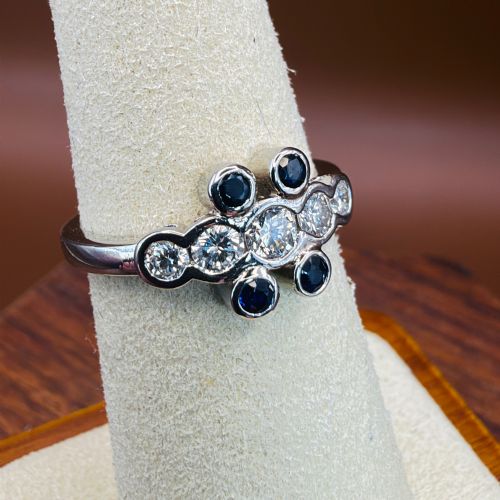
Gemstones including old-cut and single-cut diamonds, rubies, and sapphires are set directly into the metal bands using precise techniques of the period. Collet settings and close channel or claw configurations secure the stones in continuous or multi-stone arrangements.
Materials across the selection combine platinum with white gold, yellow gold, diamonds, rubies, and sapphires.
Assessing quality in period rings
Quality rests upon the uniformity and matching of the set gemstones, whether diamonds, rubies, or sapphires, alongside the precision of the metalwork. Master jewellers ensured even spacing and secure seating that protected the girdle of each stone.
The integrity of the platinum band itself dictates longevity, particularly in full eternity designs where metal is thin between stones. Superior examples maintain structural thickness and crisp geometric detailing without thinning from wear or previous resizing.
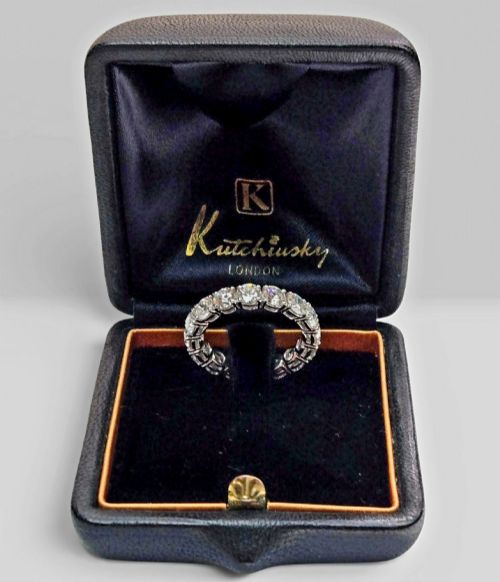
Kutchinsky
The Vintage Platinum Eternity Band Glossary
- Platinum
- A dense, strong, naturally white precious metal used in fine jewellery for its durability and secure stone settings. It allows for delicate prongs that hold diamonds firmly.
- Full eternity ring
- A band set completely around the entire circumference with continuous gemstones signifying endless love. These rings cannot be easily resized.
- Art Deco
- A design style prominent in the 1920s and 1930s characterised by geometric symmetry, clean lines, and stylised motifs. Pieces from this era often feature precise platinum work.
- Old cut
- A diamond cutting style preceding modern brilliant cuts, featuring a smaller table, higher crown, and larger culet. These stones exhibit a softer, distinct candlelit sparkle.
- Collet set
- A method of securing a gemstone inside a low metal collar or rim that encircles the stone's girdle. This technique provides a smooth, snag-free profile.
Vintage Platinum Eternity Band: Frequently Asked Questions
Can a vintage platinum eternity band be resized?
Full eternity bands are exceptionally difficult to resize because the gemstones encircle the entire band. Altering the metal circumference disrupts the continuous stone setting.
Partial eternity rings or five-stone rings offer more flexibility for adjustment by a skilled jeweller. Buyers should verify their exact ring size before purchasing a full circle design.
What is the difference between platinum and white gold?
Platinum is a naturally white, dense metal that maintains its colour without plating and develops a soft patina over time. It offers superior weight and tensile strength for holding precious stones securely.
White gold is an alloy of yellow gold mixed with white metals, frequently rhodium plated to brighten the surface. Over time, the plating wears away, revealing the warmer metal underneath.
How do I wear an eternity band with an engagement ring?
An eternity band traditionally sits beside the engagement ring on the ring finger, resting closer to the base of the hand. Many wearers pair a geometric Art Deco band with a matching period engagement ring.
Because eternity bands feature stones all the way around, ensure the profiles sit flush against your engagement ring to prevent rubbing and stone damage.
What stones are typically found in these bands?
Diamonds are the predominant gemstone found in these period bands, ranging from old mine cuts to single cuts. Coloured gemstones such as rubies and sapphires also appear frequently as accents or primary stones.
These stones reflect the luxury palettes of the 1920s through the 1960s, often contrasting sharply against the bright white platinum settings.