
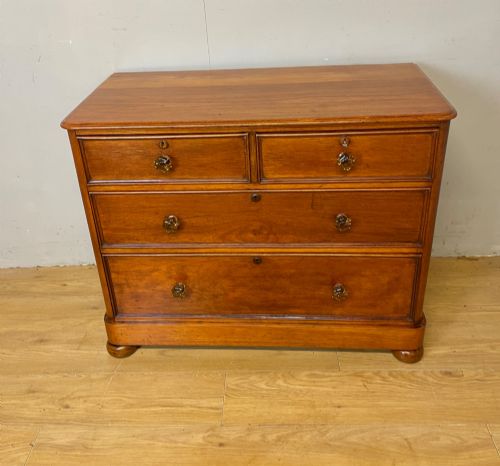
Victorian 3 Height Chest
A victorian 3 height chest is a sturdy nineteenth-century drawer set arranged in tiered proportions for domestic storage.
Victorian 3 Height Chest
A victorian 3 height chest is a nineteenth-century storage piece built with three primary drawer tiers, appearing frequently in mahogany and ash forms. These chests date predominantly from the Victorian era and the broader nineteenth century, reflecting standard domestic storage needs of the period. Buyers examining this page will most commonly encounter mahogany examples, alongside variations in flame mahogany veneer, ash, and satin walnut.
The physical form encompasses standard chests of drawers as well as specialised dressing chests. Several pieces display stylistic influences such as Arts and Crafts or Regency, while others exhibit traditional Victorian craftsmanship. Proportions vary from compact small chests to bow fronted layouts designed to suit different room dimensions.
Materials and construction
Makers utilised solid timbers and selected veneers, relying heavily on mahogany, flame mahogany veneer, ash, and satin walnut across the surviving pieces. Secondary woods and decorative edgings incorporated boxwood, while internal framing frequently utilised general wood construction.
Hardware details relied on brass fittings and iron elements to secure drawers and provide functional handles. Joinery techniques supported the stacked drawer configurations typical of nineteenth-century cabinet making.
Cabinet makers occasionally added secret shallow drawers hidden just beneath the top surface moulding.
What separates the best from the rest
The choice of primary timber surface sets apart the standard examples from the exceptional ones. Pieces utilising figured flame mahogany veneer or select satin walnut display superior visual depth compared to plain wood surfaces.
Refinement in secondary details, such as boxwood stringing, well-turned brass pulls, and balanced proportions across the tiers, elevates the overall execution. Coarser utilitarian chests rely on simpler ash or standard mahogany construction without decorative embellishment.
The Victorian 3 Height Chest Glossary
- Bow front
- A convex curved cabinet front that swells outward at the centre. This configuration appears on select Victorian chests to soften the rectangular silhouette.
- Flame mahogany veneer
- A thin slice of mahogany timber cut from the fork of the tree to produce a flickering, flamelike grain pattern. It provides a highly decorative surface on nineteenth-century drawer fronts.
- Satin walnut
- A light-toned timber utilised during the later nineteenth century, particularly within Arts and Crafts pieces. It offers a smooth, pale grain distinct from traditional dark mahogany.
- Arts and Crafts
- A design movement emphasising handcraftsmanship and simple structural honesty. Pieces from this style often feature solid ash or satin walnut construction.
- Dressing chest
- A lower storage chest incorporating a mirror or surface arrangement intended for personal grooming. These items combine drawer storage with a dressing function.
Victorian 3 Height Chest: Frequently Asked Questions
What woods were used for these chests?
Cabinet makers built these pieces using mahogany, flame mahogany veneer, ash, and satin walnut.
Secondary detailing sometimes incorporated boxwood stringing and brass or iron hardware.
Are these chests strictly Victorian?
The majority date from the Victorian era and the wider nineteenth century, spanning from around eighteen-sixty to eighteen-nought-y.
Stylistic influences occasionally extend into Arts and Crafts and Regency design traditions.
Where were these chests used in a home?
These pieces served as practical bedroom storage for clothing and personal linens.
Dressing chest variants were specifically equipped for personal grooming and chamber use.