
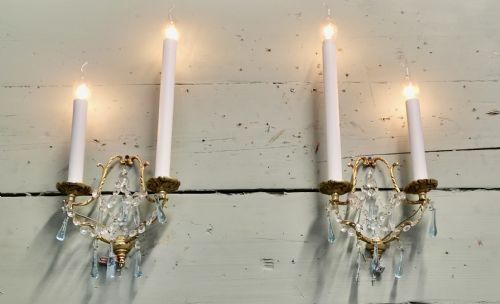


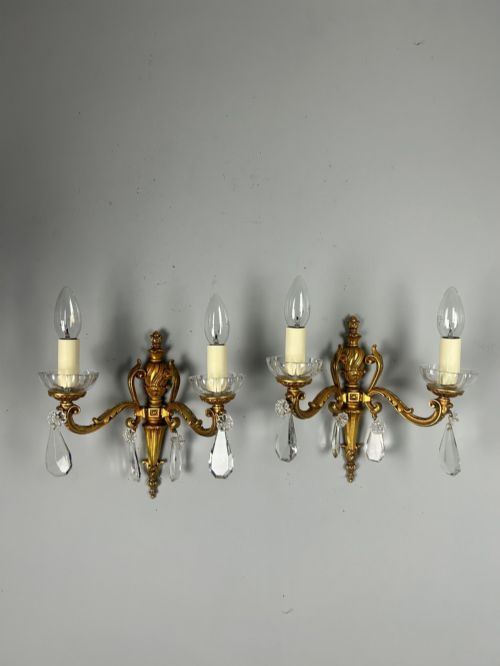


Two Light Crystal Sconces
These two light crystal sconces bring authentic period illumination to a room, offering the sparkling refraction of early twentieth-century glass and gilt brass.

Two Light Crystal Sconces
When you search for two light crystal sconces, you encounter matched pairs of antique wall lights designed to hold twin candles or electrical bulbs. The pieces available here originate predominantly from the early twentieth century, spanning the decades between nineteen hundred and nineteen thirty.
Most examples rely on a two-arm configuration, often described as twin branch or twin arm. These fixtures serve to project candlelight or electric light across a room while the hanging crystal pendants multiply the visual impact.
Materials and construction
The structural framework of these fixtures relies on cast metals, specifically brass, gilt brass, gilded bronze, and painted metal or toleware. These metals provide the sturdy armature necessary to support the weight of branching arms and suspended glass elements.
Cut glass and crystal form the decorative pendants, drops, and bobeches that characterise the style. These refractive elements are wired or pinned directly to the metal frames, creating the characteristic sparkle associated with early twentieth-century lighting.
Wood also appears in specific regional variants, notably as carved giltwood configured into leaf motifs for Florentine lighting. This variety demonstrates how local artisan traditions influenced the execution of standard twin-arm wall fixtures.
Florentine makers occasionally sculpted wood into delicate foliage, proving that even a wall light wanted to go green for the season.
Assessing quality and execution
Quality in these wall lights is determined by the crispness of the metal casting and the depth of the gilding. Finer pieces exhibit sharp detail in the brass or bronze work, whereas simpler examples show softer contours and less refined finishing on the reverse.
The cut and clarity of the crystal components further distinguish the grades of manufacture. Superior fixtures utilise hand-cut glass pendants with sharp facets that catch the light effectively, while standard pieces feature simpler pressed glass drops.
The integration of the design elements reveals the maker's hand, from the harmonious sweep of the twin arms to the proportional balance between the metal backplate and the hanging drops.
The Two Light Crystal Sconces Glossary
- Girandole
- A branched wall light or sconce designed to hold multiple candles or bulbs, frequently embellished with hanging glass prisms. These fixtures combine structural metal arms with reflective backplates to maximise illumination.
- Gilt Brass
- Brass that has been treated with a thin layer of gold or gold-coloured wash to give the appearance of solid gold. This technique provides a durable, lustrous finish common in early twentieth-century decorative hardware.
- Bobeche
- A small saucer-like disc fitted beneath the candle nozzle to catch melting wax. In crystal sconces, this component often supports a ring of hanging glass pendants.
- Toleware
- Painted or lacquered sheet metal items popular in period decorative arts. In wall lighting, toleware is often shaped into floral or leaf forms with applied colour.
- Rococo
- An ornate design style characterised by asymmetric scrolls, C-curves, and naturalistic motifs derived from shell and plant forms. French lighting from this tradition emphasises fluid, organic lines.
Two Light Crystal Sconces: Frequently Asked Questions
How were two light crystal sconces used?
These wall lights were positioned in pairs flanking fireplaces, doorways, or large mirrors to amplify ambient illumination within reception rooms. Their twin arms held candles originally, spreading light across the walls while crystal drops reflected the glow.
Over time, many of these fixtures were adapted for electricity while retaining their decorative function as primary wall art and supplementary lighting sources.
How do I identify early twentieth-century lighting?
Examine the construction methods of the metal frame, noting whether components are cast, hand-chased, or assembled with period screw threads. The style markers, such as Florentine leaf carvings or French neoclassical motifs, often align with manufacturing practices of the nineteen tens, twenties, and thirties.
The specific composition of the glass pendants and the patina on the brass or bronze provide additional clues to the era of manufacture.
Are these sconces difficult to wire?
Most antique wall lights require professional rewiring to meet contemporary electrical standards and ensure safe installation on standard wall junctions. A qualified electrician can adapt internal channels or backplates to house modern wiring safely.
Consulting an expert ensures that the historical armature remains undamaged during the modern adaptation process.