




Tufted Walnut Ottoman
These tufted walnut ottoman pieces are sturdy Victorian seating forms designed for drawing rooms and libraries, prized for deep buttoning and rich timber frames.
Tufted Walnut Ottoman
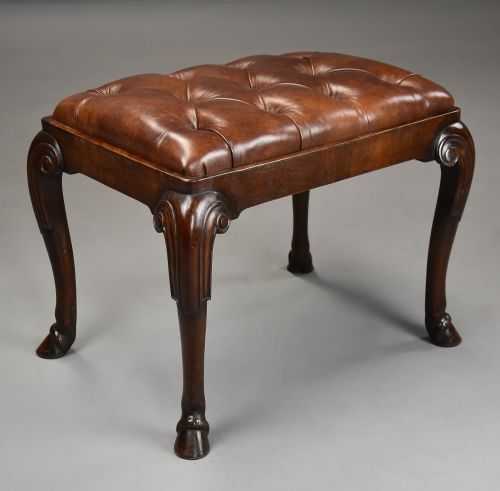
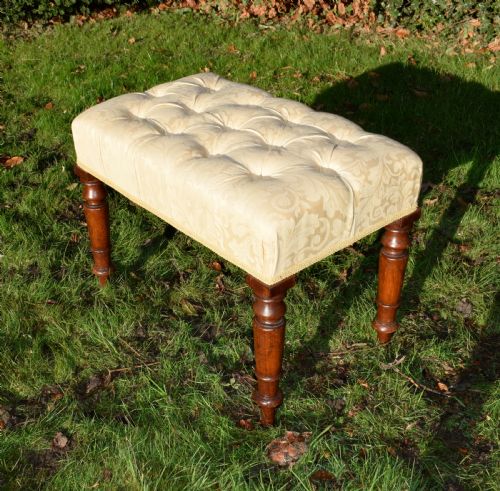
When you search for a tufted walnut ottoman, you encounter low Victorian seating forms and footstools built from solid timber with upholstered, buttoned tops. The examples on this page range from compact cabriole-legged stools to large library window stools and low salon pieces.
Most items you meet here date from the nineteenth century, including specific pieces from eighteen sixty and the Victorian Rococo Revival or Queen Anne styles. Makers utilised walnut and occasionally mahogany, shaping the timber into cabriole legs or intersecting X-frames.
How they were made
The frames rely on turned and carved walnut or mahogany, joined carefully to support heavy daily use in nineteenth-century drawing rooms. Artisans shaped cabriole legs and X-frames from solid hardwoods, applying hand-finishing techniques to the timber surfaces.
Upholstery methods involved deep buttoning across leather, damask, or textile covers, secured with brass detailing on selected pieces. Craftsmen padded the interior platforms tightly to maintain the characteristic tufted surface over decades of sitting and resting feet.
The site listings feature walnut and mahogany frames paired with leather, damask, and textile upholstery across Victorian and Queen Anne styles.
What varies in quality
Quality rests in the crispness of the walnut carving on the legs and the structural integrity of the frame beneath the upholstery. Pieces featuring hand-dyed red leather or robust X-frame geometry demonstrate greater ambition in design than simpler domestic stools.
The preservation of the buttoned upholstery and the depth of the timber grain determine how successfully a piece retains its original character. Subtle variations in the turning of cabriole legs distinguish standard workshop production from finer salon seating.
The Tufted Walnut Ottoman Glossary
- Cabriole leg
- A furniture leg that bends outward in a convex curve and tapers inward to a foot, typical of eighteenth-century design and later revivals. This form appears frequently on Victorian walnut stools.
- Buttoning
- An upholstery technique where twine is pulled through padding and secured with buttons to create a diamond pattern. This method provides the characteristic tufted surface on leather and fabric stools.
- X-frame
- A structural base formed by two intersecting diagonal members that support the upper seat. It provides robust weight distribution for low salon and library seating.
- Damask
- A reversible figured fabric traditionally woven on a jacquard loom with patterns visible in contrasting matte and lustrous surfaces. It serves as a decorative textile covering on period upholstery.
- Queen Anne style
- A domestic design movement characterised by curved lines, pad feet, and walnut as a primary timber. Nineteenth-century makers frequently revived these earlier aesthetic conventions.
Tufted Walnut Ottoman: Frequently Asked Questions
Where were these stools used?
These pieces served primarily in nineteenth-century drawing rooms, libraries, and salons as movable seating or footrests. Their low profiles suited domestic spaces where comfort and mobility mattered.
Larger examples often sat beneath windows or paired with armchairs to create matching seating arrangements for reading and social gatherings.
How do I identify a Victorian piece?
Victorian pieces display specific timber choices, particularly walnut and mahogany, combined with characteristic upholstery styles like deep buttoning. Examining the frame construction under the base reveals period joinery methods.
Stylistic revivals, such as Queen Anne Revival or Victorian Rococo Revival, offer additional clues to the manufacturing date of the woodwork.
Are these pieces sturdy enough for daily use?
Solid hardwood frames built from walnut or mahogany provide substantial structural strength for sitting and resting feet. Nineteenth-century joinery methods ensure these forms remain resilient in modern rooms.
Routine care for the timber frame and leather or fabric surface preserves their stability for continued domestic service.