





Teak Elephant Table
A teak elephant table brings sculptural colonial character into a room through dense carving and sturdy domestic timber.
Teak Elephant Table
A teak elephant table combines regional craftsmanship with domestic utility across occasional, side, and coffee table formats. These pieces emerge from periods such as the nineteenth century, Victorian era, and early decades of the nineteen hundreds, reflecting colonial trade and travel.
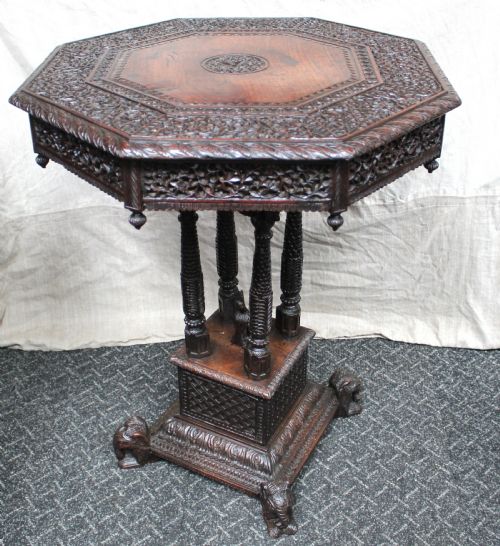
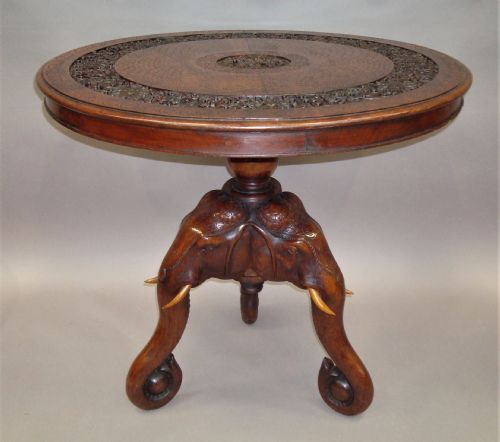
The most common examples on this page are carved occasional and side tables originating from the Bombay Presidency or Burma. They often take octagonal, circular, or rectangular shapes supported by figural animal legs or detailed structural carvings.
Beyond standard tables, related forms include plant stands, pedestals, and hall benches that share the same distinctive carved motifs and tropical hardwood construction. Buyers seek these items for their strong silhouette and deep historical connection to Anglo-Indian and Anglo-Burmese design traditions.
Materials and construction methods
Teak forms the primary structural foundation of these pieces, selected for its dense oil content and ability to hold intricate detail. Artisans paired this durable hardwood with contrasting inlays of bone, brass, ebony, and rosewood to highlight geometric patterns and surface designs.
Carving technique defines the surface ornamentation, utilising deep relief work to render animal figures, foliage, and architectural motifs. Joinery and assembly relied on traditional regional methods suited to tropical timbers and complex multi-part forms like tripod bases and folding frames.
Teak Elephant Table Retail Price Guide 2026
Typical asking prices for teak elephant table among the pieces listed under this phrase on Sellingantiques today, from the lower quarter to the upper quarter. They describe what is for sale here now, not the wider market.
Several tables rely entirely on carved animal legs to hold up the tea service.
Assessing craftsmanship and finish
The refinement of the carving dictates the distinction between standard production and exceptional execution. Finer pieces display crisp anatomical detail in the animal figures and precise control in the depth of the background relief.
The integration of secondary materials such as bone inlay and contrasting hardwoods indicates higher workmanship. Well-balanced proportions and stable structural joints distinguish superior examples from simpler regional variants.
The Teak Elephant Table Glossary
- Anglo-Indian
- Pertaining to the cultural and stylistic exchange between Britain and India during the colonial period. It describes furniture made in India for British residents or export.
- Hoshiarpur
- A region in Punjab known for intricate woodwork and inlay techniques. Pieces from this tradition typically feature dense geometric patterns using bone or brass.
- Tripod
- A three-legged support structure commonly found on small occasional tables and stands. This configuration provides stability on uneven floors.
- Octagonal
- A geometric shape with eight sides frequently utilised for table tops in regional colonial furniture. It allows for complex border patterns and central inlaid panels.
Teak Elephant Table: Frequently Asked Questions
Where were these tables made?
These pieces originate primarily from workshops in India and Burma during the nineteenth and early twentieth centuries. They were produced to serve colonial households or for export to Britain.
Craftsmen in regional centres utilised local tropical hardwoods and traditional carving techniques to create forms tailored for Western domestic interiors.
How do I care for teak furniture?
Teak is a durable timber that requires minimal maintenance to keep its natural appearance. Regular dusting with a soft cloth prevents surface build-up.
Avoid placing the wood near direct heat sources or strong sunlight to prevent drying and splitting. Natural oils can be applied sparingly if the surface appears dry.
What periods do these pieces date from?
The selection spans from the mid nineteenth century through the Edwardian era and into the early twentieth century. Common stylistic markers align with Victorian tastes and later colonial production.
Dates are determined by construction methods, stylistic evolution, and the presence of regional trade characteristics.
How do I identify Hoshiarpur work?
Hoshiarpur pieces are recognised by their dense surface ornamentation covering every visible area of the wood. Artisans embedded intricate patterns of bone or brass into the dark timber.
Floral motifs and geometric lattices dominate the design, creating a heavily textured and visually complex finish.