






Small Georgian Serpentine Chest
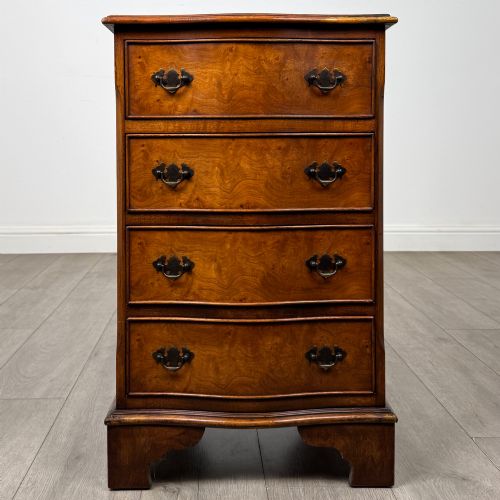
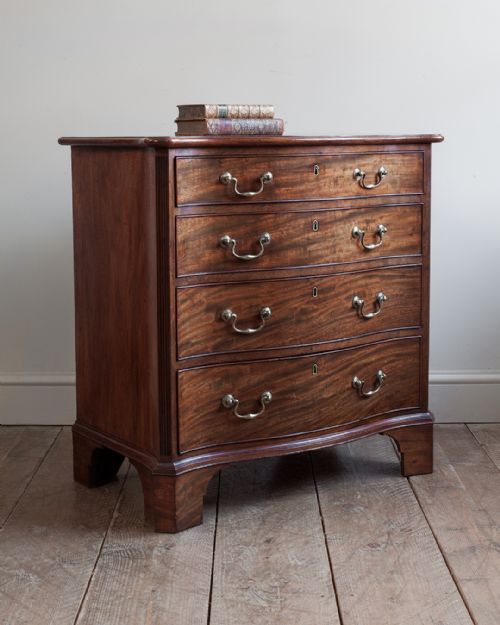
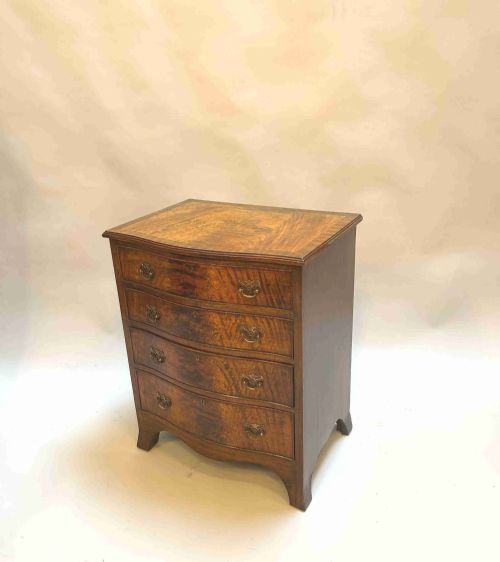
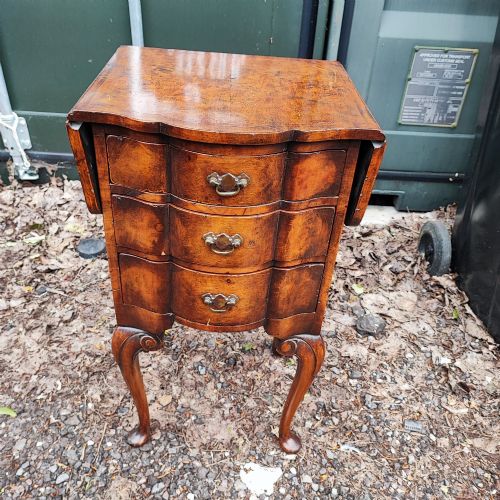
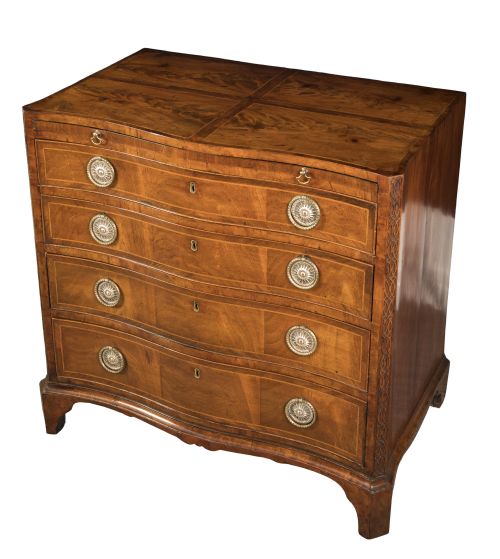
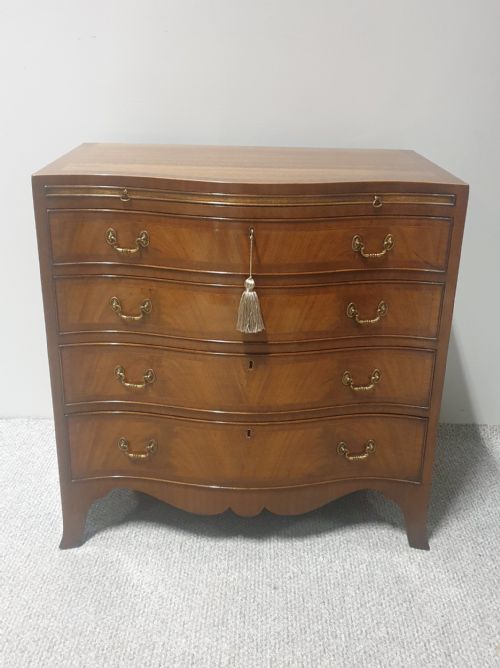
A small georgian serpentine chest brings undeniable curve and presence to a room, offering period storage shaped by a distinctive undulating front.
Small Georgian Serpentine Chest
A small georgian serpentine chest presents a distinctive undulating front profile that sweeps gently inward and outward, catching the light across polished timber surfaces. These compact storage pieces appear across eighteenth-century production as well as subsequent revival periods spanning the Edwardian era and the early twentieth century.
Materials and construction
Cabinetmakers constructed these chests predominantly using mahogany and walnut, frequently applying burr walnut or flame mahogany veneers to enhance the visual depth of the curved drawer fronts. Wood veneer requires precise skill to lay across a complex serpentine shape without lifting or cracking along the tight radius of the curves.
Brass hardware, including swing handles and escutcheons, fastens to the drawer faces to complement the dark timber tones. The integration of solid wood framing with decorative veneers underpins the structural integrity necessary to maintain the sweeping lines over centuries of use.
Small Georgian Serpentine Chest Retail Price Guide 2026
Typical asking prices for small georgian serpentine chest among the pieces listed under this phrase on Sellingantiques today, from the lower quarter to the upper quarter. They describe what is for sale here now, not the wider market.
Listings feature pieces spanning the eighteenth century, the Edwardian era, and the 1920s and 1930s, constructed in mahogany, walnut, and burr walnut.
Assessing quality in curved cabinetry
The degree of refinement in the timber figure fundamentally separates pieces across the range, with well-figured mahogany and richly patterned burr walnut commanding attention. Grain selection dictates how light moves across the undulating facade, revealing the natural depth of the wood.
Execution of the serpentine curve itself marks the distinction between standard production and superior work. A harmonious contour requires precise carpentry where the drawers meet the carcass smoothly without interrupting the fluid motion of the design.
The Small Georgian Serpentine Chest Glossary
- Serpentine
- A front profile curving inward centrally and outward at the sides. This contour demands advanced woodworking skill to execute cleanly.
- Veneer
- A thin slice of figured wood applied over a secondary timber base. This technique displays decorative grain patterns efficiently.
- George III
- The period spanning the reign of George III from seventeen sixty to eighteen twenty. Pieces from this era often display refined proportions and classical detailing.
- Revival
- A later design movement replicating historical styles such as the Georgian aesthetic. These pieces utilise traditional forms while reflecting the manufacturing dates of their own era.
Small Georgian Serpentine Chest: Frequently Asked Questions
How do I spot an 18th-century piece?
Examining the construction methods inside the drawer boxes and the ageing of the secondary timbers provides clues regarding age. Eighteenth-century pieces exhibit hand-cut dovetails and timber characteristics distinct from later revival work.
Surface patination accumulated over generations also helps distinguish genuine period examples from twentieth-century interpretations.
Where should I place a serpentine chest?
The compact proportions of these chests make them suitable for bedrooms, hallways, or living spaces as accent storage. Their finished front profiles allow them to sit effectively against walls where flat furniture might appear too rigid.
Placing the chest away from direct heat sources protects the timber and delicate veneers from drying and splitting over time.
How do I maintain the wood finish?
Regular dusting with a soft, dry cloth preserves the polished surface of mahogany and walnut furniture. Avoiding silicone-based polishes prevents buildup that can dull the grain.
Applying a traditional beeswax periodically nourishes the wood and maintains a subtle sheen across the curved surfaces.
What is the difference between revival and original?
Original eighteenth-century pieces carry the wear patterns and structural markers of their initial period of manufacture. Revival pieces replicate these historical shapes during the Edwardian era or the early twentieth century using contemporary workshops.
Both categories offer distinct craftsmanship, though original pieces hold a direct link to the Georgian era.