

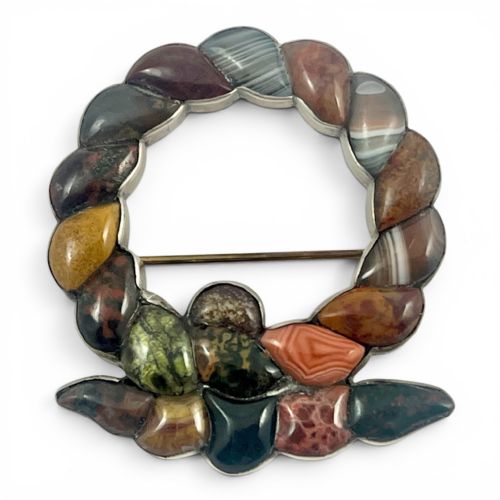


Silver Jasper Brooch
These pieces of silver jasper brooch design are substantial Victorian ornaments that bring tactile texture and deep earthen colour to modern lapels.
Silver Jasper Brooch
A silver jasper brooch is typically a Victorian Scottish Revival jewel designed to fasten heavy woollens and plaids. These pieces frequently take the form of broadsword kilt pins, padlocks, bows, or traditional circular pebble settings.
The objects appearing in this inventory hail entirely from the Victorian era, spanning from the early decades through to the turn of the twentieth century around nineteen hundred. They reflect a nineteenth-century fascination with Highland heritage, translating regional armaments and symbols into wearable everyday ornaments.
Makers and provincial retailers across Scotland shaped these items using regional hardstones alongside imported jasper, mounting them securely within heavy silver frameworks. Their survival bridges the gap between historical costume accessories and collectable antique jewellery.
How They Were Made
Craftsmen built these brooches using sterling silver and other silver grades, shaping the metal into intricate baskets, braided ribbons, or padlocks. The silver mounts serve as architectural cages designed to hold tightly fitted hardstone inlays without the need for modern adhesives.
Stones such as jasper, agate, bloodstone, and citrine were painstakingly cut, polished, and fitted flush into the metal channels. Lapidaries selected these minerals for their natural banding and rich opacity, contrasting the muted tones of jasper against brighter linear agates.
Silver Jasper Brooch Retail Price Guide 2026
Typical asking prices for silver jasper brooch among the pieces listed under this phrase on Sellingantiques today, from the lower quarter to the upper quarter. They describe what is for sale here now, not the wider market.
Current listings exclusively feature nineteenth-century Victorian pieces incorporating silver, jasper, agate, bloodstone, and citrine.
What Varies in Quality
Superior examples distinguish themselves through the precision of the stone-cutter's fit and the depth of the metalwork engraving. When individual panels of jasper and agate meet without gaps, the overall design possesses a structural integrity missing in looser assemblies.
The complexity of the silver framework also dictates the tier of the piece, moving from simple bezels to elaborate basket-hilted broadsword hilts and braided ribbon motifs. Heavier gauge silver provides a reassuring weight that signals a more ambitious workshop origin.
The Silver Jasper Brooch Glossary
- Jasper
- An opaque, microcrystalline variety of quartz that exhibits earthy red, green, or yellow hues. It provides a solid, matte counterpoint to translucent agates in nineteenth-century Scottish jewellery.
- Agate
- A common chalcedony stone featuring distinct natural banding or concentric rings. Victorian lapidaries prized it for its varied colouration and smooth polish.
- Citrine
- A transparent, yellow-to-brown variety of quartz often set as a central focal point. It brings warmth and brightness to otherwise dark assemblages of hardstones.
- Plaid brooch
- A large ornamental pin traditionally used to secure a Highland plaid or heavy shawl over the shoulder. Their substantial size required robust silver pins and hinges.
- Victorian Scottish Revival
- A nineteenth-century cultural movement that popularised Celtic motifs, dirks, and hardstone jewellery following royal patronage of the Highlands. This style dominated mid-to-late Victorian regional manufacturing.
Silver Jasper Brooch: Frequently Asked Questions
How were these brooches worn?
Victorian wearers pinned them directly onto heavy woollen shawls, plaids, and lapels as both functional fasteners and decorative statements.
Their substantial weight demanded sturdy mountings to prevent tearing the fabric during daily use.
How do I date a Scottish hardstone brooch?
Dating relies on examining the construction of the pin mechanism, the weight of the silver, and the stylistic cues of the period.
Most pieces originate from the Victorian era, specifically between eighteen-forty and nineteen hundred, reflecting the height of the Scottish Revival.
What stones appear alongside jasper?
Agate, bloodstone, and citrine frequently accompany jasper within these Victorian silver settings.
Lapidaries selected these stones for their contrasting colours and capacity to take a high, reflective polish.
How should I care for antique silver and stone jewellery?
Keep these pieces away from moisture and harsh chemical dips to protect the polished stone surfaces and delicate silver joints.
Gentle cleaning with a soft, dry cloth preserves the historical patina without damaging the softer hardstone inlays.