
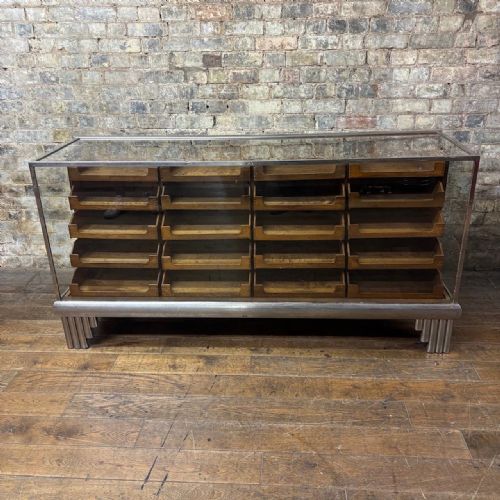


Shop Display Drawers
Shop display drawers are commercial fittings built for merchandise storage, and you buy them to bring robust, period utility into a modern room.
Shop Display Drawers
Shop display drawers encompass heavy commercial storage units, drapers counters, and chemist banks designed to organise and showcase goods in retail spaces. When you search for shop display drawers, you are looking at functional trade furniture built from the nineteenth century through the interwar commercial period.
The versions you are most likely to meet on this page span Victorian pine and mahogany pieces, Edwardian oak cabinets, and 1930s chrome-trimmed counters. These items range from large haberdashery banks with dozens of small drawers to countertop needle cases and glass-fronted display units.
Originating from outfitters, drapers, and cotton spool manufacturers, these fittings bring utilitarian design straight from the trading floor into domestic interiors. They offer deep banks of compartmentalised storage designed for heavy daily use.
Materials and Construction
Makers built these commercial units predominantly in oak, mahogany, and pine, selecting dense hardwoods for counters and softer timbers for internal carcass work. Brass handles, card holders, and chrome framing provide structural reinforcement and clear labelling points for stock.
Glass panels feature on upper display tiers to allow merchandise to be viewed while kept secure from handling. Painted finishes, sign-written lettering, and polished wood surfaces reflect the specific branding and utility required by nineteenth and twentieth-century merchants.
Some cabinets still carry the ghosts of cotton reels and collar studs in their corners.
Evaluating Quality
Quality rests on the integrity of the timber framing, the original hardware, and whether the multi-drawer banks retain their functional configuration. Solid walnut and figured mahogany builds sit at the upper end, alongside pieces bearing original trade sign-writing.
Proportion and scale dictate desirability, with long drapers counters and large fifty-drawer haberdashery fittings commanding more attention than smaller modular chests. Alterations to handles or replaced timber elements distinguish factory-original examples from heavily restored trade units.
Dudley & Co·E. Pollard & Co. Ltd·John Piggott & Co Ltd·Fred Wade·Cha’s Baker·Lawn & Burton Norwich
The Shop Display Drawers Glossary
- Haberdashery cabinet
- A multi-drawer storage unit originally used in drapery shops for ribbons, threads, and small accessories. These pieces typically feature numerous shallow drawers to sort small inventory.
- Drapers counter
- A long shop counter incorporating banks of drawers or glazed display sections facing the customer. They served as the main transaction and presentation surface in nineteenth-century outfitters.
- Sign written
- Hand-painted commercial lettering applied directly to the timber facade to advertise the shop name or goods housed within. This denotes original retail provenance.
- Chemists bank
- A tall set of apothecary drawers used in pharmacies and apothecaries to store dry drugs and botanical ingredients. They are prized for their high density of small drawers.
- Interwar commercial
- A design period spanning the 1920s and 1930s incorporating streamlined trade fittings, oak, and chrome details. These pieces bridge traditional cabinet making with modern retail needs.
Shop Display Drawers: Frequently Asked Questions
What are shop display drawers?
Shop display drawers are commercial storage units built for nineteenth and twentieth-century retail environments to organise and present merchandise.
They include drapers counters, haberdashery cabinets, and chemist banks designed with multiple shallow drawers and sometimes glazed fronts.
How were they used?
Merchants used these cabinets behind or beneath counters to store dry goods, sewing cottons, ribbons, and gentleman's outfitting accessories.
The layout allowed shop assistants to locate and retrieve small items quickly while keeping stock visible to customers.
How do I live with them?
These pieces serve well as kitchen islands, sideboards, or studio storage units, offering vast compartmentalised organisation for modern homes.
Their deep timber construction and utilitarian hardware anchor a room with distinct historical character and heavy-duty practicality.
How do I tell periods apart?
Victorian examples often feature solid mahogany or painted pine with traditional brass pulls, while Edwardian pieces lean towards sturdy oak construction.
Interwar and 1930s designs introduce chrome framing, streamlined proportions, and mass-produced commercial hardware.