


Regency Painted Carvers
Regency painted carvers bring genuine architectural line and fluid ornament to a room, offering the collector both decorative presence and usable seating.
Regency Painted Carvers
When you search for regency painted carvers, you are looking at armchairs and elbow chairs designed with substantial back rails, open arms, and decorated surfaces. These pieces draw primarily from the Regency period itself, alongside later interpretations from the Georgian era and the 1920s.
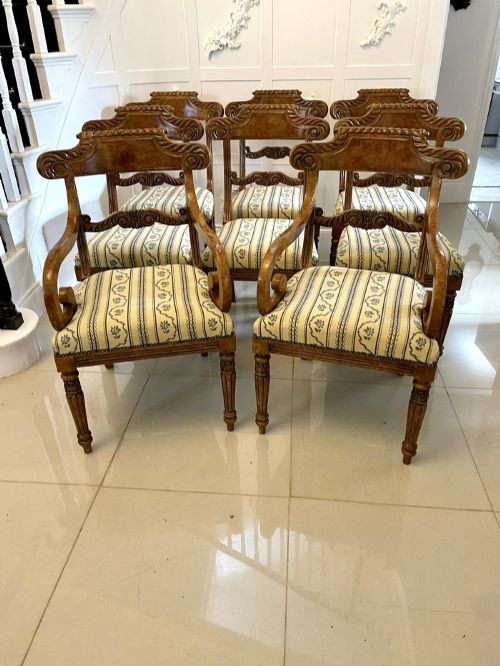
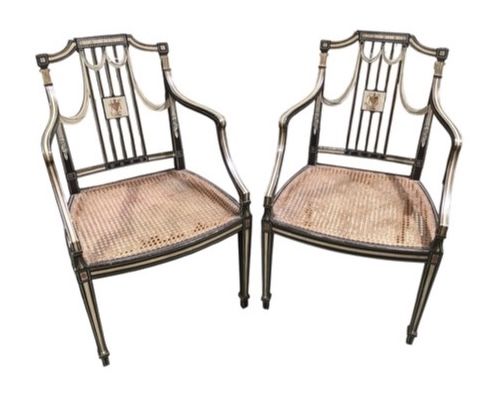
The most common forms on this page include pairs of armchairs and elbow chairs featuring painted finishes, ebonised wood, and cane seats. You will also encounter larger dining sets finished to mimic exotic timbers alongside floral and avian decoration.
Makers of these chairs utilised specific stylistic idioms that bridge classical restraint with lively surface pattern. They function equally well as standalone decorative items or as the head chairs at a dining table.
How they were made
Carpenters constructed these carvers using solid wood frames prepared for painted finishes, ebonisation, or faux graining such as bird's-eye maple. Surfaces were then hand-decorated with floral motifs, musical themes, and painted bird details.
Seating construction frequently incorporated woven cane panels inserted directly into the wooden framework, providing a resilient and breathable base. Alternatively, frames were prepared to receive drop-in or fixed upholstery pads covered in traditional fabric.
Materials recorded across the inventory include cane, ebonised wood, upholstery fabric, and painted finishes.
What varies in quality
Quality in these carvers rests upon the crispness of the painted decoration and the structural integrity of the frame joints. Hand-painted motifs executed with fine detail elevate a piece above simpler, mass-produced revival iterations.
The choice of secondary materials, such as finely woven cane and carefully applied ebonised or faux maple finishes, dictates the overall refinement of the chair. Pieces retaining their original decorative schemes command greater attention from discerning collectors.
The Regency Painted Carvers Glossary
- Carver
- An armchair designed with open sides to accommodate wider clothing, often placed at the head of a dining table. These chairs match or complement the smaller side chairs in a set.
- Bergere
- An enclosed upholstered armchair with solid or caned sides and a loose seat cushion. This French-inspired form offers a deeper and more relaxed sit.
- Ebonised
- Wood treated with a chemical stain or black paint to imitate expensive ebony. This finish was heavily favored during the Regency era for dramatic contrast.
- Cane
- Woven rattan split into thin strips and worked through holes in the chair frame. It creates a flexible, patterned seating surface common in lightweight dining and elbow chairs.
- Elbow chair
- A traditional British term for an armchair with low armrests intended to support the elbows. They frequently appear alongside sets of standard dining chairs.
Regency Painted Carvers: Frequently Asked Questions
What is a regency painted carver?
A regency painted carver is an armchair featuring decorative surface paint, often associated with the Regency era or later revivals. These chairs combine classical structural lines with painted floral, avian, or faux wood finishes.
They were typically produced as elbow chairs for dining rooms or as occasional seating for parlours and drawing rooms.
How do I spot a revival piece?
Revival pieces dating to the 1920s often replicate the forms and painted finishes of the original Regency period. Examine the timber preparation and the consistency of the painted decoration to determine the age of the piece.
Construction methods and tool marks on the underside of the frame also help distinguish early nineteenth-century work from later twentieth-century interpretations.
Can I use these chairs daily?
These carvers are structurally robust enough for regular use provided the joints remain sound and the cane work is intact. Caned seats offer surprising resilience but require care to prevent puncturing.
Placing them away from direct heat sources helps preserve the dried timber and delicate painted decoration over time.
Are pairs more common than sets?
Pairs of armchairs appear frequently alongside larger dining sets that include matching elbow chairs. Complete sets of eight are less common and often feature specialised faux maple decoration.
Collectors often acquire pairs to use as statement pieces at either end of a table or as fireside armchairs.