
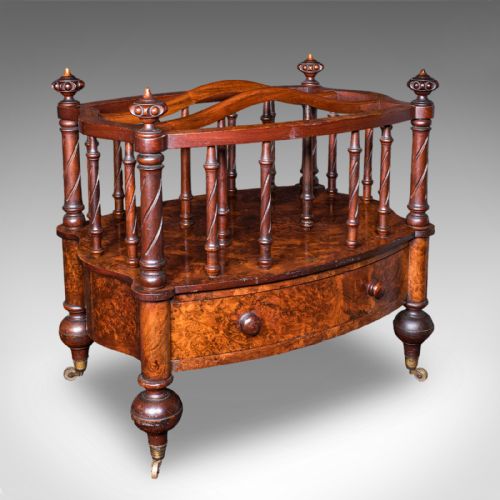


Regency Carved Canterbury
A regency carved canterbury organises journals and scores with refined woodwork that grounds a formal room.
Regency Carved Canterbury
A regency carved canterbury is a low stand designed to hold newspapers, magazines, and sheet music within partitioned compartments, frequently featuring a carrying handle and a small drawer below. Buyers searching for a regency carved canterbury most often encounter rosewood and mahogany forms hailing from the Regency, George IV, and William IV periods, alongside later nineteenth-century interpretations.
These pieces function primarily as movable music and paper racks, sitting beside seating areas or desks in period interiors. The selections span compact country house examples to large Cuban mahogany and burr walnut editions, sometimes incorporating painted wood or brass details.
How they were made
Cabinetmakers utilised dense timbers such as mahogany, rosewood, burr walnut, and Cuban mahogany to construct these sturdy stands, often pairing them with brass castors and handles. Joinery methods secured the vertical divisions and slatted sides, while turning and carving created the decorative uprights and legs.
Carved motifs, including wreath work and Prince of Wales feathers, were hand-chiselled directly into the solid wood frames. Selected pieces received painted finishes or contrasting veneers to enhance the grain of the primary timber.
Listings feature rosewood, mahogany, burr walnut, and painted wood, spanning the Georgian, Regency, and William IV periods.
What varies in quality
The distinction between standard examples and superior pieces rests upon the choice of timber and the depth of the carving. Finely figured rosewood or Cuban mahogany paired with crisp, hand-carved details and integrated drawers elevates a piece above simpler vernacular items.
Proportion and the handling of structural elements also set examples apart. Well-executed turned supports, balanced partitions, and original brass fittings indicate higher workshop standards.
Gillows of Lancaster·J. C. Loudon
The Regency Carved Canterbury Glossary
- Canterbury
- A low stand with partitions for holding sheet music, newspapers, and periodicals. It usually includes upright dividers and a low drawer.
- Regency
- A design period spanning the early nineteenth century, characterised by classical restraint and rich cabinet timbers. It draws inspiration from ancient Greek and Roman forms.
- Rosewood
- A heavy, dark timber with distinct figuring, widely utilised by nineteenth-century cabinetmakers for high-status furniture. Its deep reddish-brown colour takes a high polish.
- Cuban Mahogany
- A dense, dark mahogany species favoured for fine furniture during the Georgian and Regency eras. It resists warping and allows for sharp carving.
- Castor
- A small wheel fitted to the legs of furniture to allow easy movement across floor surfaces. They are frequently cast from brass on these stands.
Regency Carved Canterbury: Frequently Asked Questions
What was a canterbury used for?
These stands held loose sheets of music, newspapers, and magazines near pianos or seating areas in nineteenth-century drawing rooms. The partitioned sections kept publications upright and sorted for daily reading.
Lower drawers provided additional storage for smaller paper items or writing accessories, keeping the main living spaces tidy.
How do I identify a Regency period piece?
Look for dense timbers such as rosewood and mahogany, combined with classical decorative motifs like turned uprights and carved foliage. Proportions tend to be balanced and restrained.
Hardware often includes brass castors, while construction methods reflect traditional nineteenth-century cabinetmaking techniques without modern fasteners.
Where should I place a canterbury in my home?
They fit naturally beside a sofa, armchair, or desk where periodicals and books accumulate. Their compact footprint allows them to occupy small corners or wall spaces effectively.
Keep them away from direct heat sources and strong sunlight to protect the polished wood surfaces and delicate veneers from drying out.
What is the difference between mahogany and rosewood versions?
Mahogany stands typically display a warm reddish-brown grain, ranging from standard stock to heavily figured Cuban timber. They offer a robust and traditional appearance suited to various period rooms.
Rosewood versions present a darker, heavily variegated surface with contrasting dark streaks. They generally represent a more decorative finish favoured in formal Regency interiors.