


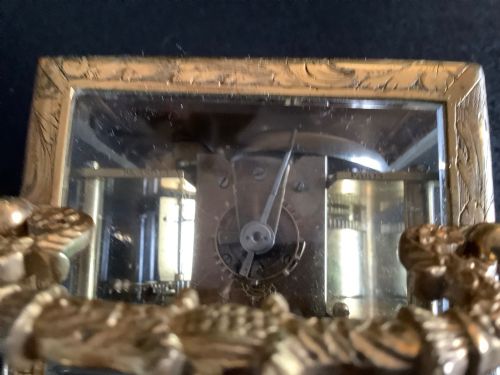


Ornate Enamel Table Clock
An ornate enamel table clock brings colourful Victorian and French design to a desk or mantelpiece.
Ornate Enamel Table Clock
An ornate enamel table clock encompasses mantel clocks, carriage clocks, desk clocks, and clock garniture sets originating from the nineteenth century. These pieces reflect Victorian and French revival aesthetics, particularly Louis XVI and Rococo styles.
The version most commonly met on this page is the French brass or ormolu carriage clock or mantel clock featuring champleve enamel dials and panels. These items combine timekeeping with vibrant decorative metalwork.
Many of these objects date from the 1880s and 1890s, though examples span from the 1860s through to the early twentieth century. They range from miniature bedside pieces to large mantel clocks housed in glass or marble.
How they were made
Maker workshops utilised brass, bronze, and gilt bronze, often applying ormolu or gilding to the metal surfaces to create a rich sheen. Cases frequently incorporate glass panels, marble, or alabaster alongside cast metal mounts.
Enamel work, including champleve and painted panels, provided rich colour and intricate patterns on dials and bezels. Clock movements were produced by specialised French makers and housed within these decorative architectural or miniature cases.
Ornate Enamel Table Clock Retail Price Guide 2026
Typical asking prices for ornate enamel table clock among the pieces listed under this phrase on Sellingantiques today, from the lower quarter to the upper quarter. They describe what is for sale here now, not the wider market.
What varies in quality
The standard of an ornate enamel table clock depends heavily on the crispness of the cast metal ornamentation and the depth of the gilding. Finer examples display sharp detailing in the bronze or brass mounts and careful hand-painting on enamel panels.
The reputation of the maker and the complexity of the movement, such as repeating mechanisms or striking trains, further distinguish superior pieces. Well-preserved enamel free from heavy chips or hairline cracks elevates the piece.
Japy Freres·Tiffany·Leroy & Fils·Bellenot Paris
The Ornate Enamel Table Clock Glossary
- Ormolu
- Gilded bronze, where a finely ground gold-mercury amalgam is applied to a bronze base and heated. This technique creates a distinctive, dull golden finish on nineteenth-century French clock cases.
- Champleve enamel
- A technique where troughs are dug into the surface of a metal object and filled with vitreous enamel powder before firing. It frequently decorates the brass frames of carriage clocks.
- Carriage clock
- A small, spring-driven timekeeper originally designed for travelling by nineteenth-century travellers. They usually feature glass sides and a swinging handle on top.
- Garniture set
- A matched group consisting of a central clock flanked by matching decorative objects such as vases or candelabra. These sets were designed to sit together on a mantelpiece.
- Crystal regulator
- A mantel clock featuring glass panels on all four sides that reveal the internal movement and pendulum. They often include an enamel dial decorated with painted floral motifs.
Ornate Enamel Table Clock: Frequently Asked Questions
How do I wind a carriage clock?
A carriage clock is wound using a specific key fitted to the arbors on the backplate. Care should be taken not to overwind the mainspring.
Most of these nineteenth-century timekeepers require gentle handling and occasional professional servicing to keep the mechanical movement running accurately.
What is a crystal regulator?
A crystal regulator is a mantel clock enclosed in glass panels that allow light to pass through and expose the swinging pendulum and movement. They emerged during the late nineteenth century in France.
These clocks often feature decorated enamel dials and polished brass or ormolu frames that reflect period interior design tastes.
Who made these French clocks?
Numerous nineteenth-century French clockmakers and retailers produced these items, ranging from independent workshops to established houses. Names like Japy Freres and Leroy & Fils appear on movements and dials.
Retailers such as Tiffany also retailed high-end carriage clocks featuring engraved gilt brass cases during the 1890s.