

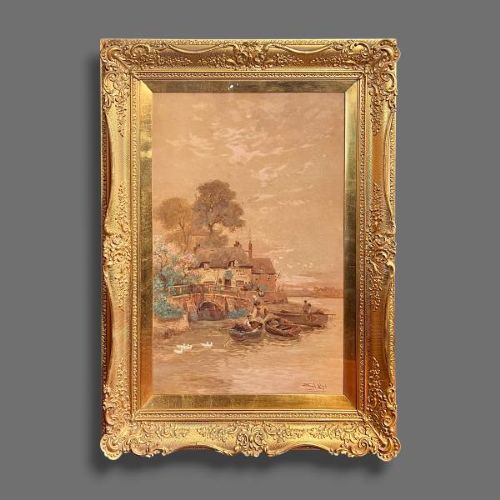


Original Water Colour
Original water colour paintings bring genuine hand-painted pigment to the wall, offering immediacy and character that prints simply cannot match.
Original Water Colour
An original water colour represents a direct application of pigment suspended in water upon a paper surface, capturing landscapes, architectural views and figurative scenes. These works span the nineteenth century through to the mid-twentieth century, encompassing both British topographical scenes and continental views.
Buyers encounter distinct stylistic approaches, ranging from nineteenth-century romanticism and Victorian Dutch school interpretations to interwar realism and mid-century modern compositions. Many pieces arrive framed in period wood or giltwood frames, preserving the paper behind glass.
The selection includes cabinet-sized topographical studies alongside larger scale works by named artists, providing variety in both subject matter and physical presence.
Materials and technique
Artists executed these works using water-based pigments applied directly to paper supports, occasionally incorporating bodycolour or pencil underdrawing to define form and highlight details. The transparency of the washes allows the luminous quality of the paper ground to shine through the pigment layers.
Framing materials reflect the period of production, utilising traditional timber mouldings, gesso, and gilt wood to protect the delicate paper surface from atmospheric moisture and physical damage.
Original Water Colour Retail Price Guide 2026
Typical asking prices for original water colour among the pieces listed under this phrase on Sellingantiques today, from the lower quarter to the upper quarter. They describe what is for sale here now, not the wider market.
One unexpected illustration brings animated cinematic history directly to the wall, proving that watercolour pigment tells stories far beyond traditional landscapes.
Assessing quality
Quality rests upon the surety of the brushwork, the handling of light and atmospheric perspective, and the preservation of the paper support free from heavy acidic foxing. A skilled hand achieves depth and luminosity with minimal pigment, whereas lesser works appear overworked or muddy.
The distinction also lies in the strength of the composition and the artist's ability to capture the specific topography or mood of the scene with economy and precision.
Stuart Lloyd·Jan van Couver·Edith E Caswall·B. Kaufmann·Charles H Poingdestre·Walt Disney·Yves Brayer·Belisario Gioja·JS Cooper·J . W . Carey
The Original Water Colour Glossary
- Watercolour
- A painting method where the paints are made of pigments suspended in a water-based solution. The paper serves as a reflective ground beneath translucent washes.
- Giltwood
- Wood that has been treated with a thin layer of gold leaf or gilt powder. It is commonly found on traditional frames enclosing nineteenth-century works.
- Topographical
- A genre of art depicting specific places, buildings or landscapes with geographical accuracy. These form a significant portion of early painted views.
- Bodycolour
- Watercolour paint mixed with a white pigment to make it opaque. Artists used this technique to add highlights and solid areas of colour.
Original Water Colour: Frequently Asked Questions
How should I hang original water colour art?
Keep water colour works away from direct sunlight to prevent the delicate pigments and paper from fading over time. Position them on interior walls where temperature and humidity remain relatively stable.
Ensure the frame is properly sealed against dust and insects, and use professional picture wire attached securely to the wooden moulding.
Can I remove water colour from its original frame?
It is generally advisable to leave the work within its period frame, especially if the backing boards and mount appear original to the piece. Removing the artwork can expose the vulnerable paper to modern acidic materials.
Consult a paper conservator if the glass is broken or if mould requires professional intervention inside the frame.
How do I identify a Victorian water colour?
Victorian examples often feature romantic landscapes, coastal scenes or architectural studies executed on heavyweight rag paper with muted earth tones. The framing typically involves ornate giltwood or deep wooden moulding under glass.
Signatures, dates, or period inscriptions on the reverse often provide confirmation of the Victorian era of production.
What is the difference between an illustration and a water colour painting?
An illustration is typically created for a specific commercial purpose, such as a book, animation, or magazine publication, often carrying studio notes or production markings. A water colour painting is usually conceived as a finished standalone artwork for display.
Both utilise the same water-based pigment techniques upon paper supports.