





Narrow Tea Table
A narrow tea table is a drop-leaf occasional piece designed for compact spaces, prized for folding flat when not in use.
Narrow Tea Table
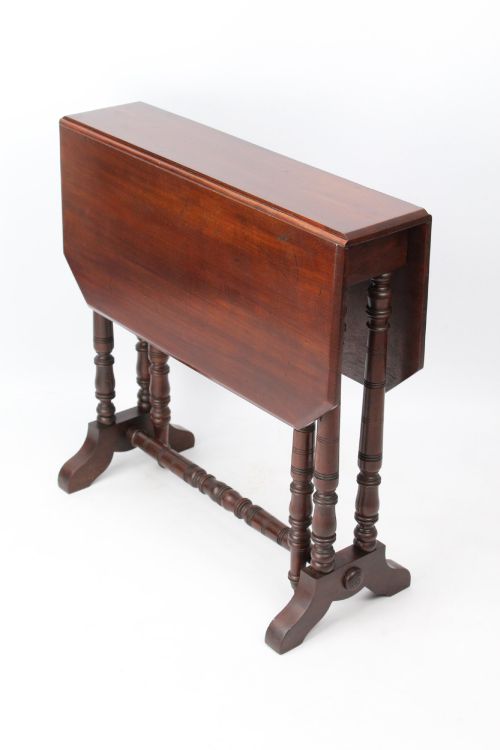
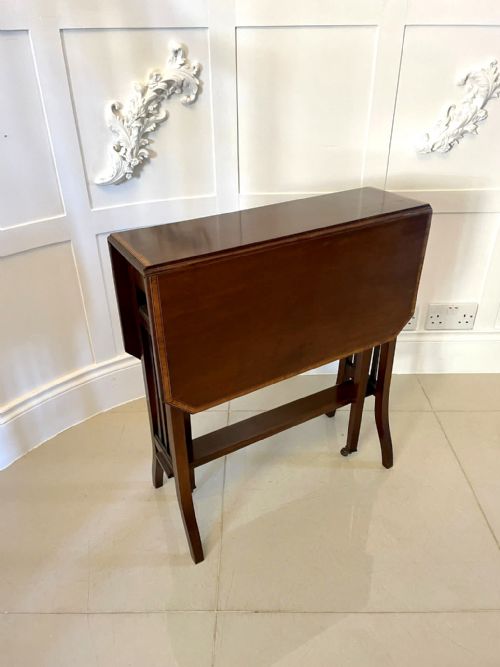
A narrow tea table on this page is almost invariably a Sutherland table, a form characterised by its exceptionally slender drop leaves and low-profile folding action. These pieces serve primarily as occasional or side tables that expand swiftly when tea is served.
The selections span the Victorian and Edwardian eras, with dates clustering around the late nineteenth and early twentieth centuries. Forms range from oval tops to canted corners, often supported by pivoting gatelegs.
Origins are rooted in British cabinet-making traditions, utilising timber frames designed to maximise surface area while occupying minimal floor space in domestic interiors.
Materials and Construction
Makers relied heavily on solid and veneered mahogany, frequently complemented by burr walnut or satinwood inlay and crossbanding. The structural integrity depends upon the pivoting gateleg mechanism that supports the hinged drop leaves.
Surface decoration often incorporates contrasting stringing and satinwood banding, applied to the top panels while maintaining the slender proportions characteristic of these tables.
Narrow Tea Table Retail Price Guide 2026
Typical asking prices for narrow tea table among the pieces listed under this phrase on Sellingantiques today, from the lower quarter to the upper quarter. They describe what is for sale here now, not the wider market.
Listings feature items from the Victorian and Edwardian periods, utilising mahogany, walnut, satinwood, and brass hardware.
Distinguishing Quality
Quality in a narrow tea table rests on timber selection and the precision of the gateleg hinge mechanism. Superior examples display figured mahogany or burr walnut with fine inlay, whereas simpler iterations rely on plain timber surfaces.
Structural refinement shows in the stability of the leaves when raised and the crispness of the turning on the legs, distinguishing finer cabinet work from utilitarian workshop production.
The Narrow Tea Table Glossary
- Sutherland table
- A narrow drop-leaf table with hinged flaps that fold almost vertically, supported by swinging gatelegs. It was patented in the nineteenth century and remains a staple of compact furniture.
- Drop leaf
- A hinged section of a table top that can be raised and supported or lowered to reduce the footprint. This design allows the table to function in restricted spaces.
- Gateleg
- A leg attached to a pivoted gate that swings outward to support a drop leaf. It provides structural load-bearing capacity when the table is fully extended.
- Crossbanding
- A strip of veneer applied to the border of a table top with the grain running perpendicular to the central panel. This technique creates a decorative framing effect.
- Stringing
- Thin inlay of a contrasting wood used to outline geometric shapes or panels on furniture surfaces. It defines edges and highlights the cabinet maker's precision.
Narrow Tea Table: Frequently Asked Questions
What is a narrow tea table?
A narrow tea table is typically a Sutherland table featuring hinged drop leaves and a slender frame designed for occasional use in parlours or drawing rooms.
These pieces fold down into a compact profile, making them suitable for placement against a wall when not utilised for serving refreshments.
How do you operate a Sutherland table?
To expand the surface, lift each drop leaf upward until it locks into position, then swing the supporting gateleg outward from the central underframe to hold the leaf steady.
Closing the table simply involves swinging the gatelegs back toward the centre and lowering the leaves into their vertical resting positions.
Where were these tables used?
They originated in British homes during the Victorian and Edwardian periods as versatile furniture for entertaining guests in limited spaces.
Their narrow profile allowed them to sit unobtrusively in reception rooms until needed for tea or occasional writing.
How do I date a Victorian tea table?
Dating relies on timber choices, leg turning styles, and decorative details such as satinwood inlay or ebonised finishes characteristic of the late nineteenth century.
Victorian examples often display heavier mahogany construction, while Edwardian pieces frequently incorporate lighter satinwood crossbanding and slender supports.