


Narrow Folding Table
A narrow folding table solves space issues with hinged drop leaves, offering an adaptable surface for occasional tea or dining.
Narrow Folding Table
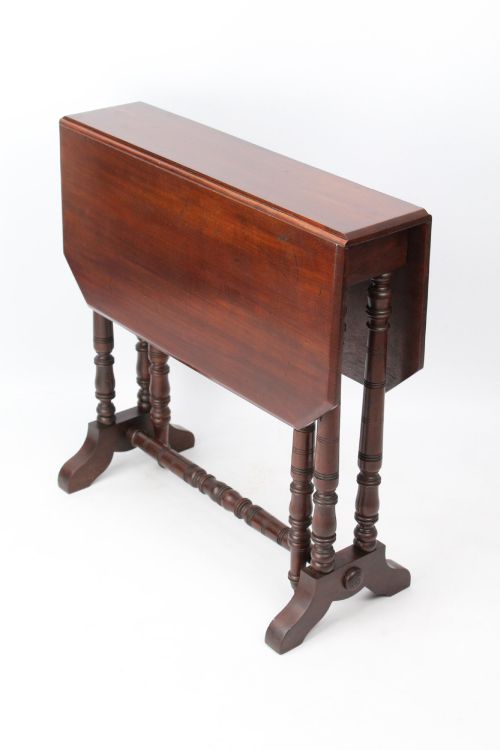
A narrow folding table primarily takes the form of a Sutherland table or a Pembroke table, designed with hinged drop leaves supported by swinging legs. These pieces emerge predominantly from the Victorian and Edwardian periods, alongside examples from the late nineteenth and early twentieth centuries.
The profile remains compact when folded down, allowing it to stand unobtrusively against a wall or function as an occasional side table. When the leaves lift, the surface expands to seat several people for tea or light dining.
Makers fashioned these tables using rich timbers like mahogany, walnut, and burr walnut, frequently incorporating satinwood inlay and crossbanding. The selection spans straightforward utility designs to more refined neoclassical revival and arts and crafts interpretations.
Materials and construction
Cabinetmakers utilised solid mahogany, oak, and walnut for the primary structure and framing, ensuring stability for the folding mechanisms. Rich veneers and burr walnut figured prominently on the table tops, often enhanced by delicate satinwood inlay or crossbanding.
The folding action relies on hinged leaves supported by pivoting gatelegs or slender spider-legs that swing outward. Brass hinges and fittings provided durable joints for the moving leaves and drop-leaf supports.
Periods represented in the selection range from the Victorian and Edwardian eras through to the early twentieth century.
Assessing quality in folding tables
Quality rests in the precision of the joinery and the smoothness of the folding mechanism. Better examples feature tightly fitted hinges and stable gatelegs that support the drop leaves without sagging.
The choice of timber and veneer work dictates the visual distinction. Superior pieces display figured burr walnut, crisp satinwood inlay, and well-proportioned turned or spider-leg supports rather than plain, utilitarian pine.
The Narrow Folding Table Glossary
- Sutherland table
- A narrow drop-leaf table featuring exceptionally slender legs and leaves that fold down almost vertically. This form became popular in the Victorian era for its space-saving versatility.
- Pembroke table
- A small table with two hinged leaves on opposite sides, often equipped with a single drawer. The design dates from the eighteenth century and continued through the Victorian period.
- Crossbanding
- A decorative border of veneer laid around the perimeter of a table top, with the grain running perpendicular to the central panel. It frames the primary wood species and adds visual depth.
- Gateleg table
- A table with hinged legs that swing out like a gate to support the drop leaves. This construction provides robust support for an expanded surface.
Narrow Folding Table: Frequently Asked Questions
How do you use a narrow folding table?
These tables function well in compact rooms by standing flat against a wall with the leaves dropped.
When guests arrive, simply lift the leaves and swing out the supporting legs to create an immediate surface for tea or dining.
How do I care for a mahogany folding table?
Keep the timber away from direct heat sources and strong sunlight to prevent the polish and veneer from fading.
Apply a traditional wax polish periodically to nourish the mahogany and maintain the lustre of the wood.
How can I tell a Victorian table from an Edwardian one?
Victorian examples often display heavier timbers, darker finishes, and more robust turned supports.
Edwardian pieces tend to feature lighter mahogany, finer satinwood inlay, and slenderer legs reflecting changing tastes.