
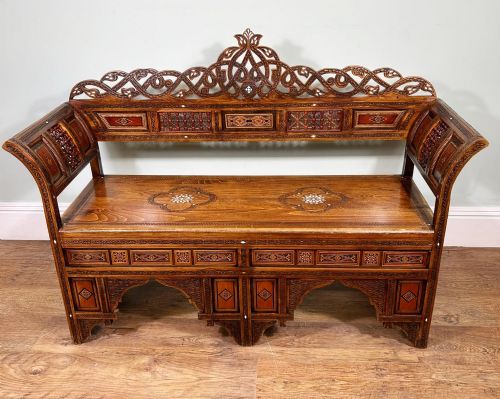
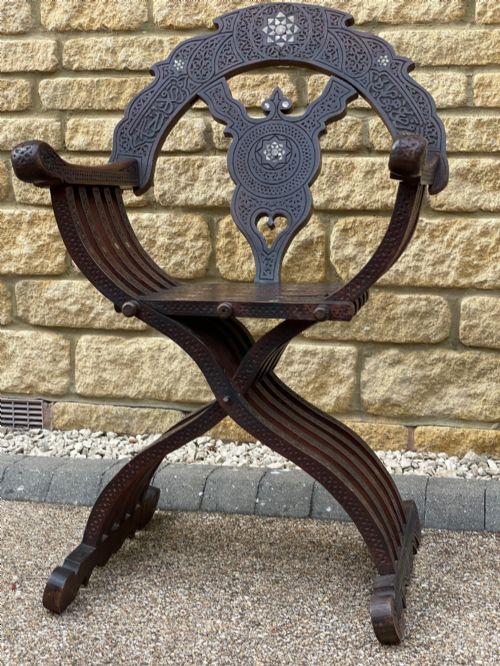
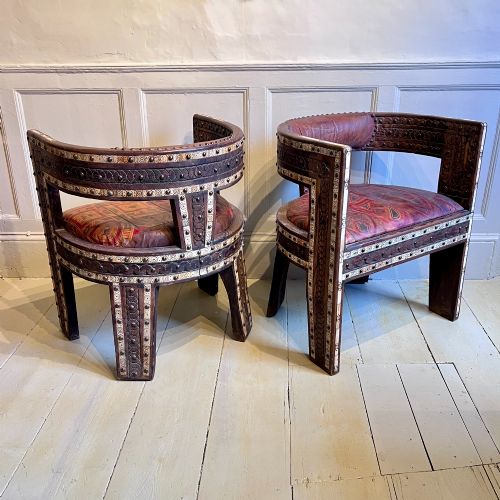


Moorish Style Inlaid Seat
These moorish style inlaid seat examples bring intricate geometric patterns and warm timber tones into a room.
Moorish Style Inlaid Seat
When searching for a moorish style inlaid seat, you are looking at intricate seating pieces originating from the late nineteenth and early twentieth centuries. The selection ranges from folding chairs and corner chairs to substantial settees, armchairs, and window seats.
You are most likely to meet pieces spanning the nineteenth century up to the nineteen-thirties, reflecting styles such as Moorish Revival, Syrian Ottoman, and Anglo-Moorish. These forms often incorporate distinctive architectural elements like Mashrabiya panels and X-frame structures.
The origins stretch across Syria, North Africa, and Andalucia, bringing distinct regional interpretations to the market. Such seating brings a strong decorative presence to domestic spaces through complex woodwork and contrasting surfaces.
How they were made
Carpenters utilised dense timbers such as walnut, fruitwood, and various hardwoods as the foundational structure for these seats. This stable base allowed for intricate carving and the recessing of decorative elements.
Artisans applied detailed ornamentation using mother-of-pearl, nacre-shell, bone, and brass wire to form geometric and floral motifs across the timber surfaces. Additional texture and comfort were introduced through upholstered inserts in leather and fabric.
Materials recorded across current listings include walnut, mother-of-pearl, hardwood, bone, brass, leather, and fabric.
What varies in quality
The standard of a moorish style inlaid seat is determined by the precision of the geometric woodwork and the density of the pearl or bone inlay. Finer examples display meticulous hand-cut pieces fitted tightly into the timber ground without excessive filler.
Structural complexity also separates standard items from exceptional ones, particularly where delicate turning, folding mechanisms, and integrated Mashrabiya latticework are executed with architectural accuracy.
Liberty and Co
The Moorish Style Inlaid Seat Glossary
- Mashrabiya
- A type of projected wooden bay window enclosed with carved wood latticework panels. It is frequently adapted into chair backs and decorative screens.
- Nacre
- An organic-inorganic composite material produced by the inner shell layer of certain molluscs, commonly known as mother-of-pearl. It provides an iridescent quality when polished flat.
- X-frame
- A structural form where two curved or straight members cross in the manner of the letter X to form a folding or fixed chair base. This ancient form reappears in revival furniture.
- Anglo-Moorish
- A nineteenth-century design style blending traditional Middle Eastern geometric woodwork with British furniture forms. It became popular through retail houses like Liberty and Co.
Moorish Style Inlaid Seat: Frequently Asked Questions
What periods do these seats come from?
The pieces span from the late nineteenth century through the nineteen-thirties, capturing the height of the Moorish and Islamic Revival movements.
Most items you encounter will date around nineteen hundred, nineteen-ten, or nineteen-twenty, often reflecting regional workshops in Syria or North Africa.
How were inlaid chairs used originally?
These seats served as conversation chairs, window seats, and reception furniture in eclectic nineteenth-century drawing rooms and smoking rooms.
Their striking geometric surfaces and architectural panels were designed to display the owner's sophisticated taste for exotic craftsmanship.
How do I care for inlaid wooden furniture?
Maintain stable humidity levels in the room to prevent the hardwood base from expanding and causing the delicate mother-of-pearl or bone inlays to lift.
Dust gently with a dry, soft cloth and avoid applying modern liquid polishes that can seep beneath the tessellated surface.
What materials make up the surface decoration?
Decorations consist primarily of mother-of-pearl, nacre-shell, and bone, meticulously cut into geometric polygons and pressed into hand-carved channels in the timber.
Brass wire is frequently hammered alongside these organic elements to outline the complex star and polygon patterns.