



Middle Eastern Wood Inlay
Middle Eastern wood inlay brings intricate geometry and shimmering nacre into a room through tables, chairs, and mirrors.
Middle Eastern Wood Inlay
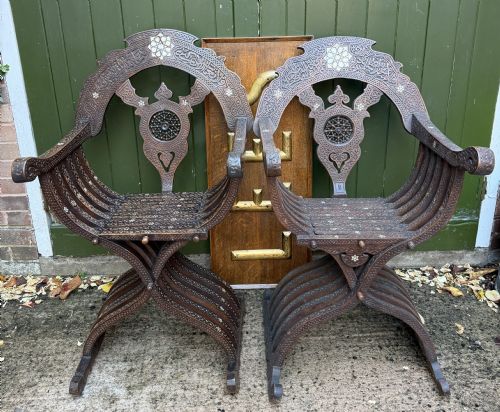
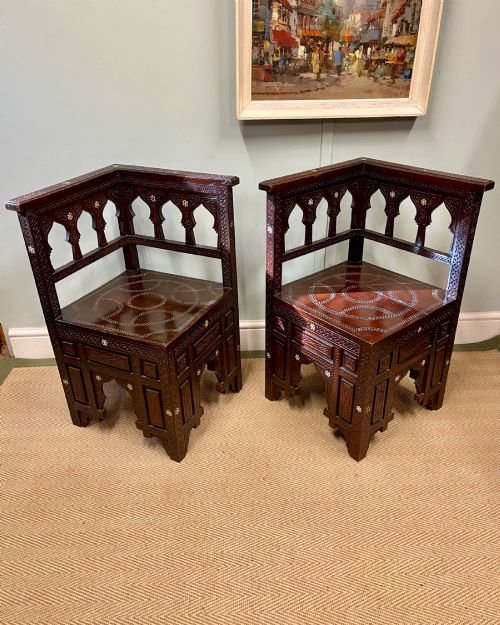
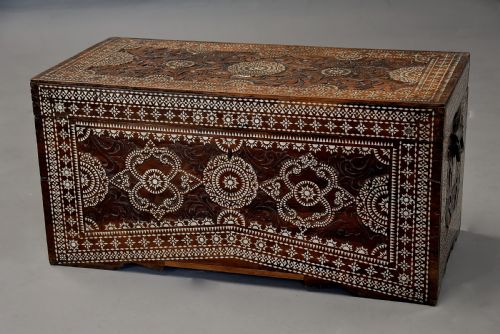
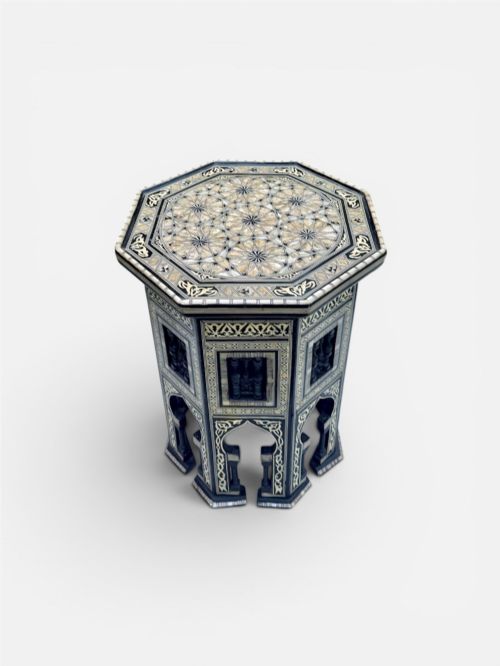
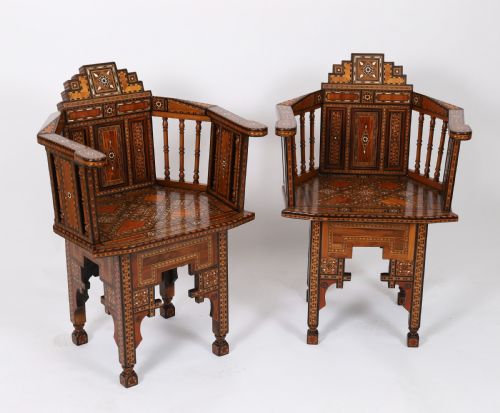
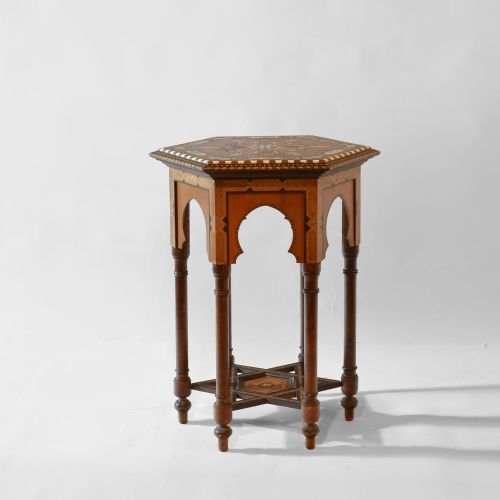
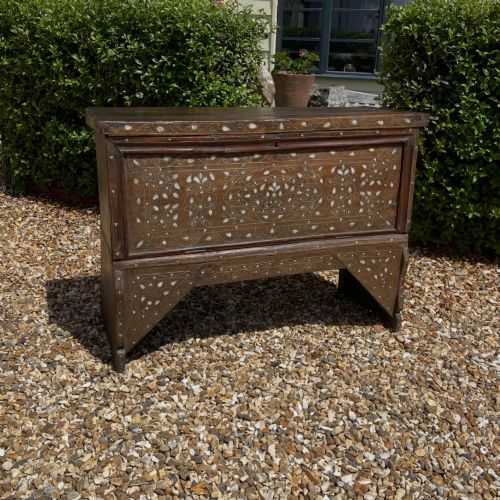
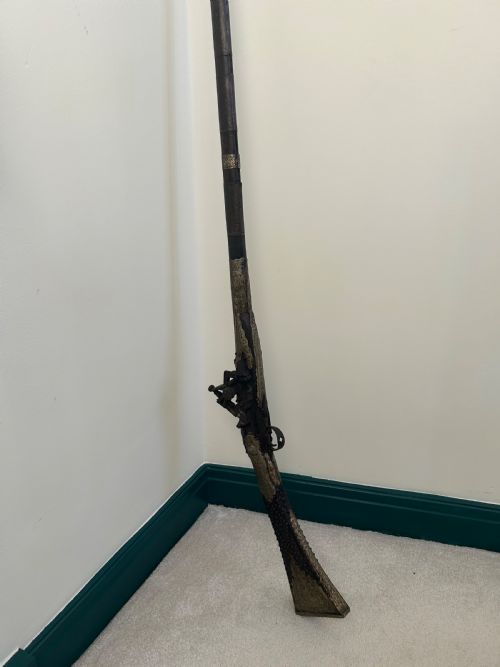
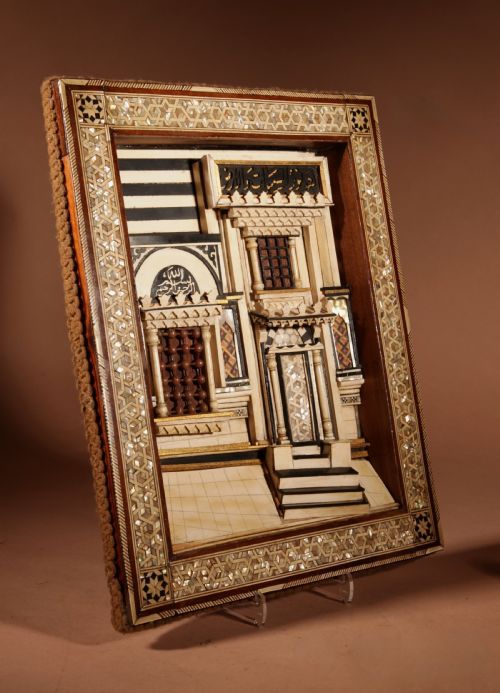
Middle Eastern wood inlay encompasses intricate furniture and decorative objects originating from regions such as Syria, Egypt, and the broader Ottoman sphere, spanning the eighteenth century through to the early twentieth century. Buyers encounter a diverse range of domestic items, from octagonal side tables and folding armchairs to large trunks, wall mirrors, and architectural dioramas.
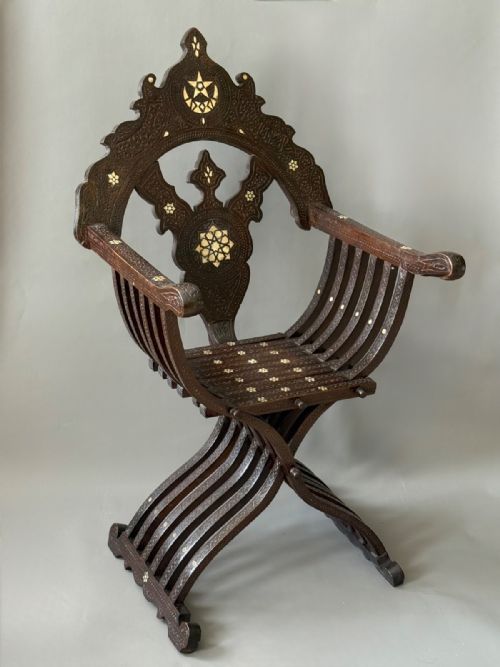
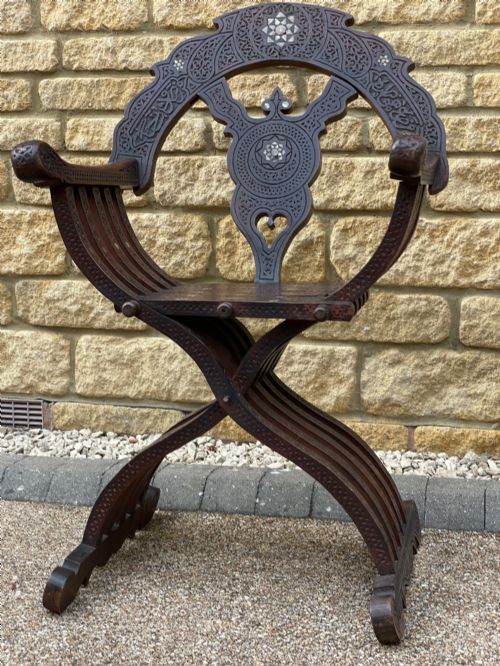
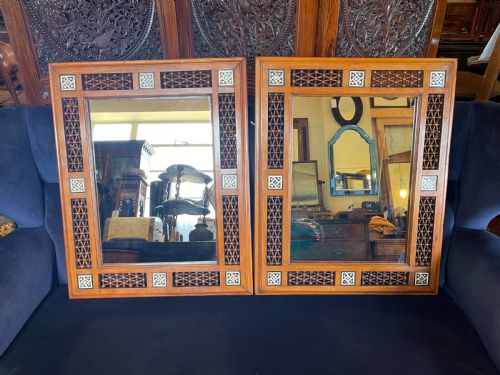
The most common pieces met on this page are Syrian and Levantine occasional tables, often hexagonal or octagonal in form, alongside X-frame chairs and inlaid wall mirrors. These items reflect distinct regional design vocabularies, including Moorish Revival styles and Ottoman influences, which arrived in Western interiors during various periods of nineteenth and early twentieth-century trade and travel.
Materials and Technique
Craftsmen built these pieces using dense hardwoods and walnut as a structural base, onto which they meticulously applied complex geometric patterns. Artisans cut tiny slivers of bone and mother-of-pearl, embedding them flush into the timber to form interlocking stars, polygons, and floral motifs.
Additional detailing often involved fine brass wire work, turned wooden panels known as mashrabiya, and carved frames. The combination of reflective nacre and white bone against dark wood created high-contrast surfaces that caught the ambient light in dim interiors.
Middle Eastern Wood Inlay Retail Price Guide 2026
Typical asking prices for middle eastern wood inlay among the pieces listed under this phrase on Sellingantiques today, from the lower quarter to the upper quarter. They describe what is for sale here now, not the wider market.
Listings feature items spanning the 18th century through the Edwardian era, incorporating bone, brass, and hardwood.
Evaluating Execution
Quality rests entirely on the precision of the geometric layout and the density of the inlay work. Finer pieces display tight, seamless joints between the wooden tessellations and uniform slivers of mother-of-pearl that sit completely flat within the surface.
Weaker examples show wider gaps in the wooden matrix, filler material masking poor alignment, or simplified patterns with minimal bone and nacre content. The depth of the underlying carving and the complexity of turned elements like mashrabiya panels further distinguish standard workshop output from exceptional regional cabinet-making.
The Middle Eastern Wood Inlay Glossary
- Moorish Revival
- A nineteenth-century architectural and decorative style that reinterpreted Islamic design motifs from Spain and North Africa. It heavily influenced European tastes for exotic furniture.
- Mashrabiya
- An architectural element of turned wooden lattice-work used to control light and airflow. In furniture, these panels appear as decorative screens on mirrors and frames.
- Khatamkari
- A Persian technique of marquetry that uses delicate geometric tiling to decorate wooden surfaces. Artisans bundle rods of bone, brass, and various woods before slicing them into thin sheets.
- Nacre
- The iridescent internal layer of mollusc shells, commonly referred to as mother-of-pearl. It provides the shimmering white highlights in Levantine and Syrian inlay work.
Middle Eastern Wood Inlay: Frequently Asked Questions
How do I clean middle eastern wood inlay?
Dust the surface regularly with a soft, dry cloth to prevent particles from lodging between the tiny inlay pieces. Avoid liquid cleaners and harsh polishes, as moisture can loosen the bone and mother-of-pearl elements from their wooden channels.
Apply a micro-layer of quality beeswax strictly formulated for antique furniture once or twice a year to nourish the timber. Buff gently with a clean cloth to maintain the natural sheen without damaging the delicate nacre.
Are these items suitable for everyday use?
Most smaller pieces like side tables, mirrors, and wall brackets function well in contemporary homes with normal domestic care. Place them away from direct heat sources and strong sunlight to prevent the wood from warping and the natural glues from drying out.
Larger seating forms, such as X-frame chairs and folding chairs, are structurally sound for occasional sitting but require a gentle touch due to their intricate joinery. Treat them with respect as decorative works of art rather than heavy-duty modern seating.
How do I date middle eastern inlaid furniture?
Examine the timber substrate, the type of screws or nails used in secondary areas, and the style of the inlay pattern. Pieces from the eighteenth and early nineteenth centuries often exhibit hand-cut components and denser, more irregular backing woods compared to later twentieth-century production.
Cross-reference the decorative motifs with documented periods of the Moorish Revival and Ottoman influences active during the nineteenth century. Dealer descriptions often provide contextual clues based on the specific Syrian or Levantine workshops of the era.
What rooms suit middle eastern wood inlay best?
These decorative pieces serve as striking focal points in hallways, living rooms, and studies where their geometric patterns can contrast against plain walls. An octagonal side table works effectively beside a simple sofa, while an inlaid wall mirror opens up a darker corner with its reflective nacre.
Because the surfaces feature complex designs, pair them with understated furnishings rather than competing patterns. This lets the intricate bone and mother-of-pearl work stand out as a sculptural element in the interior.