



Library Coffee Table
A library coffee table brings sturdy timber and grounded proportions to a room, offering a practical surface adapted from larger reading tables.
Library Coffee Table
A library coffee table draws on forms from earlier centuries, frequently repurposing centre tables, occasional tables, and sofa tables into low, functional surfaces for modern rooms. These pieces originate from periods spanning the seventeenth century through to the Art Deco era and the nineteenth century, reflecting diverse historical revivals.
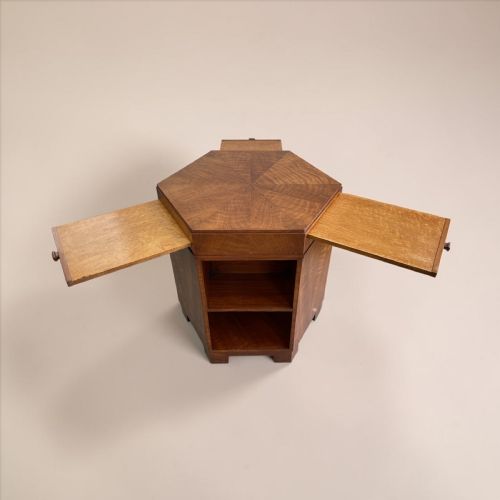
The versions most commonly met on this page include Victorian oak and walnut centre tables alongside twentieth-century Art Deco interpretations. Cabinetmakers constructed these pieces using heavy timbers such as oak, walnut, and fruitwood, often incorporating leather inserts or marble tops.
Makers adapted formal writing and reading furniture to suit domestic sitting spaces, resulting in sturdy structures with substantial timber legs and occasional brass mounts. Buyers encounter diverse regional styles, ranging from English Gothic Revival to French marquetry and Dutch parquetry.
How they were made
Cabinetmakers utilised solid timbers such as oak, walnut, and fruitwood, often applying walnut veneer or detailed parquetry to surface tops. Construction relied on traditional joinery methods to ensure stability across heavy tabletops and supportive frames.
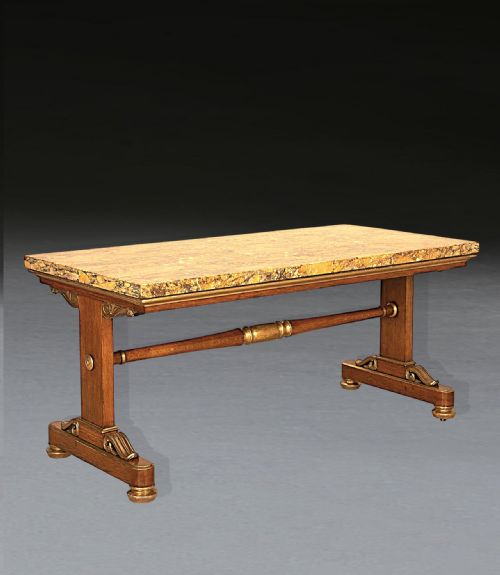
Surfaces frequently incorporated inset leather panels or polished Siena marble slabs, framed by timber mouldings and finished with cast brass sabots or mounts. Artisans employed hand-carving and marquetry techniques to ornament the friezes and legs of nineteenth-century and earlier examples.
Library Coffee Table Retail Price Guide 2026
Typical asking prices for library coffee table among the pieces listed under this phrase on Sellingantiques today, from the lower quarter to the upper quarter. They describe what is for sale here now, not the wider market.
Listings feature timbers like oak, walnut, and fruitwood, alongside decorative surfaces in leather, Siena marble, and parquetry across the nineteenth century.
What varies in quality
The standard of a library coffee table depends upon the selection of timber and the precision of the cabinetwork in the frame and surface veneers. Superior examples display balanced proportions, crisp carving, and harmonious integration of secondary materials like leather or marble.
Finer pieces maintain structural integrity through robust joinery and original mounts, whereas simpler iterations rely on straightforward plank construction with minimal ornamentation. The depth of patination on the wood and the finesse of any marquetry or parquetry distinguish workshop output.
Cottier and Company
The Library Coffee Table Glossary
- Centre Table
- A freestanding table designed to be viewed from all sides, frequently placed in the middle of a room rather than against a wall. These pieces often serve as the basis for modern library coffee table conversions.
- Parquetry
- Geometric patterns formed by small pieces of wood veneer laid onto a supportive panel. This technique appears on tabletops to create decorative surface designs.
- Siena Marble
- A yellow ornamental marble featuring dark grey or purple veins, quarried in Italy. It provides a smooth, heavy surface top on select classical tables.
- Sabot
- A metal shoe fitted to the foot of a furniture leg to protect the timber and provide decorative contrast. These are commonly cast in brass on nineteenth-century pieces.
- Marquetry
- The art of applying pieces of veneer to a structure to form decorative pictures or ornamental patterns. It is frequently seen on French revival tables.
Library Coffee Table: Frequently Asked Questions
What is a library coffee table?
A library coffee table is typically a sturdy antique table, such as a Victorian centre table or a nineteenth-century occasional table, adapted to a lower height for daily use. These pieces bring substantial timber and historical character into a sitting room.
They originate from various periods including the Victorian era, the seventeenth century, and Art Deco design, offering diverse aesthetic styles from heavy oak to refined marquetry.
How were these tables used originally?
In earlier centuries, large tables served as centrepieces in libraries and drawing rooms for reading, writing, and holding heavy volumes. They were constructed to bear substantial weight and withstand frequent use.
Today, those same proportions provide a stable surface for contemporary living spaces, retaining their original craftsmanship while serving a relaxed domestic function.
How do I care for timber and leather tops?
Solid woods like oak and walnut benefit from regular dusting with a dry cloth and occasional application of appropriate furniture wax to nourish the grain. Leather inserts require gentle cleaning without harsh chemical solvents to preserve the surface.
Keeping these tables away from direct heat sources and strong sunlight prevents the timber from splitting and protects delicate veneers.
How can I tell the period of a table?
Dating relies on observing the timber species, joinery techniques, and stylistic markers such as Victorian Gothic carvings or Art Deco geometric lines. Secondary woods and hardware also offer clues to the era of manufacture.
Comparing construction details with documented examples from specific decades helps establish whether a piece dates to the seventeenth, nineteenth, or twentieth century.