
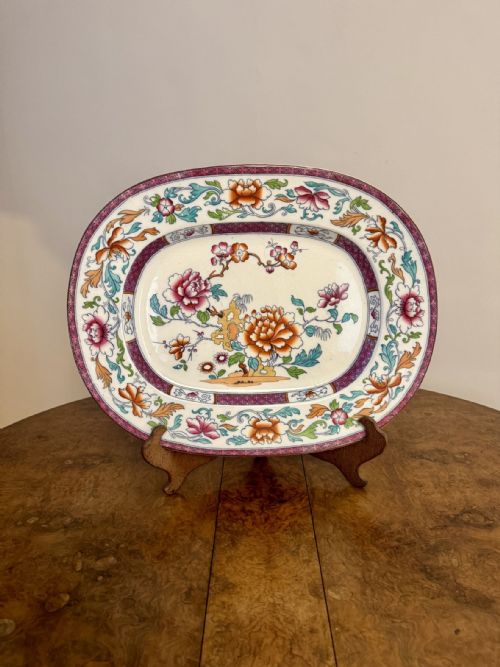


Large Ironstone Serving Platter
A large ironstone serving platter is a heavy, durable ceramic dish designed for family feasts, combining robust utility with striking nineteenth-century decoration.
Large Ironstone Serving Platter
A large ironstone serving platter represents the heavy-duty backbone of nineteenth-century dining, built to hold substantial joints of meat for the table. When searching for a large ironstone serving platter, buyers encounter robust earthenware vessels primarily originating from the Georgian and Victorian eras. These serving dishes and platters take various forms, including meat plates, well and tree platters, chargers, and dishes complete with strainers.
The pieces listed here showcase a distinct range of nineteenth-century aesthetics, moving from early nineteenth-century Regency styles to elaborate Victorian Chinoiserie and Imari patterns. Many examples feature blue and white transfer printing, while others display rich enamel and gold leaf highlights over glazed ceramic bodies. Buyers meet everything from simple country house platters to intricately decorated Oriental-style chargers.
How they were made
Makers produced these platters using a dense, vitreous ironstone ceramic body designed to resist chipping and heavy kitchen wear far better than standard earthenware. This sturdy clay body received a smooth glaze that sealed the surface, providing a durable foundation for both utilitarian meat dishes and decorative chargers.
Decoration on these platters relied on skilled hand application and early industrial transfer printing techniques. Artisans applied intricate patterns such as Chinoiserie landscapes, Italianate scenes, and Indian grasshopper motifs, often finishing the ironstone with hand-painted enamel and gold leaf details.
Listings feature ironstone platters spanning the nineteenth century, including pieces marked by Minton and Mason's alongside unmarked country house examples.
What varies in quality
The standard of a platter rests upon the crispness of its transfer-printed design and the precision of any additional hand-painted enamel and gold leaf work. Superior examples display sharp, deep impressions and vibrant, well-preserved polychrome or blue and white pigments across the glazed ceramic surface.
Structural complexity also dictates the tier of the piece, distinguishing simple meat dishes from elaborate well and tree forms equipped with integrated drainage channels and matching strainers. The presence of documented factory attribution from established nineteenth-century makers elevates the standing of an ironstone platter within the broader range.
Minton·Mason's Ironstone
The Large Ironstone Serving Platter Glossary
- Ironstone
- A heavy, durable type of ceramic patented in the nineteenth century that bridges the gap between earthenware and porcelain. It provides exceptional strength for large serving platters and meat dishes.
- Well and tree
- A specialised serving platter design featuring a carved channel around the edge and a sloped well with a ridged pattern to collect meat juices. This clever layout keeps carved joints resting above their own drippings.
- Chinoiserie
- A decorative European style from the eighteenth and nineteenth centuries that imitates Chinese artistic traditions. It appears on ceramic platters through imaginative landscapes and motifs.
- Imari
- A distinctive decorative style utilising deep underglaze blue, iron red, and gilt highlights. Victorian makers adapted this palette for decorative chargers and meat plates.
- Transfer printing
- A mechanical technique used in the nineteenth century to apply detailed patterns onto ceramic surfaces from engraved copper plates. It allowed workshops to produce uniform blue and white landscapes efficiently.
Large Ironstone Serving Platter: Frequently Asked Questions
What is an ironstone meat platter?
An ironstone meat platter is a heavy, durable ceramic dish designed in the nineteenth century for serving large joints of meat at the dining table.
These platters utilised a dense earthenware body covered in a protective glaze, making them resilient enough for daily country house use while accommodating elaborate transfer-printed and hand-painted designs.
How do I use a well and tree platter?
A well and tree platter was historically used for serving carved roasts, utilising its carved surface channels to drain meat juices away from the joint.
The sloping well collects the liquid at one end of the platter for easy spooning into gravy boats, keeping the meat elevated and presentable during a meal.
How do I date a Victorian serving platter?
Dating a Victorian serving platter involves examining the stylistic clues, such as nineteenth-century Chinoiserie or Imari patterns, alongside any registered shape marks on the reverse.
While exact years often rely on factory stamps or registration dates, the presence of specific transfer-printed motifs helps narrow down whether a piece belongs to the Georgian or Victorian era.
Can I use antique ironstone for serving food?
Antique ironstone platters are structurally robust ceramic dishes that remain suitable for serving dry foods and cooked meats at the modern table.
Because nineteenth-century glazes and enamels can be sensitive to modern detergents and dishwashers, careful hand washing helps preserve the gold leaf and delicate enamel details.