



Large Gold Earrings
Large gold earrings are substantial statement pieces spanning the Victorian, Edwardian, and mid-century eras, prized for their bold scale and craftsmanship.
Large Gold Earrings
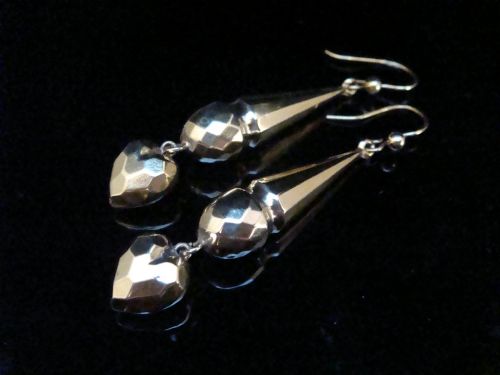
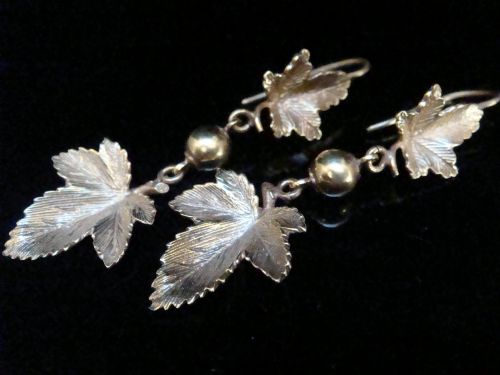
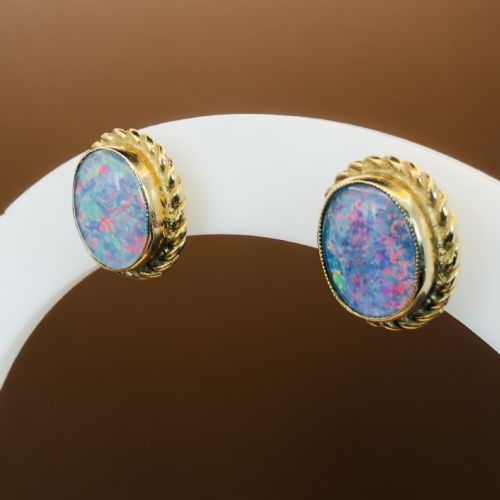
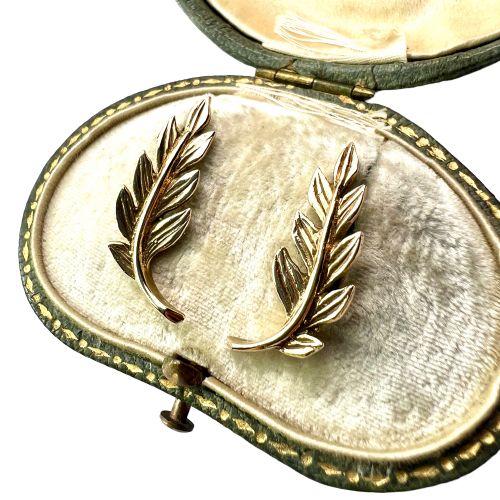
Large gold earrings encompass dramatic drop designs, ornate hoops, and substantial studs that reflect the aesthetic priorities of their respective periods. When searching for large gold earrings, buyers frequently encounter Edwardian leaf and drop motifs alongside Victorian hollow hoops and mid-century mabe pearl clusters.
The selection ranges from delicate openwork filigree to heavy cast gold constructions incorporating gemstones such as diamonds, opals, garnets, and turquoise. These pieces derive their character from the distinct manufacturing techniques and design revivals of the nineteenth and twentieth centuries.
Earrings from the Victorian and Edwardian periods often utilise lower and higher carat yellow gold, rose gold, and white gold to create dimensional botanical and geometric forms. Mid-century examples introduce textured finishes and omega backs to support heavier weights on the earlobe.
Materials and Techniques
Jewellers constructed these earrings using 9ct, 14ct, 15ct, and 18ct gold, often employing hollow forming techniques to achieve substantial visual presence without excessive weight. Surface decoration involved repoussé work, granulation, and pique inlay, alongside claw and bezel settings for diamonds, pearls, and coloured gemstones.
Ear wires, screw backs, and omega clips were engineered to secure heavier drops and studs comfortably, reflecting the changing technical standards of the Victorian, Edwardian, and mid-century decades.
Large Gold Earrings Retail Price Guide 2026
Typical asking prices for large gold earrings among the pieces listed under this phrase on Sellingantiques today, from the lower quarter to the upper quarter. They describe what is for sale here now, not the wider market.
The documented periods span the Victorian, Edwardian, and mid-century eras, incorporating retro and vintage revival styles.
Distinctions in Quality
Quality in large gold earrings depends upon the crispness of the chased or stamped detail and the structural integrity of hollow components. Superior examples maintain intact original fixings and securely set stones, whereas lower quality pieces show flattening to high relief motifs or heavy solder repairs at stress points.
The Large Gold Earrings Glossary
- Mabe pearl
- A cultured half-pearl grown against the inside shell of an oyster, frequently utilised in mid-century clusters and surround settings. These hemispherical pearls offer a large surface area relative to their weight.
- Old cut diamond
- A precursor to the modern brilliant cut, featuring a small table, high crown, and open culet. These stones display distinctive hand-faceted light return common in Edwardian pieces.
- Pique
- A method of inlaying contrasting materials, such as gold or silver, into a tortoiseshell or organic base. Victorian hoop earrings occasionally utilise this technique for geometric surface patterns.
- Parure
- A matched set of jewellery intended to be worn together, which can include earrings paired with matching pendants or brooches. Complete surviving sets represent coordinated design schemes.
- Foxtail chain
- A flexible, square-section chainwork formed from curved interlocking links. This technique provides fluid movement in tassel and drop configurations.
Large Gold Earrings: Frequently Asked Questions
How do I care for antique gold earrings?
Store them individually in soft pouches to prevent scratching between pieces. Clean them gently with a soft cloth, avoiding harsh chemical dips that damage organic gems like pearls and opals.
Check the security of stone settings and omega backs periodically. Professional inspection ensures worn ear wires or clasps are repaired before loss occurs.
Are antique earrings heavy to wear?
Many Victorian and Edwardian examples utilise hollow gold construction to maintain a large visual scale while keeping the overall weight manageable. Heavier drop earrings and mabe pearl clusters often employ secure omega backs or larger ear wires to distribute weight evenly across the lobe.
Earring weight varies significantly depending on whether the piece is solid cast or hollow-formed. Buyers sensitive to weight often prefer hollow Edwardian drops over solid mid-century designs.
How can I identify the period of gold earrings?
Period identification relies on a combination of metal hallmarks, gemstone cuts, and stylistic motifs. Victorian pieces frequently feature natural garnets, turquoise, and hollow gold hoops, while Edwardian designs favour platinum-topped gold, old cut diamonds, and botanical drop motifs.
Mid-century and retro pieces introduce textured gold finishes, mabe pearls, and omega clip mechanisms. Examining the construction of the findings and the backings provides additional clues to the decade of manufacture.
What is the difference between stud and drop earrings?
Stud earrings sit directly on the earlobe, securing with a post and butterfly or screw back. They highlight central stones or geometric motifs close to the skin.
Drop earrings suspend components below the earlobe, utilising movement to catch the light. This format was favoured during the Victorian and Edwardian eras for botanical, tassel, and gemstone pendants.