

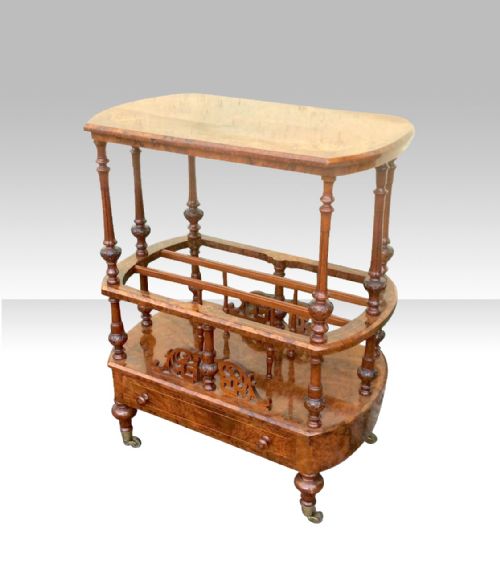


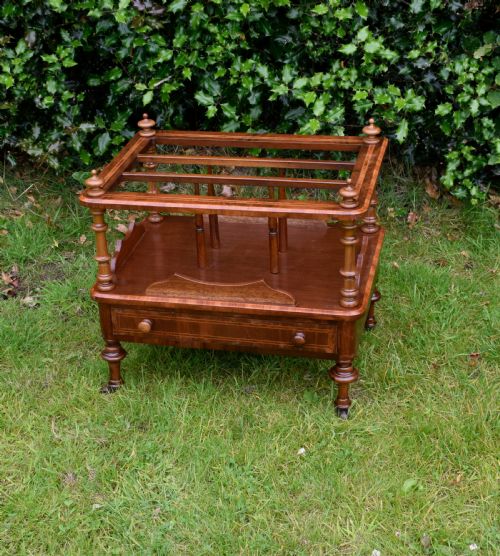
Inlaid Wood Canterbury
An inlaid wood canterbury is a small, partitioned stand for sheet music and books that brings refined Victorian and Edwardian craftsmanship to any room.
Inlaid Wood Canterbury
When someone searches for an inlaid wood canterbury, they are looking at freestanding occasional furniture designed to hold folios, magazines, and sheet music. These pieces combine practical compartmentalised storage with decorative woodwork, serving as both utility items and elegant focal points.
The versions most commonly met on this page date from the Victorian and Edwardian eras, spanning the nineteenth century and around nineteen hundred. They take the form of traditional canterburys, magazine racks, music cabinets, and occasional tables with integrated bookstands.
Makers constructed these items in walnut, mahogany, rosewood, burr walnut, and gonçalo alves, incorporating wood inlay, marquetry, and fretwork details. Brass fittings and glass elements also appear across the selection, reflecting the decorative priorities of nineteenth-century cabinet makers.
How they were made
Cabinet makers utilised dense hardwoods such as mahogany, walnut, and rosewood as the structural foundation for these pieces, often selecting figured timbers like burr walnut for visible surfaces. Wood inlay and marquetry were then applied to panels and tabletops to create geometric or floral patterns.
Constructive details included fretwork panels and brass elements to support the partitions and open racks of the canterburys and music cabinets. Artisans shaped these timbers by hand, joining panels to withstand the daily weight of books and heavy sheet music folios.
Inlaid Wood Canterbury Retail Price Guide 2026
Typical asking prices for inlaid wood canterbury among the pieces listed under this phrase on Sellingantiques today, from the lower quarter to the upper quarter. They describe what is for sale here now, not the wider market.
Named after a Bishop of Canterbury who requested a special music stand, these handy little racks ended up holding everything from sheet music to embroidery.
What varies in quality
The distinction between standard and finer examples rests upon the choice of timber and the precision of the inlay work. Pieces fashioned from burr walnut or gonçalo alves with intricate marquetry demonstrate a higher level of cabinet-making skill than simpler mahogany versions.
Proportion and structural integrity also divide the range, as well-balanced proportions and refined fretwork indicate superior workshop production. The complexity of the partitions and the integration of brass fittings show the care taken during initial construction.
The Inlaid Wood Canterbury Glossary
- Marquetry
- The art of applying pieces of veneer to a structure to form decorative patterns and pictures. It differs from inlay by assembling the pattern on a veneer background before fixing it.
- Fretwork
- Ornamental design created by cutting patterns through thin wood panels. This technique lightens the visual weight of cabinet doors and partitions.
- Gonçalo Alves
- A dense exotic hardwood with striking contrasting grain patterns, sometimes called tiger wood. It was utilised for high-status nineteenth-century cabinetry.
- Burr walnut
- Timber taken from a walnut tree growth, yielding swirling, highly figured grain patterns. Cabinet makers prized it for veneering prominent surfaces.
Inlaid Wood Canterbury: Frequently Asked Questions
What is a canterbury used for?
A canterbury was originally designed to hold sheet music, folios, and loose papers near a piano or seating area. Victorian and Edwardian households utilised them to keep reading materials organised and close at hand.
Over time, their function expanded to include storing magazines, books, and small portfolios. Today, they serve a similar domestic purpose while displaying decorative inlaid wood details.
How do I tell Victorian from Edwardian pieces?
Victorian pieces generally display heavier timbers, darker finishes, and dense ornamentation such as elaborate fretwork and burr walnut veneers. They date from the nineteenth century up to nineteen hundred.
Edwardian items often appear lighter in build, frequently incorporating satinwood or delicate marquetry on mahogany and rosewood. Their proportions reflect a shift towards airier drawing-room aesthetics around the turn of the century.
Where should I place a canterbury?
These pieces suit living rooms, studies, or music rooms where their partitioned compartments can hold current reading material or sheet music. Their compact footprint allows them to sit beside armchairs, sofas, or against panelled walls.
Because they feature finished woodwork and decorative inlay on multiple sides, they look effective when positioned to be viewed from various angles within a room.
What is inlaid wood?
Inlaid wood involves setting contrasting pieces of timber, shell, or metal into recesses carved into a solid wood surface. This technique creates flush, decorative patterns that ornament the piece.
Craftsmen utilised it on tabletops and cabinet fronts during the nineteenth century to add visual depth and colour variation without altering the structural form.