



Inlaid Revolving Bookcase
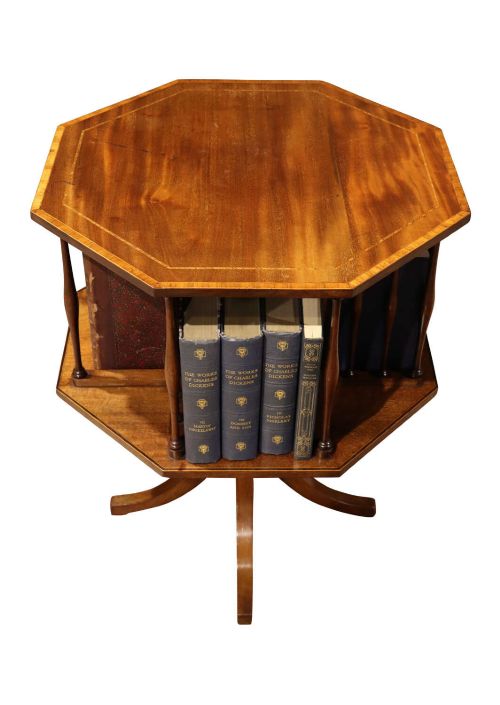
An inlaid revolving bookcase spins heavy volumes into easy reach while showing off the rich grain of mahogany and delicate satinwood lines.
Inlaid Revolving Bookcase
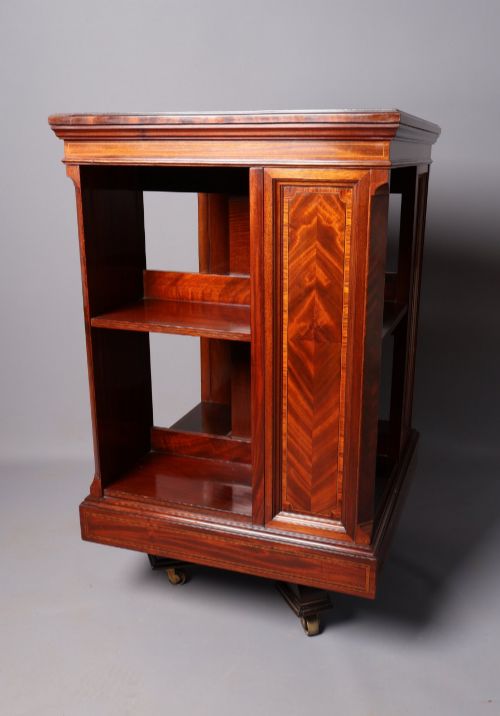
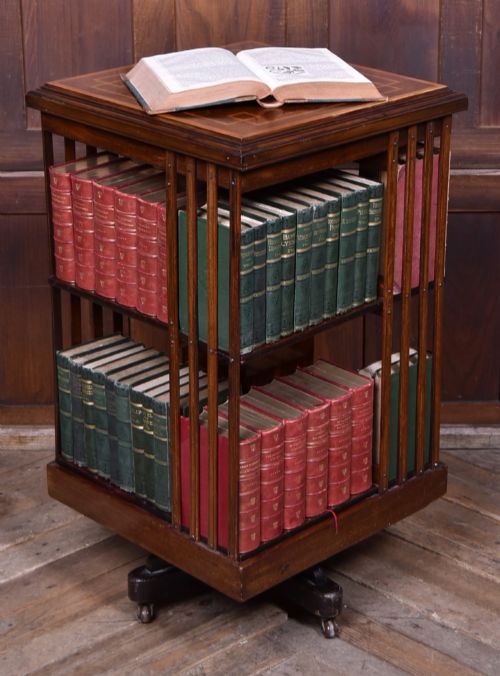
An inlaid revolving bookcase brings together practical desk-side storage and decorative cabinet work from the late Victorian and Edwardian eras. Most examples on this page date from the Edwardian period or around nineteen hundred, constructed to sit comfortably beside an armchair or upon a table top.
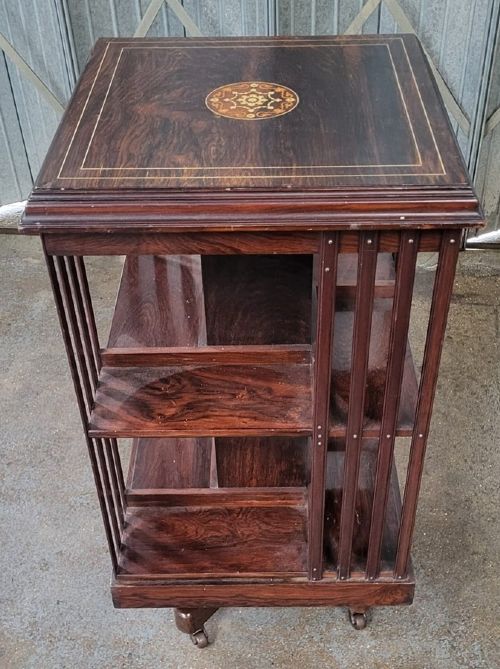
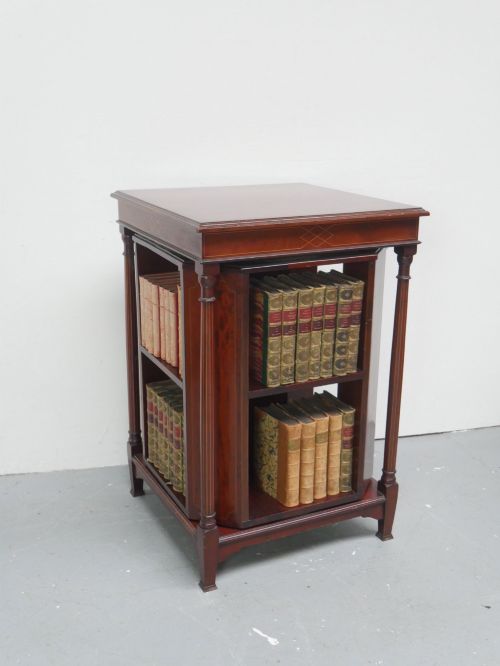
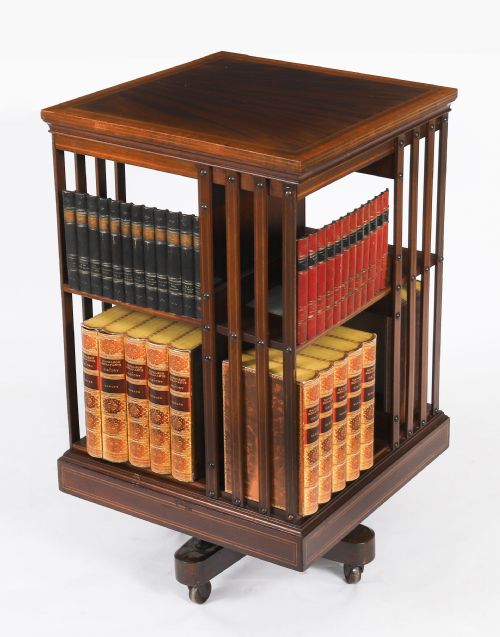
The standard form stands low to the floor, built with slatted or panelled sides that keep books upright while turning smoothly on a hidden mechanism. Alongside full-size floor models, smaller table top versions appear frequently in mahogany and rosewood.
Makers of the era drew heavily on Sheraton style influences, incorporating straight lines and balanced proportions into pieces designed for everyday utility. These bookcases satisfy both the need for accessible reading material and the desire for refined domestic furniture.
How they were made
Cabinet makers relied primarily on solid and flame mahogany, sometimes selecting rosewood for richer colour and heavier grain. Satinwood and boxwood were employed for contrasting stringing and delicate inlay work set directly into the primary timber.
Internal rotation depended on robust iron and brass hardware concealed beneath the base to ensure smooth movement under weight. Cast iron components provided the necessary ballast and stability to keep tall stacks from tipping during rotation.
Inlaid Revolving Bookcase Retail Price Guide 2026
Typical asking prices for inlaid revolving bookcase among the pieces listed under this phrase on Sellingantiques today, from the lower quarter to the upper quarter. They describe what is for sale here now, not the wider market.
Listings demonstrate that mahogany serves as the dominant timber for these bookcases, frequently accented with satinwood and boxwood inlay.
What varies in quality
The distinction between ordinary production and finer work lies in the crispness of the boxwood or satinwood inlay and the selection of figured mahogany veneers. Pieces featuring complex multi-wood banding or marble tops display a higher ambition in the workshop.
Mechanical performance separates standard examples from superior ones, as a well-adjusted iron and brass pivot allows effortless rotation without wobble. The joinery of the vertical slats and the neatness of the corner joints reveal the underlying skill of the cabinet maker.
Maple and Co
The Inlaid Revolving Bookcase Glossary
- Edwardian
- Pertaining to the reign of King Edward VII, spanning the early years of the twentieth century. Furniture from this era often lighter in proportion than Victorian precedents.
- Sheraton style
- A neoclassical design vocabulary characterised by straight tapered legs, geometric inlay, and refined classical motifs. Named after the eighteenth-century designer Thomas Sheraton.
- Stringing
- A narrow strip of contrasting timber inlaid flush into the surface of a piece to create decorative borders. Commonly executed in boxwood or satinwood against a mahogany ground.
- Flame mahogany
- Timber cut from the fork of the mahogany tree where the branch meets the trunk, producing a distinctive rippled pattern resembling flickering flames. Highly prized for cabinet fronts and top panels.
Inlaid Revolving Bookcase: Frequently Asked Questions
How do revolving bookcases work?
These bookcases sit upon a concealed internal pivot fitted with iron and brass components that allow the entire structure to spin freely. This mechanism lets a reader access multiple shelves of books from a single seated position without moving the heavy furniture.
Weight distribution remains central to their operation, so heavier volumes go on the bottom tiers to maintain balance while turning.
What is the difference between floor and table top models?
Floor standing revolving bookcases include a stable cruciform base fitted with castors or feet, standing high enough to hold substantial collections of books across several tiers. Table top versions offer a compact alternative designed to sit directly on a desk or larger piece of furniture.
Both types utilise the same rotating mechanism, but table top editions provide a lighter storage solution for smaller studies or parlours.
How do I care for inlaid mahogany wood?
Maintaining these surfaces requires simple dusting with a soft, dry cloth and avoiding direct sunlight that can fade delicate satinwood and boxwood inlay. Occasional application of a traditional beeswax polish feeds the timber without building up heavy chemical residues.
Keeping the piece away from sudden temperature shifts prevents the mahogany and its fine stringing from drying out or splitting.
How can I tell Edwardian pieces from Victorian ones?
Edwardian furniture generally exhibits lighter proportions, simpler lines, and brighter mahogany tones influenced by revived classical styles. Victorian examples tend to be heavier in construction, occasionally incorporating dark rosewood or alternative top materials like marble.
Examining the construction methods and the style of inlay helps place the piece within its appropriate manufacturing period.