


Historic Military Art
Historic military art captures centuries of service through oils, watercolours, and detailed portrait miniatures spanning multiple European traditions.
Historic Military Art
Historic military art encompasses framed paintings, original illustrations, and portrait miniatures depicting officers, regiments, and campaigns from past centuries. When searching for historic military art, buyers encounter works ranging from 17th-century portraits to First World War illustrations and interwar realism.
The pieces on this page draw from 17th-century, 18th-century, Regency, 19th-century, and Edwardian periods, executed in oil on canvas or panel, watercolour, and ink on paper. Portrait miniatures and framed wall art predominate, offering intimate depictions of individual servicemen alongside broader satirical and wartime imagery.
Subjects include British officers, French naval officers, German airmen, and volunteers, reflecting diverse military branches and European schools. Styles stretch from Baroque and 18th-century French to Victorian academic work and First World War illustration.
Materials and techniques
Works in this category rely on traditional painting and drawing supports, including oil on canvas and panel, delicate watercolours, and precise ink drawings on paper. Framed pieces frequently utilise period wood frames that complement the medium and era of the artwork.
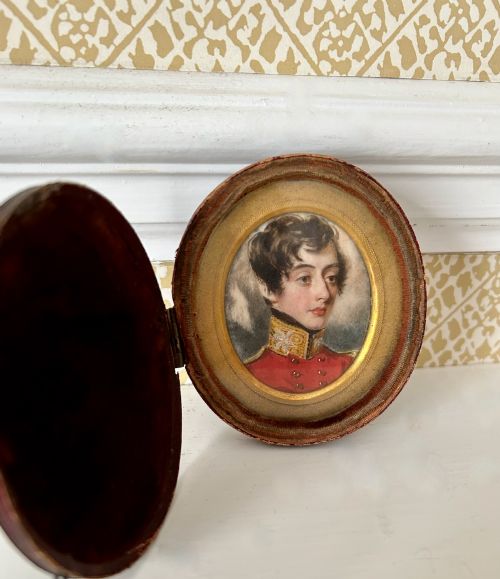
Portrait miniatures often employ specialised surfaces like ivory, demanding meticulous brushwork to capture intricate uniform details on a small scale. Ink and watercolour illustrations capture immediacy, particularly in wartime contexts where artists recorded camp life and action directly.
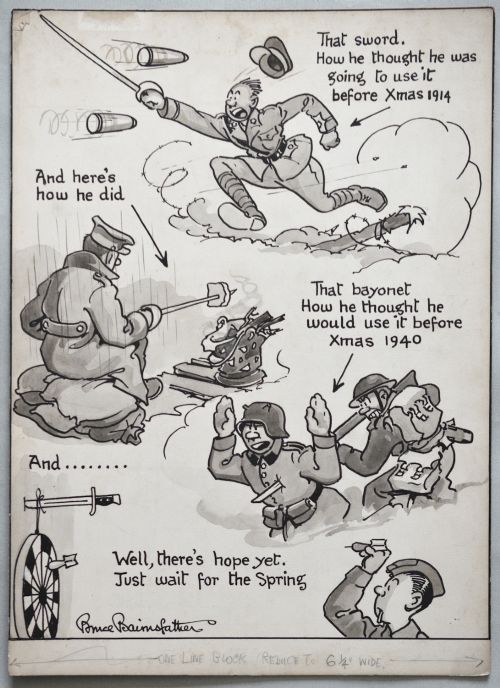
Bruce Bairnsfather's wartime ink and watercolour drawings brought wry humour straight from the mud of the trenches.
Judging quality in military works
Quality rests upon the precision of the draughtsmanship and the artist's ability to render uniform details, insignia, and facial likenesses convincingly. Finer works demonstrate superior handling of light and shadow, particularly in oil portraits and academic compositions.
The historical significance of the sitter and the attribution to recognised circles or named artists elevate a piece. Condition of the underlying support, whether paper, panel, or canvas, also influences the integrity of the surviving image.
Bruce Bairnsfather·Paul Leon Jazet·Eugen Rosenfeld·Samuel Cooper·Angelica Kauffman
The Historic Military Art Glossary
- Portrait miniature
- A small, highly detailed painting, often executed on ivory or vellum, popular for intimate likenesses of officers.
- Regency
- A British stylistic period spanning the early 19th century, known for specific military uniforms and portrait conventions.
- Interwar realism
- An artistic approach from the decades between the world wars focusing on truthful, unidealised representation.
- First World War illustration
- Period artwork capturing trench life, humour, and military operations, often created in ink or watercolour.
Historic Military Art: Frequently Asked Questions
What periods do these pieces cover?
The works span from the seventeenth century through the eighteenth century, the Regency era, the nineteenth century, and into the twentieth century including the First World War.
This broad chronological spread allows collectors to focus on specific conflicts, uniform changes, or artistic movements within military history.
What mediums are most common?
Oil on canvas and panel form the backbone of larger portraits, while works on paper include detailed watercolours and ink drawings.
Specialised materials like ivory appear specifically in miniature painting, and framed textiles such as tapestries occasionally represent military subjects.
How do I identify a military portrait?
Military portraits are identified by the sitter's uniform, red coats, naval attire, medals, orders, and associated regimental backgrounds or equipment.
Inscribed details on the reverse or contemporary documentation often confirm the regiment, date, and identity of the officer portrayed.