


Gold Clip on Earrings
These gold clip on earrings span the Victorian era through the mid-century, offering secure ear adornment without requiring pierced lobes.
Gold Clip on Earrings
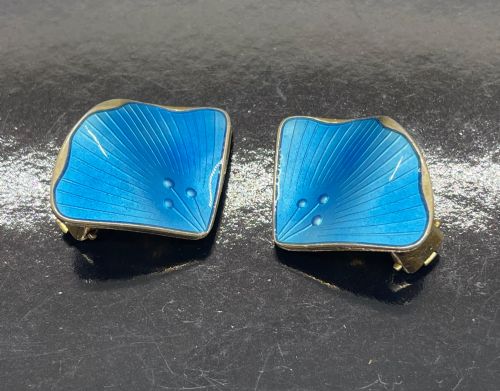
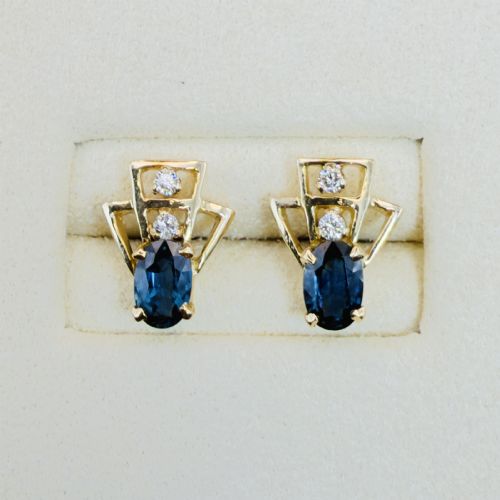
When buyers search for gold clip on earrings, they find a varied collection spanning the Victorian, Edwardian, Art Deco, Retro and mid-century periods. The designs range from floral pearl clusters and geometric diamond fan shapes to bold textured hoops and abstract modernist forms.
How they were made
The construction of these earrings relies primarily on yellow, white and rose gold in 9ct, 14ct and 18ct purities, frequently paired with platinum settings for secure diamond claw and pave work. Silver gilt is also utilised alongside vitreous enamel in Scandinavian and Austro-Hungarian decorative pieces.
Gemstone selection dictates the mounting technique, with brilliant, old-cut and single-cut diamonds, sapphires, rubies, pearls and turquoise integrated into cluster, swivel, swirl and fan motifs. Master jewellers utilised engineered screw-back and clip mechanisms to distribute weight evenly across the earlobe.
The documented periods range from the Victorian and Edwardian eras through the 1920s to the 1960s.
What varies in quality
Quality differences rest upon the precision of the metalwork, the weight of the gold used in the mountings, and the calibre of the gemstones selected. Top-tier pieces display balanced proportions, crisp stamping or hand-finishing, and high-clarity diamonds or well-matched natural pearls.
The engineering of the fastening mechanism also distinguishes the range, where robust, tightly sprung clips or smoothly threaded screw backs maintain their tension securely. Pieces featuring signed maker marks or original fitted presentation boxes sit at the upper end of the scale.
Boucheron·Andrew Grima·Christian Dior·Cartier·Kutchinsky
The Gold Clip on Earrings Glossary
- Clip-on
- A hinged fastening mechanism with a padded paddle that presses against the back of the earlobe to hold the earring in place without a post.
- Screw-back
- An adjustable mechanical fastening utilising a threaded post and screw cap to tighten the tension of the fitting against the earlobe.
- Omega back
- A hinged clip closure shaped like the Greek letter omega, commonly found on mid-century earrings to provide secure and adjustable pressure.
- Silver gilt
- Sterling silver that has been coated with a thin layer of gold, frequently seen in antique Austro-Hungarian and Scandinavian pieces.
- Mabe pearl
- A cultured hemisphere pearl grown against the inside shell of an oyster, prized for its large size and flattened back.
Gold Clip on Earrings: Frequently Asked Questions
How do clip-on earrings stay secure?
Clip-on earrings use mechanical tension from hinged paddles or spring-loaded mechanisms to grip the lobe. They distribute weight across the surface of the ear rather than relying on a single piercing hole.
Many mid-century designs utilise omega backs or adjustable screw fittings to allow the wearer to customise the pressure. This ensures the piece remains firmly positioned during movement without causing discomfort.
Are screw-back earrings difficult to adjust?
Screw-back closures feature a threaded post and a small rotating disc that moves along the thread. Turning the screw alters the distance between the backing plate and the front setting.
This design allows the wearer to set the exact tightness required for their lobe thickness. Once adjusted, the fitting stays securely in place throughout the day.
How do I date an antique earring pair?
Dating relies on stylistic motifs such as geometric Art Deco fan shapes, Edwardian platinum lace-work, or organic mid-century abstract forms. The choice of materials, such as old-cut diamonds or specific gold purities, also points to particular eras.
Examining the construction of the fastening mechanism provides further clues. Screw backs and early hinged clips became widespread during the Victorian and early twentieth-century periods.
Can non-pierced earrings be converted?
Converting clip-on or screw-back earrings to posts is generally discouraged by collectors because it alters the original structural integrity and historical form of the piece. The existing mechanisms often form an integral part of the design and manufacture.
Leaving the mountings intact preserves the character and craftsmanship of vintage and antique examples. Most buyers seek out these pieces specifically to wear them in their original non-pierced format.