


Glass Cased Clock
A glass cased clock brings precision movement into plain view through transparent panels, keeping time while revealing the mechanical heart within.
Glass Cased Clock
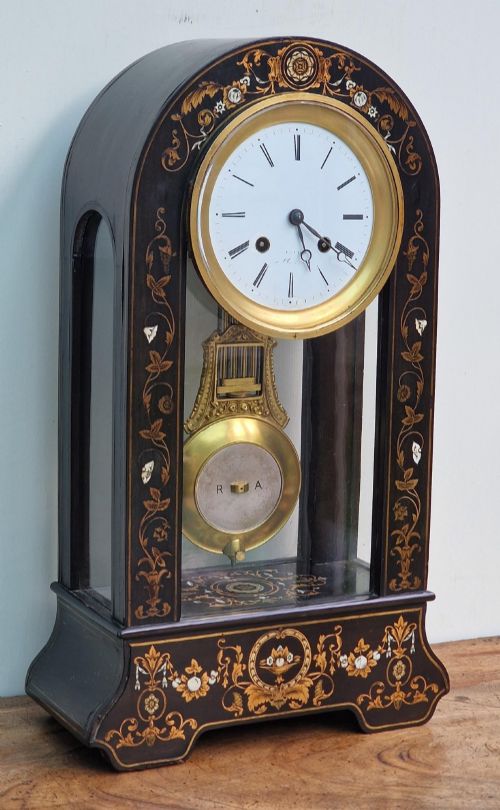
A glass cased clock encompasses a range of transparent enclosures housing timepieces, most commonly seen here as carriage clocks, French four glass mantel clocks, library clocks, and Atmos clocks dating from the Victorian and Edwardian eras alongside mid-century pieces.
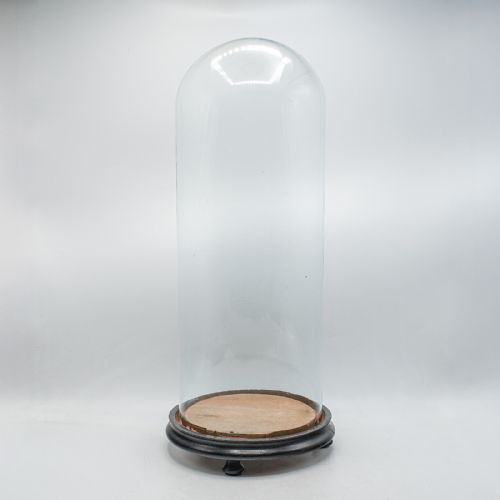
The selection frequently includes carriage clocks in gilt brass cases, heavy crystal regulators, and tall display domes paired with timber bases, reflecting nineteenth and twentieth-century domestic and scientific tastes.
Makers and retailers from London and Paris feature prominently among these designs, offering everything from portable eight-day striking movements to desk timepieces and perpetual motion mechanisms.
Materials and construction
Construction relies heavily on glass panels, brass, gilt brass, and steel, with specific examples utilising ebonised wood, mahogany, or oak for bases and outer frames.
Movements span fusee designs, pendulum escapements, and intricate mechanisms such as the coup perdu detent escapement or perpetual motion systems enclosed within glass bell jars.
Some display domes served unconventional household duties by housing taxidermy specimens or delicate botanical displays alongside the ticking mechanisms.
Evaluating the pieces
Quality reveals itself in the crispness of engraving on brass gorge cases and the clarity of the glass panels, which should be free of distortion.
Finishing extends to the complexity of the movement, such as five-glass library clocks with fusee movements or signed dials by notable makers that distinguish standard production from finer workshop output.
Walker·Dent·Samuel Marti·Jaeger LeCoultre·William Evans of Handsworth·James Wood·Drocourt·Clerke
The Glass Cased Clock Glossary
- Carriage clock
- A small, portable spring-driven timepiece with a handle, originally designed for travel and typically housed in a brass and glass case.
- Four glass clock
- A mantel clock featuring glass panels on the front, back, and sides, allowing an unobstructed view of the mechanical movement and pendulum.
- Fusee
- A conical pulley used in older clock movements to maintain even driving force as the mainspring unwinds.
- Atmos clock
- A mechanical timepiece manufactured by Jaeger-LeCoultre that is powered by subtle temperature changes in the surrounding air.
- Gorge case
- A stepped rectangular brass case style commonly found on nineteenth-century carriage clocks.
Glass Cased Clock: Frequently Asked Questions
How do four glass clocks work?
These mantel clocks utilise a central movement suspended between transparent panels, often featuring a mercury or pendulum mechanism visible from all sides.
Gravity and spring power drive the gears while the glass housing protects the delicate escapement from dust.
What is an Atmos clock?
An Atmos clock runs without manual winding by utilising a hermetically sealed capsule containing a gas and liquid mixture that expands and contracts with temperature shifts.
This continuous expansion tensions the mainspring, allowing the timepiece to operate indefinitely in a glass enclosure.
How should I clean a glass cased clock?
Glass panels require gentle wiping with a lint-free cloth and standard glass cleaner applied to the cloth rather than sprayed directly near the case joints.
Brass frames and gilt surfaces benefit from dry dusting to avoid damaging delicate lacquered finishes or exposing the mechanical movement to moisture.
Where were most carriage clocks made?
Many of the carriage clocks and multi-glass timepieces available originated in French workshops and Parisian factories during the nineteenth century.
English retailers frequently imported these movements or commissioned domestic variations featuring signed dials and engraved brass cases.