


Gilded Crystal Candle Sconces
These gilded crystal candle sconces bring the brilliant play of cut glass and polished metal to panelled walls.
Gilded Crystal Candle Sconces
When you search for gilded crystal candle sconces, you encounter wall lights, wall sconces, and wall chandeliers designed to illuminate rooms with reflected candlepower. These fittings emerge predominantly from the nineteenth and early twentieth centuries, spanning periods such as 1850, 1920, and 1930.
The majority of these pieces originate from France and Italy, adopting distinct regional characteristics from the French chateau tradition and Florentine workshops. French variants often display elaborate rococo, baroque, or Louis XV revival styling, whereas Italian pieces frequently showcase giltwood leaf work and Florentine frames.
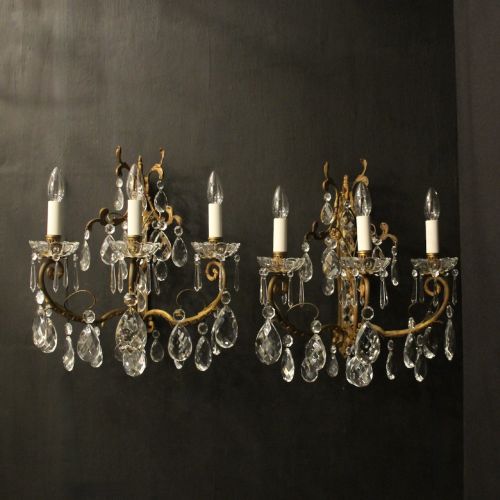
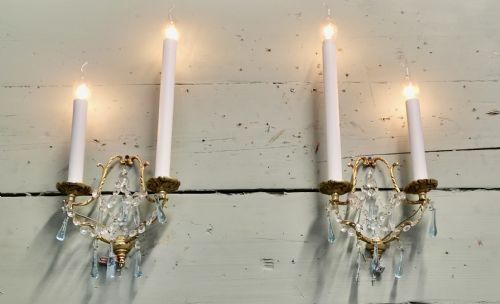
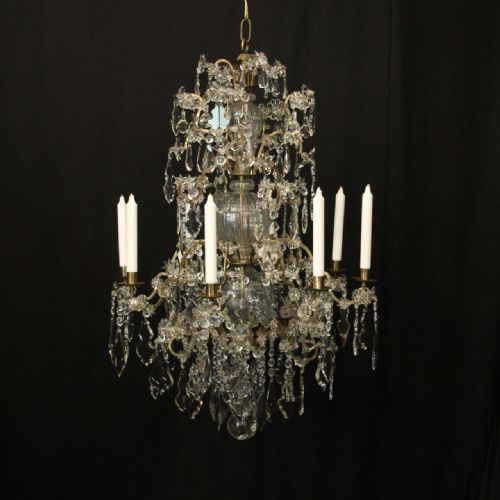
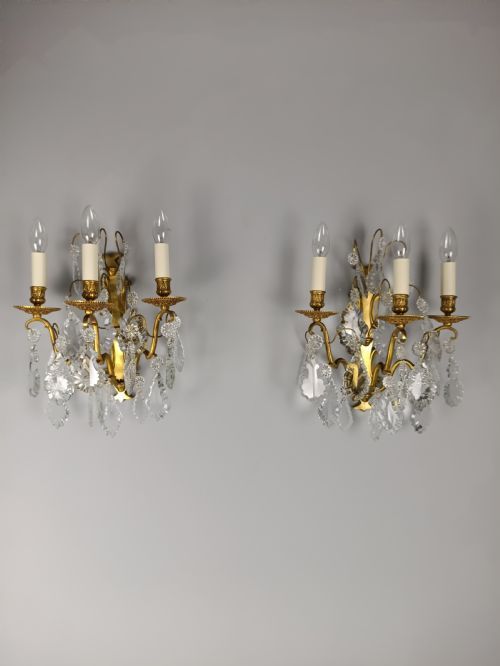
Buyers most commonly meet pairs featuring twin or triple arms designed for wall mounting, equipped with dangling crystal drops and glass beads. The forms range from simple two-light brass and glass sconces to large four-light wall chandeliers with silver gilded or bronze finishes.
How they were made
Makers constructed these wall lights using structural metals like brass, bronze, and ormolu, applying a layer of gold leaf or gilt finish over the surface. This gilded metal framework supported the weight of glass and cut crystal components while providing a decorative backdrop for the candle arms.
Craftsmen shaped crystal and glass into intricate drops, beads, and bobeches, attaching them with wire or pins to catch and refract the candlelight. The combination of cut crystal with cast gilt metal defined the aesthetic of French chateau and baroque lighting fixtures from this era.
Listings span periods from 1850 to 1930, uniting French chateau styles and Florentine giltwood leaf work under cut crystal and gilded metal materials.
What varies in quality
The precision of the metal casting and the depth of the gilding set superior wall lights apart from simpler productions. Finer examples display crisply chased ormolu and bronze work with substantial weight, while lesser pieces rely on lighter pressed brass and flat finishes.
The clarity and cut of the crystal elements dictate the overall brilliance of the sconce. Pieces utilising heavily faceted, high-grade crystal create more vibrant light refraction than those fitted with plain or pressed glass.
The Gilded Crystal Candle Sconces Glossary
- Gilt bronze
- Bronze metal treated with a thin layer of gold or gold leaf to give a rich, metallic finish. This technique protects the underlying bronze while creating a bright decorative surface.
- Ormolu
- A metallic technique involving the application of finely ground high-carat gold to a bronze object. It provides a distinct golden sheen commonly found on antique French lighting.
- Girandole
- An ornamental branched wall light or sconce fitted with mirrors or glass to multiply the reflected light. These fixtures often feature numerous crystal pendants.
- Bobeche
- A small saucer-like collar placed beneath a candle socket to catch melting wax. In these pieces, they frequently support hanging crystal prisms.
- Baroque
- An ornate design style characterised by dramatic curves, rich ornamentation, and grand proportions. Pieces in this style emphasise theatrical visual impact.
Gilded Crystal Candle Sconces: Frequently Asked Questions
How were gilded crystal candle sconces used originally?
These fixtures were mounted on walls beside mirrors or windows to maximise the illumination of candlelit rooms. The crystal pendants and gilded surfaces amplified the available light.
In grand interiors, pairs or rows of these sconces created a balanced lighting scheme along panelled corridors and reception spaces.
How do I identify French versus Italian styles?
French pieces often lean towards rococo, baroque, or Louis XV revival forms with symmetrical curved arms and cast bronze or ormolu mounts. They emphasise chateau elegance and elaborate metalwork.
Italian pieces, particularly from Florentine makers, frequently incorporate carved giltwood leaf motifs and gilt frames. Their construction highlights organic floral and botanical elements.
Can these antique wall lights be wired for electricity?
Many surviving examples have already been converted or rewired for modern electrical use while retaining their original candle-form appearances. This allows them to function safely on contemporary household circuits.
Professional electricians can integrate modern wiring through the existing metal channels without compromising the historical metalwork or crystal arrangement.
What periods do these wall sconces represent?
The available selection primarily spans the nineteenth and early twentieth centuries, with dates recorded around 1850, 1920, and 1930. These eras reflect sustained revivals of earlier baroque and rococo aesthetics.
Mid-nineteenth-century items often showcase heavy ormolu and bronze casting, whereas the 1920 and 1930 pieces frequently feature French and Florentine wall lights.