


French Dress Ring
When you search for a french dress ring, you are looking at statement finger ornamentation defined by European craftsmanship, vibrant gemstones, and enduring metallic settings.
French Dress Ring
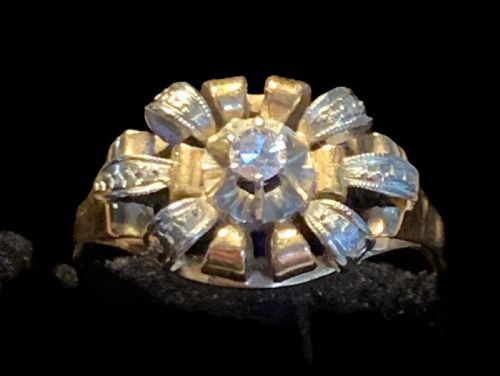
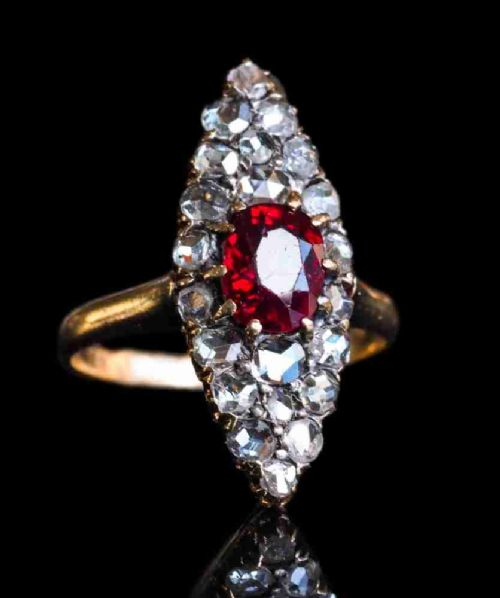
A french dress ring is primarily designed for decorative impact, appearing in forms such as elongated navette profiles, geometric cocktail clusters, and bold tank shapes. These jewels span multiple decades, drawing heavily from Edwardian delicacy, Art Deco geometry, and mid-century volume.
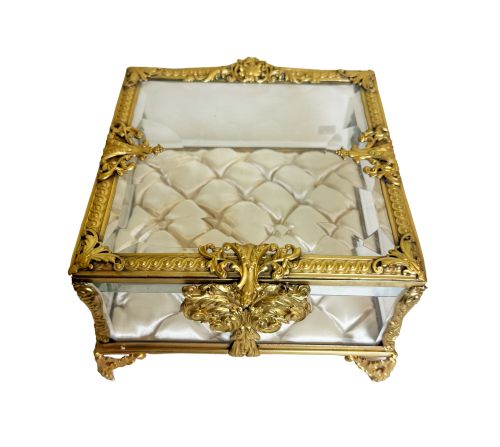
The selections encountered here range from delicate Edwardian diamond clusters set in white gold to heavy platinum Art Deco mountings encrusted with sapphires, rubies, and emeralds. Alongside traditional rings, the category occasionally encompasses related vanity accessories like crystal boxes and enameled pin trays.
Originating predominantly from French workshops, these jewels reflect distinct stylistic shifts from floral Edwardian motifs to the muscular architecture of the 1940s Tank period and the high-jewellery sparkle of the 1950s.
How they were made
Makers utilised durable noble metals, predominantly platinum and various carats of yellow and white gold, to construct intricate galleries capable of securing multiple small stones. Platinum became the preferred medium for intricate Art Deco pierced work due to its strength and bright finish.
Gemstones including old-cut diamonds, natural sapphires, aquamarines, and rubies were shaped using transitional, rose, or french cuts to catch the light within tightly packed pave settings.
The inventory spans Victorian and Edwardian aesthetics through to the mid-century modern era.
What varies in quality
The calibre of a french dress ring rests on the precision of the stone setting and the crispness of the metalwork, where hand-pierced millegrain edges and well-matched gemstone hues dictate the overall refinement. Superior examples display harmonious proportions between the central stone and the surrounding melee diamonds, avoiding uneven gaps in the pave work.
The integrity of the structural gallery underneath the finger also marks the distinction between standard workshop output and high-jewellery production, as heavier platinum or gold weight ensures the piece withstands decades of wear without distortion.
Boucheron
The French Dress Ring Glossary
- Navette
- A boat-shaped ring design that tapers to sharp points at either end. This elongated silhouette flatters the finger by creating an illusion of length.
- Tank ring
- A bold, volumetric style inspired by military machinery popular during the 1940s. These pieces combine heavy gold or platinum bands with stepped, architectural shoulders.
- Old-cut diamond
- A hand-faceted diamond cut before modern machinery standardisation, featuring a smaller table and a higher crown. These stones produce a softer, candlelit sparkle rather than pinpoint brilliance.
- Millegrain
- A decorative technique involving tiny raised metal beads along the edge of a setting. This detail provides a soft texture that frames the gemstones.
- Pave setting
- A method of setting numerous small gemstones closely together with minimal visible metal. The surface appears paved with stones.
French Dress Ring: Frequently Asked Questions
What periods do these rings come from?
The available selection spans several distinct eras, beginning with delicate Edwardian designs and moving through the geometric lines of the 1920s and 1930s Art Deco period. Later examples include bold 1940s Tank styles and mid-century cocktail rings.
Each era brings its own unmistakable aesthetic, shifting from lacy platinum wirework to heavy, sculptural gold mounts.
How do I identify an Art Deco piece?
Art Deco pieces typically feature strong geometric motifs, symmetrical patterns, and a heavy reliance on platinum paired with diamonds and calibrated sapphires or rubies. The overall impression is architectural and sharp rather than floral or curved.
Makers of this period prioritised straight lines, stepped shoulders, and high-contrast colour pairings.
What are Tank rings?
Tank rings emerged around the 1940s, taking direct aesthetic inspiration from military hardware and heavy machinery. They are characterised by wide, domed bands of yellow or rose gold often accented with platinum and channel-set diamonds.
These pieces offer a substantial, weighty feel on the hand compared to earlier Edwardian filigree rings.
Can I wear a dress ring daily?
While these rings were built with durable metals like platinum and 18ct gold, their age and intricate settings require thoughtful care. Many incorporate delicate old-cut stones or complex millegrain work that benefits from gentle handling.
Removing the ring during manual tasks ensures the claw settings and smaller pavé stones remain secure over time.