

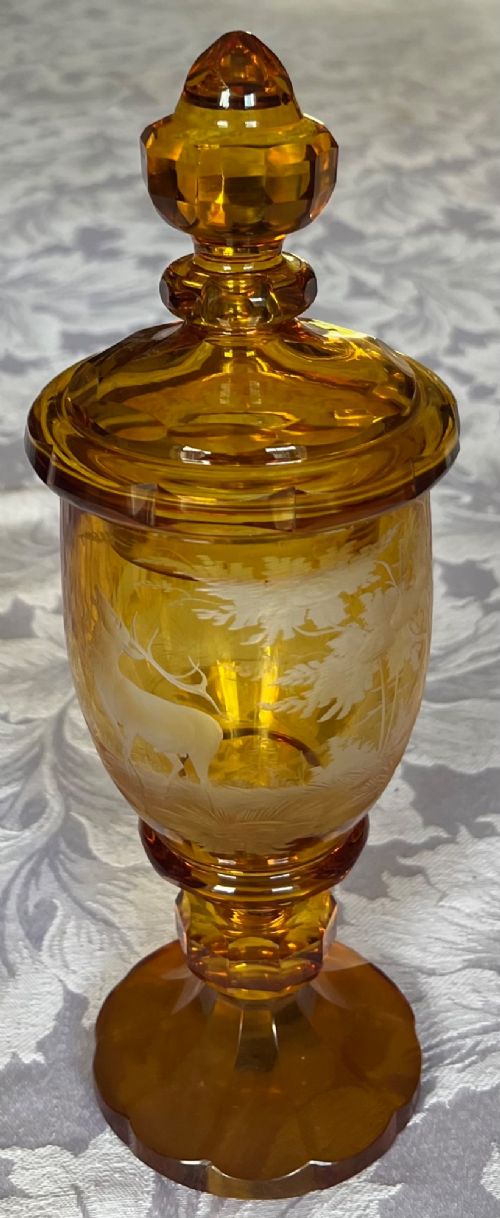





Faceted Glass Goblet
A faceted glass goblet combines crisp geometric stems with deep bowls, offering the collector a tactile piece of drinking history.
Faceted Glass Goblet
When you search for a faceted glass goblet, you encounter drinking vessels ranging from eighteenth-century English wine glasses to nineteenth-century Bohemian and Victorian pieces. These objects encompass wine glasses, port glasses, rummers, and commemorative vessels designed for display or toast.
The most common form on this page is the eighteenth-century English wine glass featuring a diamond or hexagonal facet cut stem. Alongside these appear larger commemorative goblets, green and amber coloured glasses, and heavily decorated Bohemian specimens.
Origins span Georgian England, Victorian England and Ireland, and continental workshops from the nineteenth and early twentieth centuries. The variety extends across diverse forms, including covered vases and liquor glasses sharing the characteristic cut facets.
Materials and manufacture
These pieces rely primarily on lead crystal, lead glass, and clear or coloured glass. The heavy weight and high refractive index of lead glass made it the preferred medium for deep cutting and polishing.
Craftsmen shaped the bowls by blowing before applying wheel-cutting techniques to create geometric facets along the stems and lower bowls. Additional decoration frequently involved intricate engraving, sometimes paired with surface gilding.
Faceted Glass Goblet Retail Price Guide 2026
Typical asking prices for faceted glass goblet among the pieces listed under this phrase on Sellingantiques today, from the lower quarter to the upper quarter. They describe what is for sale here now, not the wider market.
Secret political sympathies travelled across dinner tables in the form of discreetly engraved roses upon Jacobite wine glasses.
Assessing quality and character
Quality rests upon the precision of the facet cutting and the clarity of the metal. Crisp, sharply defined stem facets reflect light cleanly, whereas softer edges indicate hurried or later secondary cutting.
The presence of specialised decoration, such as historical Jacobite engraving or fine gilding by known houses, elevates a piece. Proportions between the wide foot base, the faceted stem, and the decorated bowl govern the overall visual balance.
James Giles·Moser
The Faceted Glass Goblet Glossary
- Facet cut
- A surface patterned with multiple flat planes ground and polished into the glass. This technique catches the light and provides a firm grip on drinking vessels.
- Jacobite engraving
- Decorative motifs including roses and oak leaves applied to eighteenth-century glasses in support of the exiled Stuart cause. These symbolic pieces carry significant historical resonance.
- Lead crystal
- Glass containing a high proportion of lead oxide, which increases brilliance, weight, and workability for deep cutting. It forms the basis of the finest drinking glasses.
Faceted Glass Goblet: Frequently Asked Questions
How do I date a facet cut stem?
Eighteenth-century examples generally feature longer, slender stems with precise diamond or hexagonal facets meeting neatly at the collar and foot. Later nineteenth-century versions often present broader proportions and heavier lead crystal.
Examining the wear beneath the wide foot base also helps determine age, as genuine early pieces exhibit characteristic circular friction marks from use.
What were faceted goblets used for?
These vessels served aristocratic and middle-class dining tables for consuming port, sherry, wine, and commemorative toasts. Their reflective surfaces were designed to sparkle under candlelight during formal dinners.
Larger rummers and commemorative editions additionally marked political allegiances, royal coronations, or social gatherings.
Are coloured glass versions authentic?
Coloured glass goblets in shades like green and amber appear across nineteenth-century Victorian and Bohemian listings. These saturated hues were achieved through metallic oxide additions during the melting process.
Such coloured pieces were fashionable for specialised wine service and complement clear lead crystal examples in a cabinet.
How should I display my goblets?
Display these glasses in a well-lit cabinet where light can pass through the clear and coloured crystal to highlight the geometric stem work. Ensuring stable shelving protects the wide foot bases from accidental tipping.
Avoid overcrowding so that the engraved motifs and faceted stem details remain fully visible from every angle.