
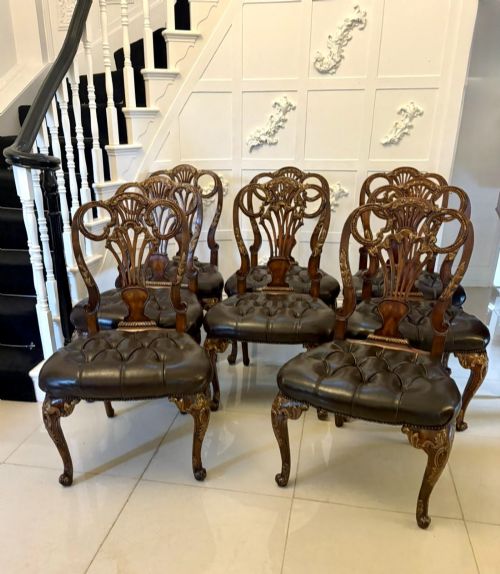
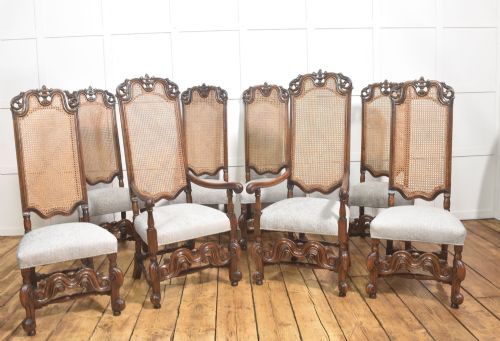
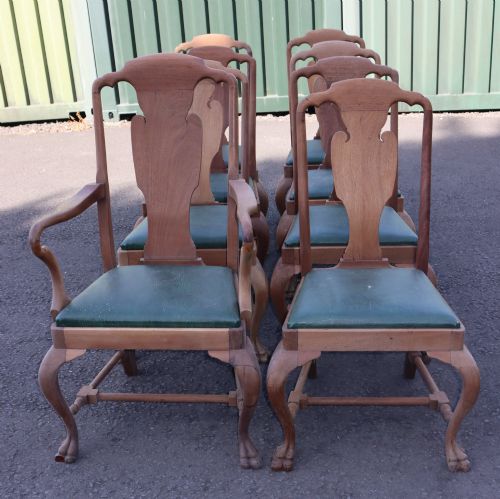


Eight Walnut Dining Chairs
Eight walnut dining chairs offer generous seating for a formal room, uniting rich timber tones with historic revival styles from the eighteenth century to the art deco period.
Eight Walnut Dining Chairs
Eight walnut dining chairs provide a matched seating arrangement for a substantial dining table, commonly appearing in complete sets of eight or as a combination of armchairs and side chairs. These gatherings of seating date across the nineteenth and twentieth centuries, reflecting changing domestic fashions in formal entertaining.
The dominant aesthetic among these pieces follows the Queen Anne style with its characteristic spoon backs and cabriole legs, alongside substantial Victorian, Edwardian and art deco interpretations. Buyers frequently encounter sets shaped by historical revivals, incorporating carved details or high cane panels derived from earlier eras.
Originating primarily from British workshops, these seating suites draw upon sturdy walnut timber, sometimes utilising burr veneers or decorative carving. Their survival in complete octets makes them practical for contemporary dining rooms while retaining the character of their period of origin.
Construction and Materials
Makers shaped these seating sets from solid walnut and figured burr walnut veneers, applying careful joinery to support the stresses of regular dining use. Frames often feature intricate hand-carved ornamentation or applied gilded accents, particularly on pieces from the Victorian and Edwardian periods.
Upholstery forms a vital component of the construction, utilising materials such as leather, embossed hide, velvet, and woven textile. Traditional stuffing and button-back techniques secure the padding to the wooden frames, occasionally complemented by brass detailing or cane work.
The archive records walnut dining sets incorporating antique Queen Anne revival styles and carved decorative woodwork.
Variations in Quality
The standard of carving and the selection of timber dictate the distinction between standard production and exhibition grade furniture. Selected burr walnut veneers and deeply carved cabriole legs demonstrate superior workshop output.
Matching across all eight pieces remains central to overall quality, as assembled sets differ from uniform suites created together by a single maker. The integrity of the original joints and the preservation of surface patination further distinguish finer examples.
Epstein·Spillman and Co·Hille·Maple and Co
The Eight Walnut Dining Chairs Glossary
- Burr walnut
- A figured timber obtained from tree growths, highly prized for its swirling grain patterns on chair backs.
- Cabriole leg
- A curved furniture leg inspired by animal limbs, commonly terminating in pad or claw and ball feet.
- High-back
- A chair design featuring an elevated vertical backrest, frequently associated with early revival and cane panels.
- Bergere
- An enclosed upholstered armchair with cane or woven sides, offering a lighter alternative to solid timber frames.
- Balloon back
- A rounded, curved backrest profile popular during the Victorian period for dining and parlour seating.
Eight Walnut Dining Chairs: Frequently Asked Questions
How do I care for walnut dining chairs?
Maintain the timber by keeping chairs away from direct heat sources and applying appropriate furniture wax periodically. Protect upholstered seats from moisture and direct sunlight to preserve leather and fabric integrity.
Check joinery regularly during routine cleaning to ensure the frames remain stable under daily use. Gentle dusting with a soft cloth prevents accumulation in carved crevices.
Are all eight chairs identical in a set?
Sets frequently comprise six single chairs and two matching armchairs intended for the table ends. This proportion allowed hosts to sit comfortably while guests occupied the standard side chairs.
Makers occasionally produced uniform sets of eight side chairs depending on the specific commission. Examining the frame construction helps confirm whether the entire group originated together.
How can I identify the period of the chairs?
Study the leg profiles, stretcher arrangements, and backrest shapes to determine stylistic influences from the eighteenth through to the twentieth century. Queen Anne revival pieces display characteristic cabriole legs, whereas art deco examples utilise streamlined burr walnut veneers.
Inspect the construction methods beneath the seat frame for tool marks and timber ageing. Secondary woods used internally often indicate whether a piece dates to the Victorian era or a later revival.
Can these chairs be used daily?
Sturdy walnut construction allows these dining chairs to function reliably for everyday meals when joints remain sound. Professional conservation can secure historical frames that have loosened over decades of use.
Consider the seat height and upholstery firmness to ensure comfort during extended dinner parties. Protective pads under the feet prevent friction on hard flooring.