


Edwardian Floor Gong
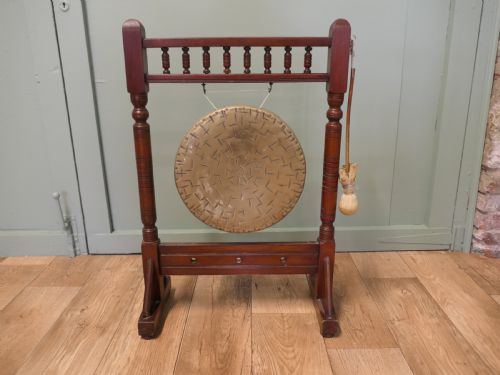
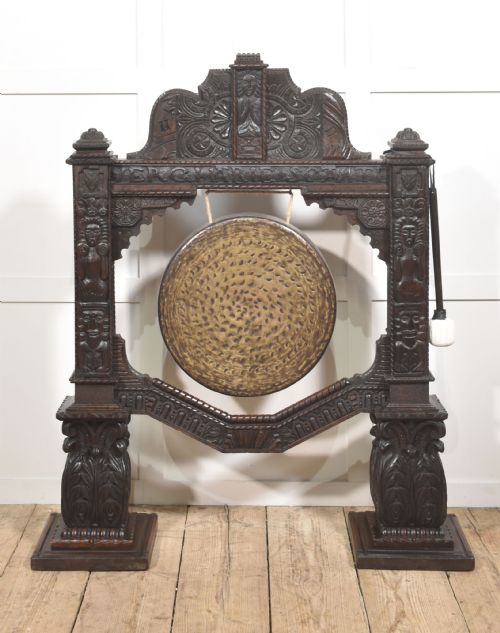
These heavy wooden frames carrying resonant metal discs are an Edwardian floor gong, built to summon households to dinner with a deep and carrying note.
Edwardian Floor Gong
An edwardian floor gong sits upright on the floor as a striking furnishing, combining a substantial wooden support structure with a suspended metal disc. You will frequently meet oak frames holding these large metal circles, designed to stand prominently in hallways or reception rooms.
The form spans several stylistic interpretations, appearing in robust oak or mahogany frames influenced by the Arts and Crafts movement and Victorian Gothic Revival traditions. These pieces reflect the formal dining rituals of large Edwardian households, where a deep resonant tone announced the evening meal.
Beyond the standard dining gongs, the category encompasses related musical forms like cased glockenspiels housed in timber frames. Each example relies on floor-standing stability to bear the weight of the heavy metal gong and its hanging cord.
How they were made
Makers constructed the supporting structures primarily from solid oak and mahogany, often carving the timber with Gothic Revival motifs or keeping the lines clean to suit Arts and Crafts aesthetics. These frames utilise sturdy joinery to support the swinging weight of the metal striking plate without tipping.
The hanging mechanism depends upon thick cord or rope threaded through the top of the frame to suspend the brass or bronze disc freely. This suspension allows the metal to vibrate fully when struck with a mallet, producing the characteristic resonant tone.
Metal components include wrought iron brackets and fittings alongside the polished brass and bronze gongs themselves. The combination of heavy turned or carved wood and cold-forged iron creates a durable domestic instrument built for daily use.
Some households relied on these deep-toned gongs to settle domestic debates by simply striking a note until everyone stopped talking.
What varies in quality
The distinction between standard utility pieces and superior examples lies in the depth of timber carving and the architectural ambition of the frame. Monumental carved oak structures demonstrate a higher grade of craftsmanship than plain or simply turned uprights.
Material thickness and metal purity dictate the resonance and sustain of the gong itself, with heavier bronze or brass plates yielding a richer acoustic profile. Frames incorporating wrought iron detail or sophisticated joinery represent the upper tier of period production.
The Edwardian Floor Gong Glossary
- Gong
- A large circular metal disc that produces a resonant sound when struck with a mallet. It hangs freely within a wooden frame by a cord or rope.
- Arts and Crafts
- A design movement favouring honest construction, simple forms, and visible hand-craftsmanship in domestic furnishings. It rejected mass-produced ornamentation in favour of natural materials.
- Gothic Revival
- An architectural and decorative style drawing inspiration from medieval forms, featuring pointed arches, tracery, and heavy carved woodwork. This style appears frequently on nineteenth-century frames.
- Glockenspiel
- A percussion instrument consisting of tuned metal bars played with mallets, occasionally found housed in wooden floor-standing cases similar to dinner gongs.
Edwardian Floor Gong: Frequently Asked Questions
What is an edwardian floor gong?
An edwardian floor gong is a large, freestanding musical instrument designed to summon people to meals in large houses. It consists of a heavy metal disc suspended inside a wooden frame.
These pieces combine furniture making with percussion, using a mallet to strike the suspended bronze or brass plate. They served a practical domestic purpose in period homes.
Where were these placed in houses?
These gongs typically stood in large hallways, entrance foyers, or spacious landings where the sound could carry effectively through the building. Their imposing wooden frames made them a prominent piece of hall furniture.
Because they were meant to be heard in every room, central locations near dining areas were chosen for placement. The floor-standing design meant no wall mounting was required.
How do you date an oak gong?
Dating relies on examining the timber framing style, joinery techniques, and decorative motifs used on the wood. Pieces featuring heavy ecclesiastical carving often point to earlier nineteenth-century Gothic Revival influences.
Simpler, cleaner lines tend to align with the later Arts and Crafts movement or Edwardian production dates. The presence of specific hardware like wrought iron brackets also helps narrow down the period.
What woods were used for frames?
Makers predominantly used oak and mahogany to build the sturdy upright structures required to hold the heavy hanging metal. Oak appears in various finishes, from carved nineteenth-century panels to plain Edwardian boards.
Mahogany and walnut also feature in framed examples, offering a smoother grain and darker tone. These durable hardwoods provided the structural strength needed to bear the swinging weight.