

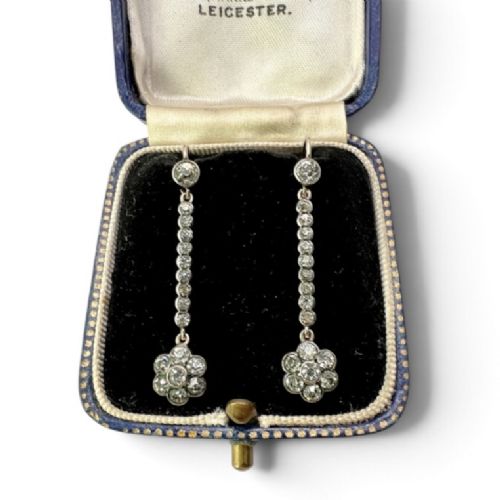
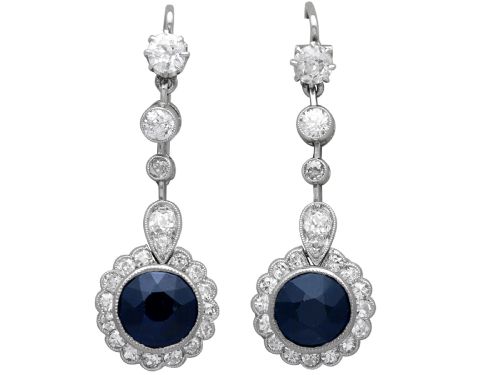
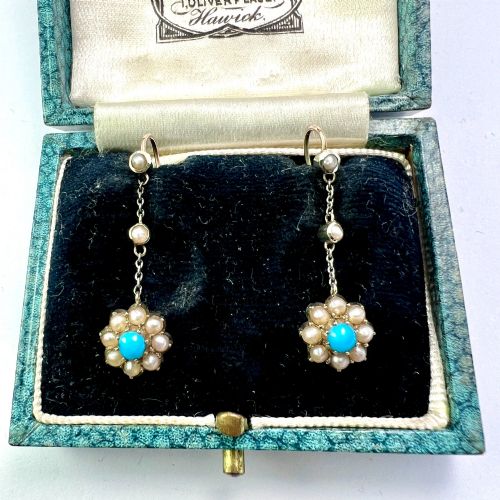
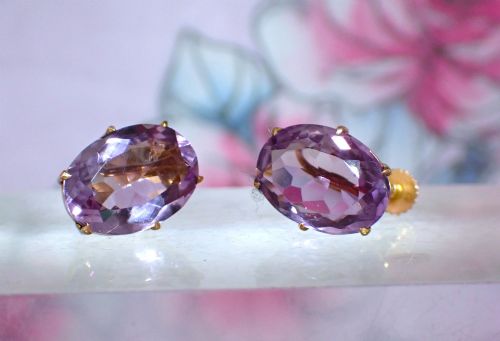
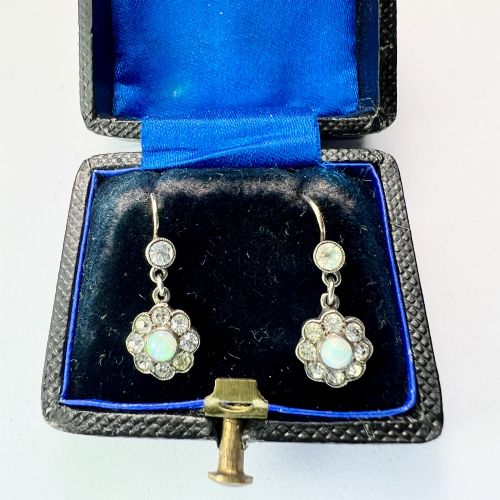


Edwardian Cluster Earrings
Edwardian cluster earrings combine central gemstones with framing stones in formats ranging from tight studs to drops, bringing period elegance to the earlobe.
Edwardian Cluster Earrings
Edwardian cluster earrings present a central gem, such as diamond, sapphire, amethyst, turquoise, garnet, opal, moonstone, or pearl, encircled by smaller accent stones to form a distinct geometric or floral pattern. The pieces meeting this search phrase appear predominantly in Edwardian and Art Deco periods, alongside Victorian and mid-century examples.
The physical forms include stud earrings, screw-on earrings, screwback fittings, clip-on mounts, and delicate drop or dangle earrings designed for pierced or non-pierced ears. Materials span silver, 9ct gold, 15ct gold, 18ct yellow gold, 18ct white gold, and platinum, often paired together in traditional composite mounts.
Makers and origins include French workshops alongside general British and continental production, recording styles from classical floral motifs to geometric daisy and marquise configurations.
Materials and construction methods
Craftsmen utilised precious metals like 18ct gold and platinum, frequently backing gold settings with silver to enhance the brightness of old cut and rose cut diamonds. Stones were hand-set into detailed galleries, securing central gems and surrounding melee stones with meticulous claw or bezel formations.
Fastening mechanisms demonstrate the period transition in ear anatomy accommodation, incorporating traditional pin stems for pierced lobes alongside screw fittings and hinged screwback mechanisms for non-pierced ears.
Edwardian Cluster Earrings Retail Price Guide 2026
Typical asking prices for edwardian cluster earrings among the pieces listed under this phrase on Sellingantiques today, from the lower quarter to the upper quarter. They describe what is for sale here now, not the wider market.
Listings feature periods spanning the Victorian era through the 1960s, with materials incorporating platinum, silver, and multiple gold karatages alongside varied gemstones.
Distinguishing quality variations
Quality separates by the proportion, matching, and cut of the gemstones, where old European cuts, old mine cuts, and rose cuts display hand-polished facets distinct from later machine precision. The integration of dual-metal techniques, such as platinum-topped gold or silver-backed gold, requires advanced bench skill that elevates the construction standard.
The crispness of millegrain borders and the symmetry of the surrounding cluster frame indicate the maker's proficiency, distinguishing standard production work from fine atelier output.
Knoll & Pregizer
The Edwardian Cluster Earrings Glossary
- Cluster earring
- A mounting style featuring a central focal gemstone surrounded by a ring of smaller accent stones. This arrangement maximises visual impact and light return from a compact surface area.
- Old cut diamond
- A hand-faceted diamond cut popular before modern brilliant standards were established. These stones possess smaller tables and open culets that produce a softer, candlelit sparkle.
- Rose cut diamond
- A dome-shaped diamond featuring flat bases and triangular facets arranged in a radiating pattern. They lack a pavilion, giving them a translucent, shimmering quality.
- Millegrain
- A decorative technique comprising a row of tiny, raised metal beads along the edge of a setting. It provides a soft, textural border typical of fine period jewellery.
- Screwback
- A mechanical earring fastening utilising a threaded post and a small screw cap to secure the piece on non-pierced lobes. This design allowed secure wear without requiring pierced ears.
Edwardian Cluster Earrings: Frequently Asked Questions
How do I wear screwback earrings?
Screwback earrings clamp onto the earlobe by turning a threaded nut along a post until it rests comfortably against the back of the skin. They require careful adjustment to hold the weight of a cluster without pinching the lobe.
These findings appear frequently on antique pieces made before pierced ears became universally common again in the mid-twentieth century.
Are these earrings for pierced ears?
The inventory includes both standard post-and-butterfly fittings for pierced ears and non-pierced screw-on or clip-on mechanisms. Listings specify the exact fastening type used on each pair.
Conversion from non-pierced to pierced fittings is possible through a jeweller, though many collectors prefer preserving the original mechanisms.
What defines Edwardian diamond cuts?
Edwardian diamonds are typically old European cuts or rose cuts shaped by hand rather than automated machinery. These cuts feature deep pavilions and distinct culets that catch ambient light in a characteristic way.
The resulting optical effect differs from modern brilliant cuts by offering a broader, more subdued flash under lower light conditions.
How do I clean antique cluster settings?
Cleaning requires warm water, mild soap, and a soft brush to remove accumulated oils from beneath the closed-back or open-back stone settings. Harsh chemical dips risk damaging softer gems like pearls, opals, and turquoise often paired in these clusters.
Professional ultrasonic cleaning is unsuitable for pearls and treated stones, making gentle manual washing the safest maintenance method.