

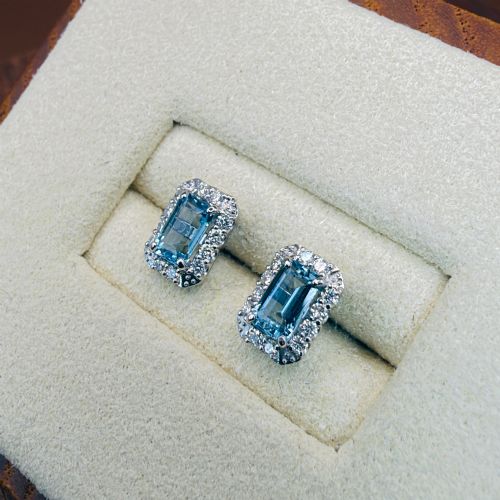
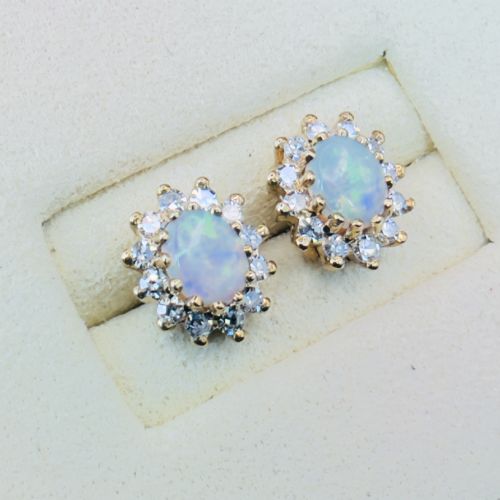


Diamond Halo Studs
Diamond halo studs gather a central gem within a ring of smaller diamonds, offering bright symmetry and secure daily wear.
Diamond Halo Studs
Diamond halo studs group a central gemstone, such as sapphire, emerald, aquamarine, opal, garnet, zircon, amethyst, or pearl, inside a sparkling perimeter of smaller diamonds. These earrings span eras from the Edwardian period and Art Deco style through 1930, 1940, 1950, and Mid-Century designs.
The most common versions on this page are cluster stud earrings set in 18ct white gold, yellow gold, 9ct gold, and platinum. Designs range from classic halo configurations to clover motifs and drop cluster variations, with certain pairs featuring screw backs or certification.
Buyers choose these earrings for their concentrated brilliance and historical variety, moving from early twentieth-century rose-cut diamond clusters to later mid-century gemstone pairings. Each piece frames the central stone to maximise light reflection close to the ear.
Materials and construction
Metals span platinum, 18ct white gold, 18ct yellow gold, 14ct gold, and 9ct yellow gold to support the clustered stones securely. Goldsmiths balance durability with fine metalwork to hold multiple small diamonds around a larger focal gem.
Stones are selected for colour and cut, featuring emerald cuts, oval cabochons, and rose-cut diamonds alongside central sapphires, emeralds, aquamarines, and pearls. Settings rely on precise claw or cluster arrangements that position the surrounding diamonds to encircle the primary gemstone.
Diamond Halo Studs Retail Price Guide 2026
Typical asking prices for diamond halo studs among the pieces listed under this phrase on Sellingantiques today, from the lower quarter to the upper quarter. They describe what is for sale here now, not the wider market.
Listings feature pieces spanning the Edwardian era, Art Deco style, 1930, 1940, 1950, and Mid-Century periods.
Assessing quality in halo clusters
Quality rests on the depth of colour in the central gemstone and the matching clarity of the surrounding diamonds. Superior examples display balanced proportions where the outer diamond ring frames the central stone without overwhelming it.
The precision of the metalwork, whether in platinum or white and yellow gold, dictates the longevity of the cluster setting. Better pieces maintain tight, secure stone settings and clean lines that respect the period style, from Edwardian delicate work to mid-century robust forms.
The Diamond Halo Studs Glossary
- Halo
- A ring of smaller pavé or prong-set diamonds surrounding a larger central gemstone. This arrangement increases the overall visual presence of the piece.
- Cluster
- A style of jewellery where multiple smaller stones are grouped tightly together. In these earrings, a central coloured gem sits amid surrounding diamonds.
- Cabochon
- A gemstone shaped and polished with a smooth, rounded surface rather than faceted. This cut is often utilised for opals and certain sapphires.
- Rose cut
- An antique diamond cut featuring a flat base and a domed crown with triangular facets. It appears frequently in Edwardian and Art Nouveau pieces.
- Pavé
- A setting technique where small gemstones are closely set together with minimal visible metal. This creates the appearance of a continuous surface of sparkle.
Diamond Halo Studs: Frequently Asked Questions
How do I date these earrings?
Dating relies on stylistic clues, metal types, and cut characteristics such as rose-cut diamonds or platinum settings. Edwardian and Art Deco pieces display distinct geometric or delicate floral motifs.
Mid-century and later designs often utilise 9ct white gold or different screw-fitting mechanisms for security.
Are all halo studs made of diamond?
No, while the outer halo usually consists of diamonds, the central stone varies significantly across pieces. Examples incorporate aquamarine, sapphire, emerald, opal, zircon, garnet, amethyst, and pearl.
The metal base also alters, ranging from 9ct yellow gold to 18ct white gold and platinum.
How should I wear cluster earrings?
These stud and cluster earrings sit flat or drop slightly against the ear, making them suitable for daily wear or evening events. Their secure backings keep the cluster centred and stable.
Matching the metal colour to other jewellery helps coordinate the look, though mixed metals appear across different vintage periods.