





Classic Regency Chairs
Classic regency chairs bring the refined geometry and dark woods of the early nineteenth century straight to the dining table or library.
Classic Regency Chairs
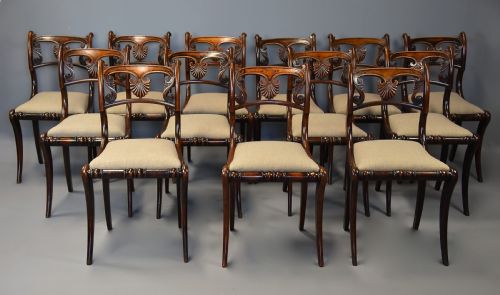
Classic regency chairs encompass dining chairs, carvers, library chairs, and armchairs spanning the Regency, George III, and William IV periods, alongside later revival pieces. Buyers exploring classic regency chairs will encounter forms ranging from single library armchairs to large dining sets numbering up to twelve or thirteen pieces.
The dominant material across these listings is mahogany, often complemented by simulated rosewood finishes and brass details, whilst seating surfaces range from leather and velvet to various upholstery fabrics and hessian.
Most examples originate from the nineteenth century, including pieces dated strictly around eighteen hundred and eighteen thirty, alongside twentieth-century revival interpretations such as nineteen-twenty editions.
Materials and construction
Makers relied heavily on solid mahogany and simulated rosewood to build these frames, applying reeded and stickback designs to shape the wood. Brass mounts and leather pads provide functional and decorative contrast on library chairs and porters armchairs alike.
Upholstered elements utilise traditional fabrics, velvet, and hessian to finish the seats, supporting comfortable daily use in dining rooms and studies.
Classic Regency Chairs Retail Price Guide 2026
Typical asking prices for classic regency chairs among the pieces listed under this phrase on Sellingantiques today, from the lower quarter to the upper quarter. They describe what is for sale here now, not the wider market.
A sturdy porter's armchair keeps the draft off your neck just as well today as it did in a drafty nineteenth-century hallway.
Assessing quality
The distinction between standard dining chairs and exhibition quality sets lies in the crispness of the timber carving and the scale of the matched suite. Larger sets of ten or twelve pieces demand consistent grain and uniform craftsmanship across every single frame.
Finer library and desk chairs display sophisticated reeding and substantial proportions, whereas simpler stickback or ropeback variants focus attention on the purity of the turned wooden members.
The Classic Regency Chairs Glossary
- Carver
- An armchair designed to sit at the head of a dining table, featuring supportive side arms. These match the smaller side chairs in a dining set.
- Reeded
- A decorative moulding formed of parallel convex strips resembling bundled reeds. This surface treatment appears frequently on legs and frames.
- Ropeback
- A chair back carved to resemble a twisted rope, often centred on the top rail. This design flourished during the early nineteenth century.
- Simulated rosewood
- A painted or stained wood finish designed to imitate the rich grain and deep colour of genuine rosewood. It allowed makers to achieve an exotic look using more accessible timber.
Classic Regency Chairs: Frequently Asked Questions
What defines classic regency chairs?
These pieces date primarily from the early nineteenth century and the Regency period, though George III and William IV examples share closely related neoclassical lines. They include both single armchairs and large dining sets.
Maker details occasionally point towards specific workshops, while revival pieces from nineteen hundred and nineteen twenty demonstrate the enduring appeal of these forms.
How do I choose a dining set?
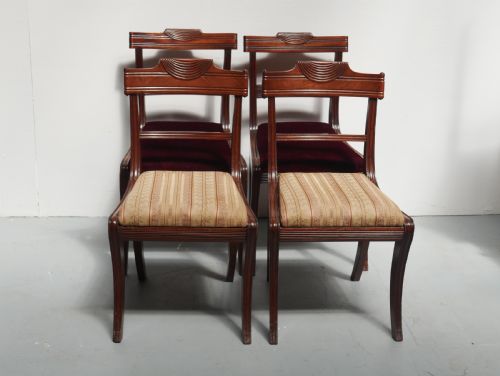
Look closely at the number of matching chairs available, as sets range from four pieces up to large gatherings of ten, twelve, or thirteen. Consistency in timber, such as mahogany or simulated rosewood, ensures a cohesive look around the table.
Consider whether you need armless dining chairs or carvers with side arms for the heads of the table.
Where were armchairs used?
Library chairs, desk chairs, and porters armchairs served specific domestic functions in studies, halls, and reception rooms rather than dining spaces. Deep leather upholstery on porters chairs provided protection from drafts.
Library chairs featured reeded frames and comfortable padding suited for reading and writing.
How do I identify the wood?
Mahogany forms the primary structural timber across most listings, offering a dense and stable base with a dark reddish-brown hue. Simulated rosewood provides an alternative decorative surface finish with distinctive grain patterns.
Brass accents and various fabric coverings complete the material palette of the period.